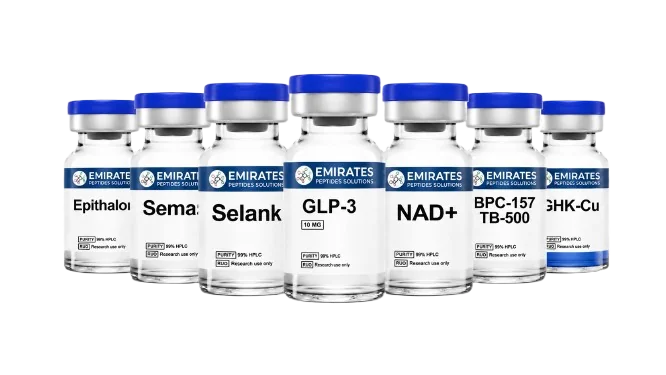

COA Library — HPLC Certificates of Analysis for All Research Peptides
Last updated: 19 April 2026 · Reviewed by the Emirates Peptides Research Team
A Certificate of Analysis (COA) is the document that binds a specific batch of a research peptide to its specific analytical results. It is the difference between a generic “99% purity” marketing claim and a verifiable, batch-traceable proof of identity, purity, and handling. This page explains what a COA contains, how Emirates Peptides tests every batch, and how to request the COA that matches the batch number printed on your vial.
What is a Certificate of Analysis?
A COA is a laboratory report issued for a specific manufacturing batch of a research peptide. It typically contains:
- Batch / lot number — matches the label printed on your vial
- Peptide identity confirmation — typically via mass spectrometry or sequence analysis
- Purity percentage — measured by High-Performance Liquid Chromatography (HPLC)
- HPLC trace / chromatogram — the actual graph of the peptide peak separated from impurity peaks
- Mass-spectrometry spectrum — confirming the molecular weight matches the expected sequence
- Manufacturing date and expiry / retest date
- Storage recommendations
- Physical description (appearance, solubility)
- Test laboratory and authorized signatory
A credible COA ties every one of these data points to a single manufacturing batch. Generic “99% HPLC tested” claims without a batch-linked certificate are marketing, not evidence.
Why the COA matters for research outcomes
Research peptide potency is sensitive to manufacturing variation. A peptide advertised as ≥99% pure might actually contain:
- Truncated fragments (short versions missing one or more amino acids)
- Deamidation products (chemically modified residues)
- Oxidized variants (when peptides contain methionine or tryptophan)
- Excess trifluoroacetic acid (TFA) from synthesis purification
- Endotoxin contamination from manufacturing
Each of these impurities can distort research outcomes in ways that look like experimental variability. A proper COA tells you the exact impurity profile of your specific vial — so you can either use the material with confidence or reject the batch against your protocol’s acceptance criteria.
How Emirates Peptides tests every batch
Every lot of research peptide supplied by Emirates Peptides passes through a defined quality-control workflow before it is released for sale:
Step 1: Incoming inspection
Each shipment is visually inspected for vial integrity, lyophilization quality (appearance of the freeze-dried cake), and labeling accuracy. Vials that fail visual inspection are rejected before any analytical testing.
Step 2: HPLC purity analysis
High-Performance Liquid Chromatography separates the target peptide from truncations, deamidation products, oxidized species, and other related impurities. The area under the peak at the retention time of the target peptide, divided by the total area under all peaks, produces the purity percentage. Emirates Peptides accepts only batches with ≥99% purity for release.

Step 3: Mass-spectrometry identity confirmation
Mass spectrometry measures the molecular weight of the purified peptide and compares it to the expected value based on the published sequence. This step prevents substitution with a similar but functionally different compound — a failure mode that purity testing alone cannot catch.
Step 4: Lyophilization under inert atmosphere
Batches are freeze-dried under controlled conditions and sealed with nitrogen headspace to protect against oxidation during storage. Every vial is labeled with the lot number that ties it back to its analytical record.
Step 5: Cold-chain dispatch
In the UAE summer, ambient temperatures routinely exceed 40°C. Peptide shipments from Emirates Peptides travel in insulated packaging with cold packs, with same-day delivery across Dubai and next-day delivery across all seven emirates.
How to request the COA for your batch
Every vial shipped by Emirates Peptides carries a batch number printed on its label. To request the matching COA:
- Locate the batch number on your vial label.
- Email the batch number to our research team from the contact form on our website, or reply to your order confirmation email.
- You will receive the matching COA as a PDF within one business day.
COAs are provided on request rather than auto-attached to every order — this keeps control of the document and prevents cross-matching of COAs to the wrong batch. Researchers designing protocols that require COA review before use are welcome to request the COA in advance of placing their order.
Products with batch-specific COAs available
Every product listed below is supplied with a batch-specific HPLC Certificate of Analysis on request:
| Product | Purity standard | Sequence |
|---|---|---|
| GLP-3 | ≥99% | 39 aa, GIP/GLP-1/glucagon triple agonist |
| MOTS-c | ≥99% | MRWQEMGYIFYPRKLR |
| BPC-157 | ≥99% | 15 aa gastric peptide |
| TB-500 | ≥99% | Thymosin-β4 fragment |
| GHK-Cu | ≥99% | Glycyl-L-histidyl-L-lysine + Cu²⁺ |
| CJC-1295 | ≥99% | 30 aa GHRH analogue |
| Tesamorelin | ≥99% | 44 aa GHRH analogue |
| Kisspeptin | ≥99% | Kp-10 or Kp-54 (specify) |
| Cagrilintide | ≥99% | Amylin analogue |
| Epithalon | ≥99% | AEDG tetrapeptide |
| Selank | ≥99% | TKPRPGP heptapeptide |
| Semax | ≥99% | MEHFPGP heptapeptide |
| KPV | ≥99% | Lys-Pro-Val tripeptide |
| SS-31 | ≥99% | D-Arg-Dmt-Lys-Phe-NH₂ |
| 5-Amino-1MQ | ≥99% | Small-molecule NNMT inhibitor |
| Melanotan 2 | ≥99% | α-MSH analogue |
| NAD⁺ 500mg | ≥99% | Nicotinamide adenine dinucleotide |
| BPC-157 + TB-500 Blend | ≥99% each | Dual-peptide blend |
| Glow Blend (BPC-157 / TB-500 / GHK-Cu) | ≥99% each | Triple-peptide blend |
What our COA does not cover (and what you should test yourself)
A pre-shipment COA establishes purity, identity, and manufacturing conditions at the time of release. It does not — and cannot — prove potency after shipping, reconstitution, or extended storage in your laboratory. For critical protocols, researchers should consider:
- In-house re-assay on receipt for high-stakes studies
- Stability monitoring of reconstituted solutions beyond the 28-day in-use window
- Functional validation in your chosen assay system (receptor binding, cell-based response)
These are good-practice recommendations for any research peptide supplier, not a gap specific to Emirates Peptides. Pre-shipment COAs verify the starting material; in-laboratory controls verify the material as it is actually used.
Frequently asked questions
Are COAs available before I place an order?
Yes. Email our research team with the product name and we will supply a representative recent COA for review. This is common practice for research purchasers conducting due diligence before committing to a supplier.
Is every batch tested, or just sample batches?
Every batch released to Emirates Peptides customers has passed HPLC purity testing and mass-spectrometry identity confirmation. There is no sampling shortcut — each manufacturing batch generates its own COA.
Can I get the raw HPLC chromatogram?
Yes. The standard COA includes the HPLC trace showing the main peptide peak separated from any related impurities. Researchers who need higher-resolution data files can request them from our team.
What about endotoxin testing?
Endotoxin testing is not part of the standard research-peptide COA but is available on request for batches intended for cell-culture or in-vitro assays sensitive to endotoxin contamination.
Do you use a third-party lab like Janoshik Analytical?
HPLC and mass-spectrometry testing are performed in our contracted analytical facility. For studies that require an independent third-party lab such as Janoshik, Emirates Peptides can route specific batches for additional external verification on request, typically at an additional cost.
Is an HPLC purity percentage enough proof of quality?
Purity alone is necessary but not sufficient. A ≥99% purity certificate without mass-spectrometry identity confirmation is incomplete — you can have a very pure peptide that is the wrong peptide. Emirates Peptides pairs HPLC purity data with mass-spectrometry identity confirmation on every COA.
How long is a COA valid?
A COA is valid as long as the stored conditions specified on it are maintained. For lyophilized peptides stored at 2–8°C, the retest date is typically 24 months from manufacturing. Beyond the retest date, researchers should either discard remaining material or request reassay.
What happens if a batch fails QC?
Batches that fail HPLC purity (<99%) or mass-spectrometry identity confirmation are not released to customers. They are held, investigated, and either reprocessed or destroyed depending on the failure mode. Customers never receive sub-specification material.
Related reading
- GLP-3 UAE: Complete Research Peptide Guide
- MOTS-c UAE: Mitochondrial Peptide Research Guide
- Shop all research peptides
Research-use-only disclaimer: All products supplied by Emirates Peptides are for laboratory and in-vitro research use. Not for human administration. Content on this page is educational and does not constitute medical advice.