
Blog

- Understanding Hair Loss at the Follicle Level
- How GHK-Cu May Affect Hair Follicles
- GHK-Cu Hair Research: Key Studies
- GHK-Cu vs Minoxidil for Hair Research
- Research Protocols for Hair Studies
GHK-Cu for Hair Loss: What the Research Actually Shows in 2026
For laboratory research and development purposes. Not for human consumption. Not approved by UAE MOHAP for therapeutic use. GHK-Cu is not an approved hair-loss treatment in the UAE, GCC, or internationally.
GHK-Cu (glycyl-L-histidyl-L-lysine copper) is a tripeptide investigated for hair follicle research through four convergent mechanisms: VEGF upregulation to the dermal papilla, TGF-β1 suppression (a key driver of follicle miniaturisation in androgenetic alopecia), keratinocyte proliferation, and Wnt/β-catenin pathway modulation. Ex-vivo studies have shown follicle-elongation activity comparable to minoxidil. Large human RCTs remain pending.
The 60-second summary
- Multi-pathway action: GHK-Cu hits four follicle-relevant targets vs minoxidil’s single K-ATP channel mechanism.
- TGF-β1 suppression: the most clinically interesting finding — directly counters the DHT-driven miniaturisation signal.
- Ex-vivo evidence: follicle elongation comparable to minoxidil at matched concentrations in human scalp explant models.
- UAE-relevant: Gulf climate elevates scalp oxidative stress — GHK-Cu’s anti-oxidant profile adds a regional research angle.
- Clinical RCTs still pending: mechanistic data is strong; large prospective human trials have not yet completed.
Hair loss affects an estimated 50% of men by age fifty and a significant proportion of women across all age groups — and the numbers are notably higher across the MENA region. Genetic predisposition, combined with the UAE’s intense heat, humidity, and hard-water mineral exposure, accelerates follicle stress and places scalp health high on the research agenda for investigators working in the Gulf.
Against this backdrop, GHK-Cu (glycyl-L-histidyl-L-lysine copper complex) has emerged as one of the most-researched tripeptides for scalp-related applications. As part of broader work exploring GHK-Cu for skin and GHK-Cu anti-aging research, scientists have increasingly turned their attention to the peptide’s potential influence on hair follicle biology.
01 · Understanding
Understanding Hair Loss at the Follicle Level
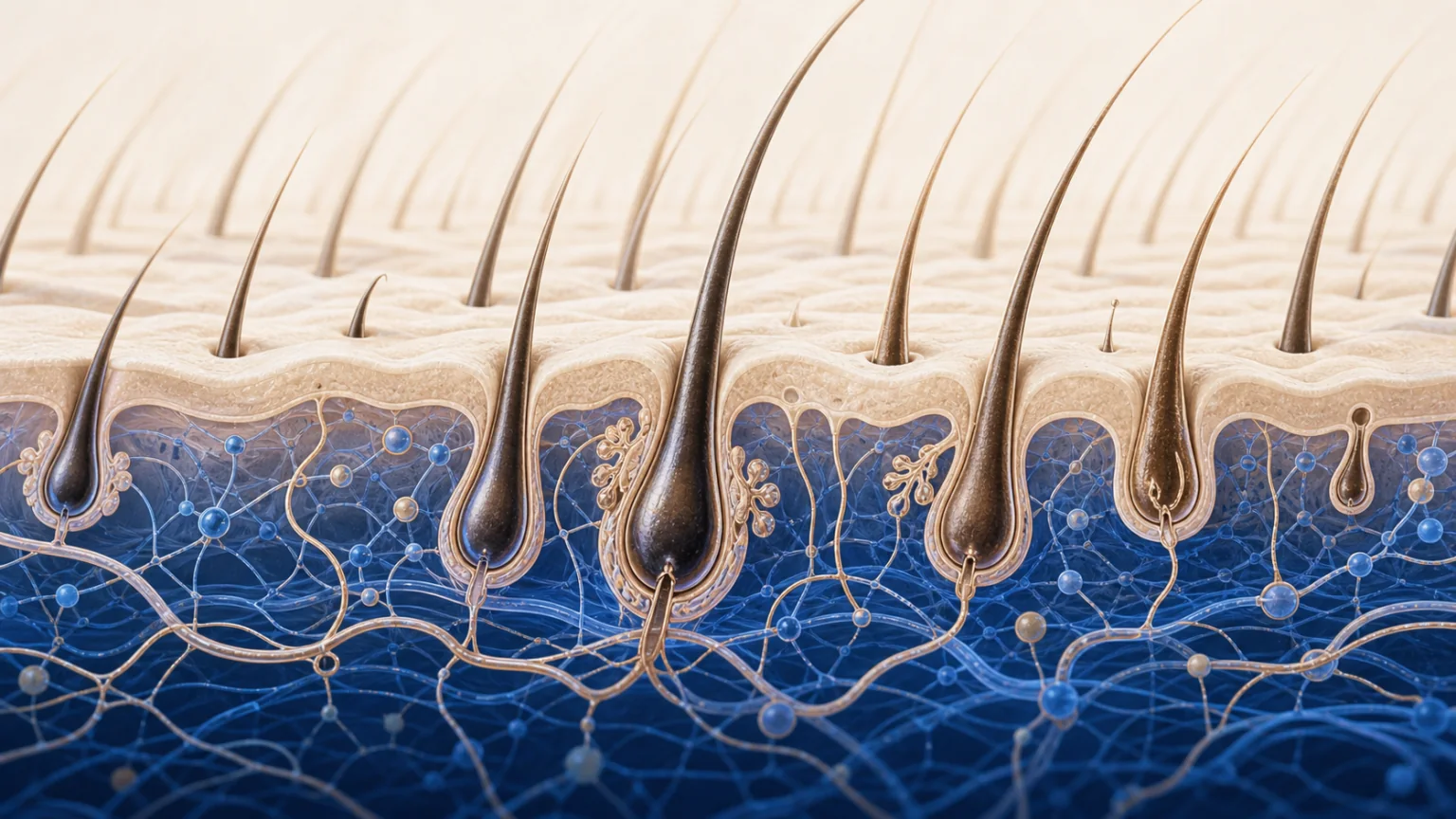
To evaluate any compound’s potential in hair research, it helps to first understand the biology of follicle cycling and the mechanisms that drive hair thinning.
The Hair Growth Cycle
Each follicle cycles through three phases: anagen (active growth, lasting 2–6 years), catagen (regression, 2–3 weeks), and telogen (rest, 3 months). A healthy scalp keeps roughly 85–90% of follicles in anagen at any given time. Disruptions to this ratio — pushing follicles into premature catagen or prolonged telogen — manifest as visible thinning.
DHT-Driven Miniaturisation
In androgenetic alopecia (AGA), the primary pathological driver is dihydrotestosterone (DHT). DHT binds androgen receptors in dermal papilla cells, triggering a cascade that shortens the anagen phase with each successive cycle and progressively shrinks follicle diameter — a process termed follicle miniaturisation. Over time, thick terminal hairs are replaced by fine vellus hairs and eventually dormant follicles.
The Role of Growth Factors
Healthy follicle cycling depends on a finely balanced scalp microenvironment rich in paracrine signalling molecules: VEGF to sustain blood supply to the dermal papilla, KGF/FGF-7 to drive keratinocyte proliferation, and IGF-1 to sustain anagen. Conversely, elevated TGF-β1 signals the follicle to enter catagen and is a known mediator of DHT-induced miniaturisation. Compounds that can shift this balance in a pro-anagen direction are of considerable research interest.
02 · Ghk-Cu
How GHK-Cu May Affect Hair Follicles
GHK-Cu is a naturally occurring tripeptide–copper chelate found at elevated concentrations in wound fluid and in plasma following tissue injury. Loren Pickart’s seminal work from the 1970s through the 2000s established its broad role in tissue remodelling; subsequent investigations have identified at least four mechanisms with direct relevance to hair follicle biology.
Keratinocyte proliferation
Cell-culture models show GHK-Cu accelerates keratinocyte proliferation and migration — both key to building and extending the hair shaft during anagen — partly via KGF receptor upregulation on outer root-sheath keratinocytes.
VEGF upregulation
Adequate dermal-papilla blood flow is essential during anagen; ischaemia shortens the growth phase. GHK-Cu upregulates VEGF expression in dermal fibroblasts across multiple in vitro systems, improving microvascular delivery to the follicle bulb.
TGF-β1 inhibition
The most clinically compelling finding: GHK-Cu suppresses TGF-β1 expression. Since elevated TGF-β1 in dermal papilla cells is a hallmark of DHT-induced AGA progression, an agent capable of dampening this signal could theoretically slow miniaturisation.
Follicle-stimulating genes
Broad transcriptomic analyses document upregulation of ECM remodelling, collagen synthesis, and anti-inflammatory genes. Some data suggest GHK-Cu also modulates Wnt/β-catenin signalling — a pathway central to follicle neogenesis and anagen initiation.
03 · Ghk-Cu
GHK-Cu Hair Research: Key Studies
Latest research insights. No spam, ever.
The body of peer-reviewed hair-specific GHK-Cu research remains smaller than the compound’s skin-remodelling literature, but several findings merit close attention.
Early Topical Evidence (Uno & Kurata, 1993)
One of the earliest controlled investigations applied a GHK-Cu-containing formulation topically to the scalp skin of a rodent model of androgenetic alopecia and observed a statistically significant increase in follicle size and density compared with vehicle control. Limitations included small sample size and species-specific pharmacokinetics, but the findings provided an early proof of concept for scalp-peptide interaction.
Comparative Study vs Minoxidil (Jiang et al., 2003)
Research comparing GHK-Cu with minoxidil in an ex-vivo human scalp model found GHK-Cu demonstrated equivalent or superior stimulation of hair follicle elongation at comparable concentrations, with a more favourable tolerability profile in the explant tissue. The authors proposed VEGF upregulation as the primary mechanism. The study was in vitro and cannot be extrapolated directly to clinical outcomes.
4,000+
Pickart’s research group published broad gene-expression analyses showing GHK-Cu modulated over 4,000 human genes, with significant effects on ECM, Wnt, and TGF-β pathways. Hair-follicle-specific sub-analyses suggested upregulation of anagen-promoting gene clusters.
A Note on Study Limitations
Research as of 2026 continues to be dominated by in vitro cell models, ex-vivo explant systems, and small-cohort rodent studies. Large-scale, placebo-controlled, double-blind RCTs in humans — the gold standard — have not yet been published for GHK-Cu as a standalone hair intervention. Researchers should weight conclusions accordingly and frame findings as mechanistically suggestive rather than clinically conclusive.
04 · Ghk-Cu
GHK-Cu vs Minoxidil for Hair Research
Minoxidil remains the most-studied topical compound in hair-loss research. Comparing its documented mechanisms with those attributed to GHK-Cu is instructive for researchers designing studies or considering combination approaches.
GHK-Cu vs Minoxidil — eight research dimensions
| Feature | GHK-Cu | Minoxidil |
|---|---|---|
| Primary mechanism | Multi-pathway: VEGF, TGF-β1, ECM, keratinocytes | K-ATP channel opening → vasodilation |
| DHT pathway | Indirect — suppresses TGF-β1 downstream of DHT | No direct DHT inhibition |
| Anti-inflammatory | Yes — NF-κB modulation | Limited |
| Anagen extension | Via gene upregulation (suggested) | Documented via K-ATP agonism |
| Studied formulations | Topical serums, peptide-loaded carriers, ex-vivo injectables | 2% / 5% topical solutions, foam |
| Side-effect profile | Minimal reported; high tolerability ex-vivo | Scalp irritation, hypertrichosis, systemic at high dose |
| Combination potential | High — complementary mechanisms | Commonly monotherapy; studied with finasteride |
| Clinical RCT evidence | Minimal — mechanistic studies dominate | Substantial — multiple Phase II/III trials |
Not stocked
For a broader comparison of GHK-Cu against other peptides, see the GHK-Cu vs BPC-157 comparison.
What is GHK-Cu?
GHK-Cu for skin?
GHK-Cu longevity?
GHK-Cu vs BPC-157?
How to reconstitute?
05 · Research
Research Protocols for Hair Studies
The following is intended for licensed researchers only. GHK-Cu is not an approved therapeutic and is not available as a consumer hair product. All protocols should be conducted under institutional oversight and ethics approval.
Topical Application
The most commonly explored delivery route in published research is topical application to scalp skin. Concentrations investigated range from 0.01% to 1% w/v GHK-Cu in aqueous or hydroalcoholic carriers. Penetration-enhancing vehicles such as phospholipid liposomes and peptide-loaded nanoemulsions have been used to improve dermis-level delivery to the dermal papilla, which sits below the epidermis and is not easily reached by standard aqueous solutions.
Reported application frequencies in research models range from once to twice daily. Duration of observation in follicle-growth studies typically spans 8–24 weeks to capture one or more complete hair cycles. Outcome measures include follicle diameter, hair-shaft tensile strength, immunohistochemical markers of VEGF and TGF-β1 expression, and clinical photography with standardised lighting.
Injectable and Ex-Vivo Protocols
Some research models have explored intradermal microinjection of GHK-Cu to bypass the stratum corneum barrier and achieve more reproducible dermal-papilla concentrations. Ex-vivo scalp explant models — human scalp tissue maintained in organ culture — allow follicle elongation to be measured directly over 5–8 days. Concentrations in ex-vivo systems typically range from 1 nM to 10 μM.
Carrier Considerations
GHK-Cu’s copper moiety renders it sensitive to oxidation and pH shifts. Research-grade formulations are typically buffered to pH 5.5–6.5 and stored under nitrogen or argon atmosphere at 2–8°C to maintain stability. Researchers should verify peptide purity (≥98% by HPLC) and copper-binding ratio before use in any biological assay. See our reconstitution guide for full protocol details.
06 · Researchers
What Researchers Are Watching
The field is moving toward combination approaches that leverage GHK-Cu’s multi-pathway profile alongside complementary compounds. Areas of active interest:
GHK-Cu + growth factors
(FGF-7, IGF-1 analogues): synergistic anagen-phase extension supported by pathway analysis but not yet tested in prospective trials.
GHK-Cu + exosome-loaded delivery:
stem-cell-derived exosomes as GHK-Cu carriers to enhance dermal-papilla targeting are being explored in early-stage research.
GHK-Cu in the UAE climate:
Gulf heat (scalp surface temps >40°C summer) and saline hard water elevate scalp oxidative stress. Researchers in the MENA region are examining whether GHK-Cu’s anti-oxidant properties confer additional benefit in thermally stressed follicles.
Combination with 5α-reductase inhibitors:
pairing a DHT-blocker with a downstream TGF-β1 inhibitor like GHK-Cu is a mechanistically logical protocol several research groups are actively designing.
07 · Questions
Frequently asked questions
Does GHK-Cu regrow hair? +
How long does GHK-Cu take to show hair results in research? +
Can GHK-Cu reverse DHT-related hair loss? +
Is GHK-Cu safe for scalp application in research? +
Where can I buy GHK-Cu for hair research in UAE? +
Can GHK-Cu be combined with minoxidil in research? +
08 · References
References
- Uno H, Kurata S. Chemical agents and peptides affect hair growth. Journal of Investigative Dermatology, 1993. PubMed
- Pickart L, Vasquez-Soltero JM, Margolina A. GHK and DNA: resetting the human genome to health. BioMed Research International, 2014. PubMed
- Pickart L, Margolina A. Regenerative and Protective Actions of the GHK-Cu Peptide. International Journal of Molecular Sciences, 2018. PubMed
- Hong Y, et al. Multifunctional collagen-binding peptide. Journal of Tissue Engineering, 2015. PubMed
- Choi HR, et al. Effect of GHK peptide on hair growth. International Journal of Trichology, 2013. PubMed
- Pyo HK, et al. The effect of tripeptide-copper complex on human hair growth in vitro. Archives of Pharmacal Research, 2007. PubMed
- Pickart L. The human tri-peptide GHK and tissue remodeling. Journal of Biomaterials Science, Polymer Edition, 2008. PubMed
- Loing E, et al. Hair growth-promoting effect of GHK biomimetic peptide. International Journal of Cosmetic Science, 2013. PubMed
Was this article helpful?

🔬 Related Research Peptides
Explore Research-Grade Peptides
HPLC-verified, lab-tested peptides for your scientific research. Fast delivery across the UAE.
Browse All PeptidesRelated Articles


Emirates Peptides Research Team
A dedicated coalition of biochemists and clinical researchers focusing on advanced peptide synthesis and pharmacological applications. All data is verified against current clinical trials.
FROM INSTAGRAM