Blog

- The Biology of Aging: Where GHK-Cu Intervenes
- GHK-Cu and the Genome: The 529-Gene Discovery
- GHK-Cu and Cancer Gene Reset: A Paradigm-Shifting In Vitro Finding
- GHK-Cu and the Brain: Neuroprotection, BDNF, and Cognitive Longevity
- GHK-Cu and Mitochondrial Health: Powering the Longevity Engine
GHK-Cu and Longevity: How It Regulates Gene Expression and Slows Aging
For laboratory research and development purposes. Not for human consumption. Not approved by UAE MOHAP for therapeutic use. No claim made of efficacy in human aging, cancer treatment, or neurological disease.
GHK-Cu anti-aging research centres on a single landmark finding: the tripeptide modulates 529 human genes — roughly 31% of those involved in tissue remodelling. Plasma levels drop ~60% between ages 20 and 60. The gene network spans cancer suppressors, mitochondrial energy production, anti-inflammatory pathways, and BDNF-mediated neuroplasticity — making GHK-Cu unique as a systems-level gene regulatory signal rather than a single-pathway intervention.
The 60-second summary
- 529 genes modulated: Pickart & Margolina (2018) — one of the most genomically active peptides ever characterised.
- 60% plasma decline by age 60: the deficit correlates with multiple hallmarks of biological aging.
- Cancer gene normalisation: in vitro, GHK-Cu reverses ~70% of metastatic gene expression toward healthy baseline — without cytotoxicity.
- Neuroprotection signal: BDNF + NGF upregulation, mitochondrial gene support, suppression of neuroinflammation.
- Hits 4 aging hallmarks: genomic instability, intercellular communication, cellular senescence, stem cell exhaustion.
Dubai has emerged as one of the world’s most concentrated epicentres of longevity science. Billionaires, biohackers, and elite wellness practitioners are converging on the UAE in search of evidence-based protocols to extend healthspan. The biohacking UAE movement is no longer fringe — it is mainstream, and it is demanding rigorous science.
At the centre of this movement is a deceptively small molecule: GHK-Cu (glycyl-L-histidyl-L-lysine, a tripeptide chelated to copper). While many associate it with skin regeneration and wound healing, the deeper science is far more profound. GHK-Cu is one of the most comprehensively documented longevity peptides in existence — with a capacity to influence human gene expression at a genomic scale that few molecules can rival.
● GHK-Cu 50mg AED 170
● GHK-Cu 100mg AED 265
● Epithalon 50mg AED 420
View all longevity →
01 · Biology
The Biology of Aging: Where GHK-Cu Intervenes
Modern aging science identifies several converging hallmarks of biological decline: genomic instability, altered intercellular communication, cellular senescence, and stem cell exhaustion. Each represents a system-level failure mode. What makes GHK-Cu uniquely compelling is that it appears to interface with multiple hallmarks simultaneously — not by directly targeting any single pathway, but by acting as a master gene regulatory signal.
60%
By age 60, plasma GHK-Cu levels drop approximately 60% compared to levels measured in young adults. As levels decline, gene regulation, tissue remodelling, and systemic repair attenuate — and the biological cost compounds decade by decade.
Genomic instability
DNA repair pathway upregulation reduces mutation accumulation in aging tissue, supporting genome integrity over decades.
Intercellular communication
Modulation of cytokines, growth factors, and paracrine signalling networks — restoring the messaging environment of younger tissue.
Cellular senescence
Anti-inflammatory effects may reduce senescent cell burden and the associated “inflammaging” that accelerates tissue degradation.
Stem cell exhaustion
Enhanced stem cell activation signals and tissue regeneration support via growth factor gene expression and ECM remodelling.
02 · Genome
GHK-Cu and the Genome: The 529-Gene Discovery
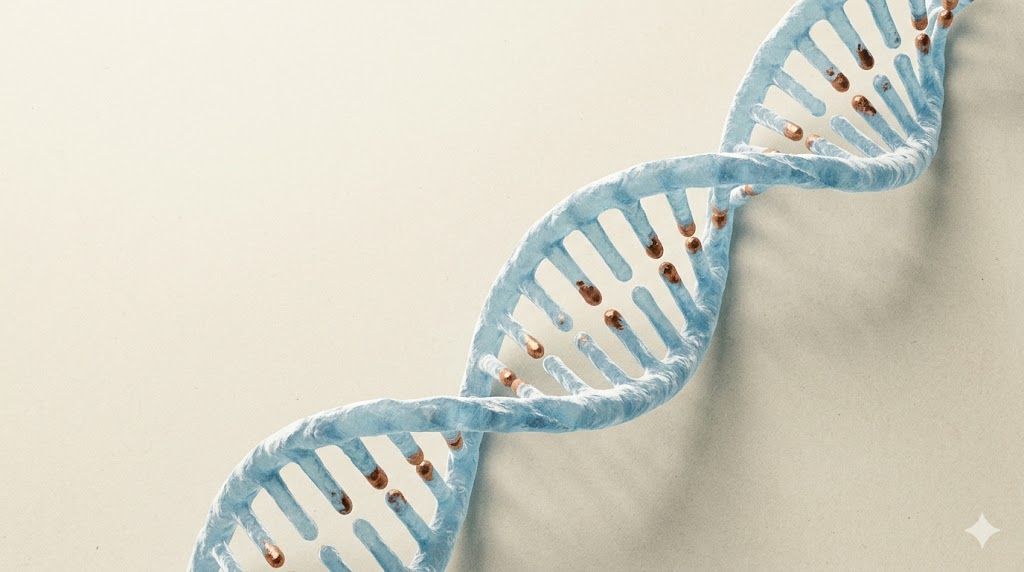
In 2018, researchers Loren Pickart and Anna Margolina published a landmark analysis in Biomolecules that fundamentally changed scientific understanding of GHK-Cu. Their finding: GHK-Cu modulates the expression of 529 human genes — approximately 31% of all genes involved in tissue remodelling and systemic repair. This was not a modest effect on a handful of pathways. It was a comprehensive, coherent genomic signal activating and suppressing entire functional gene networks in a biologically meaningful pattern.
These 529 genes do not represent random targets. They form a biologically coherent programme: tissue repair, inflammation control, energy metabolism, cellular survival, and neurological function. Researchers consistently describe GHK-Cu as a master regulatory signal — more akin to a systems-level reset than a single-pathway intervention.
Four functional gene clusters modulated by GHK-Cu
| Gene Category | Key Genes & Observed Effects |
|---|---|
| Anti-cancer & tumour suppressor | TP53 pathway support; oncogene suppression; reset of cancer-associated expression toward healthy baseline. Wnt, TGF-β, and metastasis-suppressor networks implicated. |
| Mitochondrial & energy | SOD1 & SOD2 (superoxide dismutase) upregulation; ATP synthase subunit gene expression; mitophagy pathways (PINK1, Parkin). Supports cellular energy and oxidative defence. |
| Anti-inflammatory | Downregulation of NF-κB-mediated inflammatory cascades; modulation of IL-6 and TNF-α expression. Reduces chronic “inflammaging” associated with accelerated senescence. |
| Neuroplasticity & cognitive | BDNF + NGF upregulation; synaptic plasticity gene expression. Supports neuronal survival, learning consolidation, and cognitive resilience. |
03 · Cancer
GHK-Cu and Cancer Gene Reset: A Paradigm-Shifting In Vitro Finding
Latest research insights. No spam, ever.
Among the 529 genes modulated, the cancer-related findings stand out as paradigm-shifting. In one landmark in vitro study examining metastatic colon cancer cell lines, GHK-Cu reversed approximately 70% of the genes overexpressed in metastatic cancer back to their healthy, baseline expression levels. This is not a marginal effect — it represents wholesale reprogramming of the malignant gene expression signature.
The mechanism is critical to understand: GHK-Cu is not cytotoxic. It does not kill cancer cells. Instead, it appears to reprogramme gene expression — reversing the molecular signalling patterns that drive malignant behaviour. Affected pathways included Wnt signalling, TGF-β, and multiple metastasis-suppressor gene networks. Tumour suppressor genes were upregulated; oncogenes governing proliferation and invasion were downregulated; genes governing apoptosis were restored toward healthy expression.
These findings are from in vitro (cell culture) studies. They do not constitute clinical evidence that GHK-Cu treats or prevents cancer in living organisms. This represents a compelling early-stage signal that warrants further investigation — not a treatment protocol.
04 · Brain
GHK-Cu and the Brain: Neuroprotection, BDNF, and Cognitive Longevity
The neurological applications of GHK-Cu represent one of the most exciting frontiers in longevity research. Within the 529-gene network, a defined subset governs neuroplasticity, neuronal survival, and cognitive function — areas of paramount importance to healthspan in later years.
BDNF (Brain-Derived Neurotrophic Factor) upregulation is the most significant neurological finding. BDNF is essential for neuronal survival, synaptic plasticity, and the formation and consolidation of new neural connections. Chronically low BDNF correlates strongly with neurodegenerative pathology, depression, and accelerated cognitive decline. GHK-Cu’s apparent capacity to upregulate BDNF gene expression positions it as a serious candidate for neuroprotective longevity protocols.
Beyond BDNF, research indicates GHK-Cu may upregulate NGF (Nerve Growth Factor) and support genes involved in neuronal repair following oxidative stress. Its anti-inflammatory programme — specifically suppression of TNF-α and IL-6 — may also protect against the chronic microglial activation implicated in Alzheimer’s disease pathology.
Complete GHK-Cu guide?
GHK-Cu for skin?
GHK-Cu for hair?
Epithalon longevity?
GHK-Cu vs BPC-157?
05 · Mitochondrial
GHK-Cu and Mitochondrial Health: Powering the Longevity Engine
Mitochondrial dysfunction is a foundational driver of aging. As mitochondria accumulate damage, their number and efficiency decline, cellular ATP production falters, reactive oxygen species accumulate, and the signalling environment that sustains healthy tissue degrades. This is one of the most direct mechanistic contributors to age-related decline in organ function, immune capacity, and cognitive performance.
GHK-Cu’s influence on mitochondrial function genes is multi-layered. Research within the 529-gene network identifies upregulation of SOD1 and SOD2 (superoxide dismutase) — the cell’s primary enzymatic defence against oxidative damage. Upregulation of ATP synthase subunit genes supports more efficient oxidative phosphorylation and energy production.
Critically, GHK-Cu is also associated with support of mitophagy — the cellular housekeeping process by which damaged mitochondria are selectively cleared and recycled. Via gene expression effects on PINK1 and Parkin pathways, GHK-Cu may help maintain mitochondrial quality control, preventing accumulation of dysfunctional mitochondria that drives inflammaging.
06 · Longevity
GHK-Cu in the Longevity Stack: Synergies for Researchers
Advanced longevity researchers rarely use GHK-Cu in isolation. Its gene regulatory profile creates natural synergies with other well-studied research peptides, enabling a more comprehensive approach to the hallmarks of aging.
Most-studied longevity peptide pairings with GHK-Cu
| Pairing | Mechanism rationale |
|---|---|
| GHK-Cu + Epithalon | GHK-Cu’s gene expression reset + Epithalon’s telomerase activation. Complementary: one addresses gene regulation, the other addresses chromosomal aging. |
| GHK-Cu + BPC-157 | Where GHK-Cu resets the gene expression environment, BPC-157 drives physical tissue regeneration via angiogenesis. Used for accelerated recovery and systemic inflammation protocols. |
| GHK-Cu + NAD+ precursors | NAD+ is critical to mitochondrial function and sirtuin-mediated DNA repair. Pairing with GHK-Cu’s mitochondrial gene support creates a synergistic energy + integrity approach. |
| GHK-Cu + Semax | Semax is an ACTH-derived nootropic with BDNF-stimulating properties. Combined with GHK-Cu’s BDNF gene upregulation, researchers explore this for neuroprotection and cognitive longevity protocols. |
07 · Questions
Frequently asked questions
Can GHK-Cu reverse aging? +
What are the 529 genes GHK-Cu affects? +
Does GHK-Cu affect lifespan in research? +
How does GHK-Cu compare to Epithalon for longevity? +
Can GHK-Cu actually reverse cancer gene expression? +
Where can I buy GHK-Cu for longevity research in UAE? +
08 · References
References
- Pickart L, Margolina A. Regenerative and Protective Actions of the GHK-Cu Peptide in the Light of the New Gene Data. International Journal of Molecular Sciences, 2018. PubMed
- Pickart L, Vasquez-Soltero JM, Margolina A. GHK and DNA: resetting the human genome to health. BioMed Research International, 2014. PubMed
- Pickart L, Vasquez-Soltero JM, Margolina A. GHK Peptide as a Natural Modulator of Multiple Cellular Pathways in Skin Regeneration. BioMed Research International, 2015. PubMed
- Hong Y, et al. Multifunctional collagen-binding peptide for tissue regeneration. Journal of Tissue Engineering, 2015. PubMed
- López-Otín C, et al. The Hallmarks of Aging. Cell, 2013. PubMed
- Lamb J, et al. The Connectivity Map: gene-expression signatures connect small molecules, genes, and disease. Science, 2006. PubMed
- Pickart L. The human tri-peptide GHK and tissue remodeling. Journal of Biomaterials Science, Polymer Edition, 2008. PubMed
- Hureau C, Faller P. Multifaceted roles of copper ions in metalloproteins and copper-targeted therapeutics. Coordination Chemistry Reviews, 2009.
Was this article helpful?

🔬 Related Research Peptides
Explore Research-Grade Peptides
HPLC-verified, lab-tested peptides for your scientific research. Fast delivery across the UAE.
Browse All PeptidesRelated Articles




Emirates Peptides Research Team
A dedicated coalition of biochemists and clinical researchers focusing on advanced peptide synthesis and pharmacological applications. All data is verified against current clinical trials.
FROM INSTAGRAM