
Blog
Weight Loss Peptides: The Complete Research Guide to GLP-1s, Fat Loss & UAE Access (2026)


- The four mechanism families behind weight loss peptides
- The major weight loss peptides compared
- Weight loss is not the same as fat loss
- What the side effect picture actually looks like
- How research peptide access works in the UAE
Weight Loss Peptides: The Complete Research Guide to GLP-1s, Fat Loss & UAE Access (2026)
On this page
For laboratory research and development purposes. Not for human consumption. Not approved by UAE MOHAP for therapeutic use. Material is supplied as lyophilized reference compound with HPLC purity verification.
Weight loss peptides are synthetic versions of naturally occurring signaling molecules — GLP-1, GIP, glucagon, amylin, and growth hormone-releasing hormone — engineered to bind the same receptors as their endogenous counterparts but with longer duration. Research compounds in this category include semaglutide, tirzepatide, retatrutide, cagrilintide, tesamorelin, and MOTS-c. Studies show weight reductions ranging from 15% (semaglutide) to over 24% (retatrutide). Emirates Peptides supplies research-grade material for laboratory use in the UAE.
The 60-second summary
- Four mechanism families: incretins (GLP-1/GIP/glucagon), amylin analogues, growth hormone secretagogues, and mitochondrial peptides.
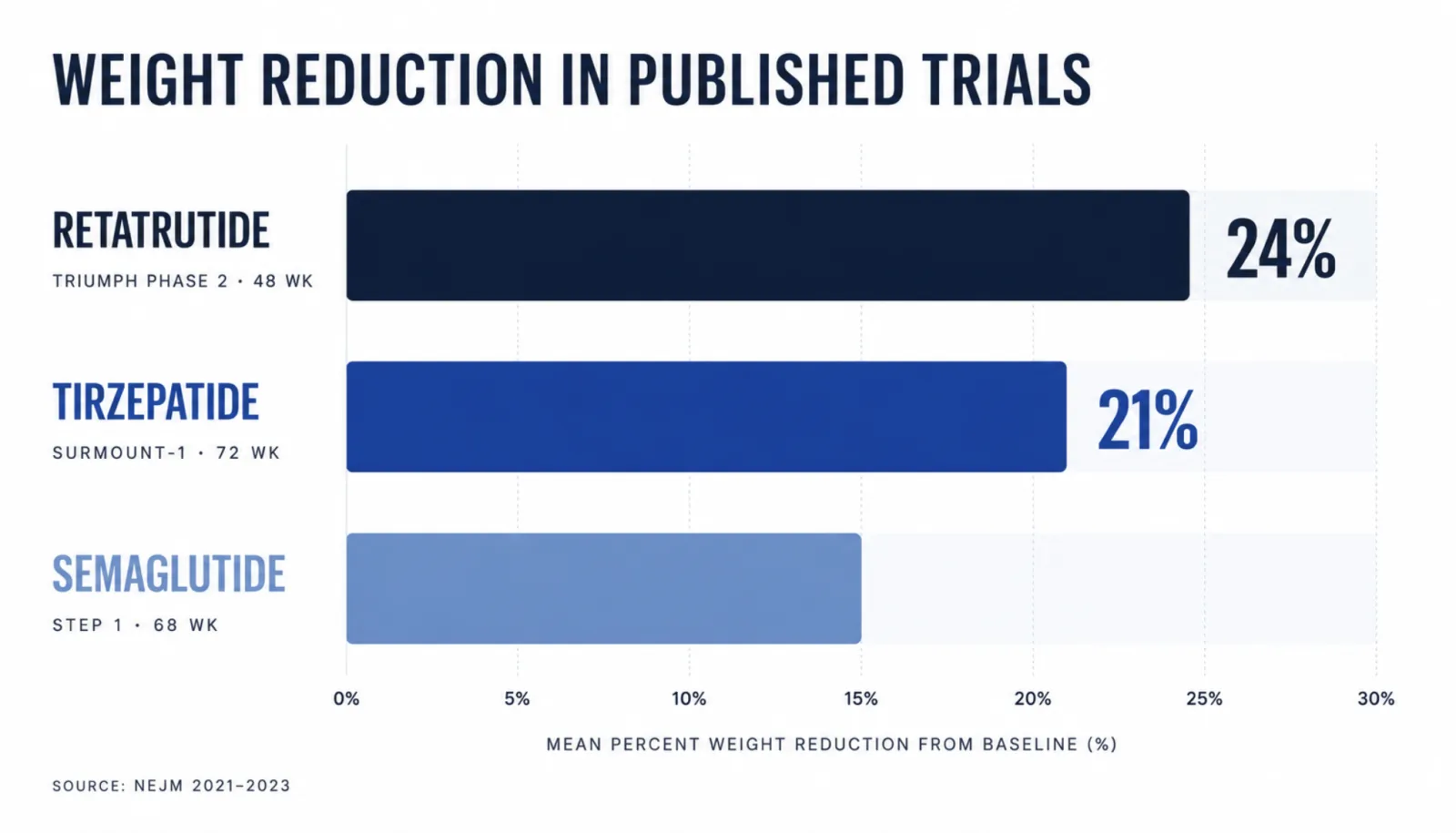
- Strongest outcomes: retatrutide ~24% (12mg, 48 wk), tirzepatide ~21% (15mg, 72 wk), semaglutide ~15% (2.4mg, 68 wk).
- 25–40% of weight lost on incretins is lean mass — fat loss ≠ weight loss.
- Class side effects are GI during titration; rare risks include pancreatitis and thyroid signals.
- UAE access: research-grade lyophilized powder, HPLC-verified, batch COA. Pharma products require MOHAP-licensed prescription.
Five years ago “peptides for weight loss” was a phrase you mostly heard in endocrinology conferences and longevity forums. Today it is the most-searched category in metabolic research, and the conversation has moved well past Ozempic. There are now four major incretin peptides under active investigation, several growth-hormone secretagogues with body-composition effects, and a growing set of mitochondrial and metabolic compounds that influence how the body partitions fat. Most of the noise online conflates them. They are not the same molecules, they don’t work the same way, and they don’t deliver the same outcomes.
This guide is the map. We cover what weight loss peptides actually are at the receptor level, the four major mechanism families and how they differ, the clinical evidence behind each one, what fat loss looks like compared to weight loss, the realistic side effect picture, and how research access works in the UAE specifically.
● Retatrutide 5mg AED 320
● Semaglutide 5mg AED 220
● Tirzepatide 10mg AED 480
View all GLP-1 →
01 · Four
The four mechanism families behind weight loss peptides
Weight loss peptides fall into four mechanism families. Each acts on a different physiological system, which determines the side effect profile, body composition outcome, and stacking compatibility.
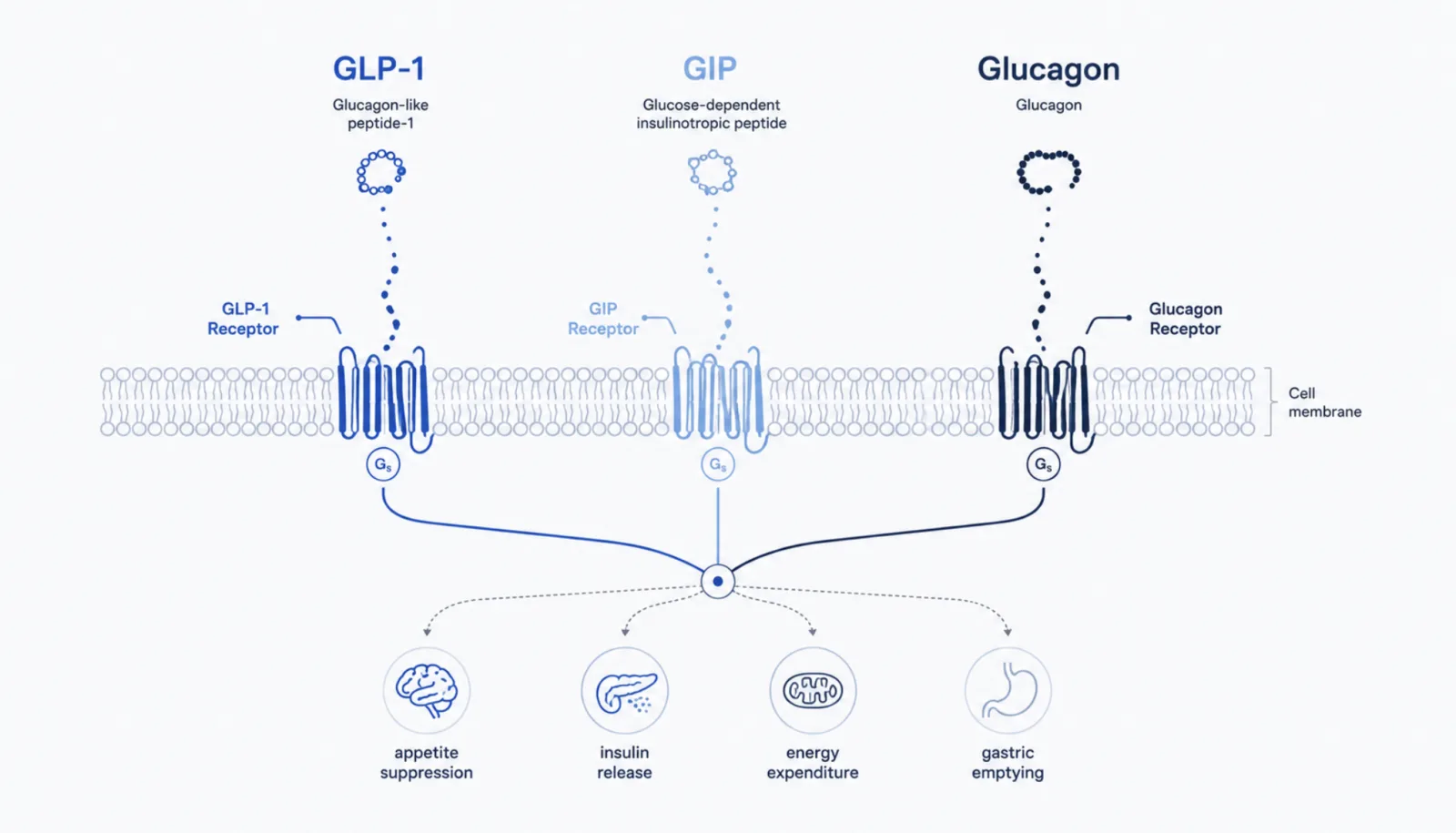
Incretin Mimetics
GLP-1, GIP, and glucagon receptor agonists. Suppress appetite, slow gastric emptying, trigger glucose-dependent insulin release.
Amylin Analogues
Co-secreted with insulin. Suppress appetite via a different brain circuit than GLP-1, making them additive in stacks.
Growth Hormone Secretagogues
Stimulate pituitary GH release; raise IGF-1. Shift body composition toward fat oxidation and muscle preservation.
Mitochondrial & Metabolic
Act on mitochondrial function and metabolic enzymes rather than appetite pathways. Adjuncts in stacks.
Why mechanism matters more than brand
GLP-1 agonism suppresses appetite at the hypothalamus, slows gastric emptying, and triggers glucose-dependent insulin release. This is the mechanism behind semaglutide.
GIP agonism improves insulin sensitivity, supports adipose tissue handling of nutrients, and appears to reduce some of the GI side effects seen with pure GLP-1 agonism. Adding GIP activity to GLP-1 activity is what distinguishes tirzepatide from semaglutide.
Glucagon agonism increases energy expenditure and promotes hepatic fat mobilization. When combined with GLP-1 activity at the right ratio, the GLP-1 effect dominates glucose control while glucagon’s energy-burning effect compounds the weight loss. This three-receptor strategy defines retatrutide.
02 · Major
The major weight loss peptides compared
Based on published clinical data through 2026, the most-studied weight loss peptides span four mechanism families. The differences in trial outcomes are significant — and predictable from the receptor profile.
Major weight loss peptides at a glance
| Peptide | Mechanism | Weight ↓ | Trial | |
|---|---|---|---|---|
| Retatrutide | Triple agonist | Phase 2 — 48 wk | Guide → | |
| Tirzepatide | GLP-1 / GIP dual | SURMOUNT-1 — 72 wk | Compare → | |
| Semaglutide | GLP-1 monoagonist | STEP 1 — 68 wk | Guide → | |
| Cagrilintide | Amylin analogue | Phase 2 — 26 wk | Product → | |
| Tesamorelin | GHRH analogue | Visceral fat focus | JAMA 2014 | Product → |
| MOTS-c | Mitochondrial | Adjunct / metabolic | Preclinical + small N | Guide → |
24.2%
Retatrutide at 12mg dose. Participants were still actively losing weight at trial end, suggesting a later plateau than semaglutide or tirzepatide.
Semaglutide: the established GLP-1 agonist
Semaglutide is the molecule inside Ozempic, Wegovy, and Rybelsus. It is a once-weekly GLP-1 receptor agonist with 94% structural similarity to native human GLP-1. The STEP 1 trial published in NEJM reported average weight loss of 14.9% at 68 weeks in adults with obesity, with more than 86% of participants achieving at least 5% body weight reduction.
Tirzepatide: the dual GLP-1/GIP agonist
Tirzepatide adds GIP receptor activity on top of GLP-1 activity. The SURMOUNT-1 trial reported average weight loss of 20.9% at the 15mg dose over 72 weeks. The dual mechanism appears to also moderate GI side effects compared to pure GLP-1 agonism at equivalent weight-loss potency. For deeper comparison, see our retatrutide vs tirzepatide vs semaglutide guide.
Retatrutide: the triple agonist
Retatrutide is the newest of the high-potency incretin peptides and the only one currently hitting three receptors simultaneously: GLP-1, GIP, and glucagon. Phase 2 data published in NEJM in 2023 showed average weight loss of 24.2% at the 12mg dose over 48 weeks. The glucagon component appears to increase energy expenditure measurably. See our retatrutide dosing protocol.
Cagrilintide: the amylin analogue
Cagrilintide is a long-acting amylin analogue. On its own, it produces modest weight loss. The interesting data comes from the combination with semaglutide (CagriSema), which has shown phase 2 outcomes approaching or exceeding tirzepatide monotherapy.
Tesamorelin: the growth hormone secretagogue
Tesamorelin is a synthetic GHRH analogue. It produces measurable reductions in visceral adipose tissue with documented effects on liver fat and waist circumference. Unlike incretins, tesamorelin does not significantly suppress appetite — it shifts where the body stores and burns fat.
Is retatrutide approved in the UAE?
What is CagriSema?
Best peptide for visceral fat?
Retatrutide vs tirzepatide?
How does MOTS-c work?
03 · Weight
Weight loss is not the same as fat loss
Latest research insights. No spam, ever.
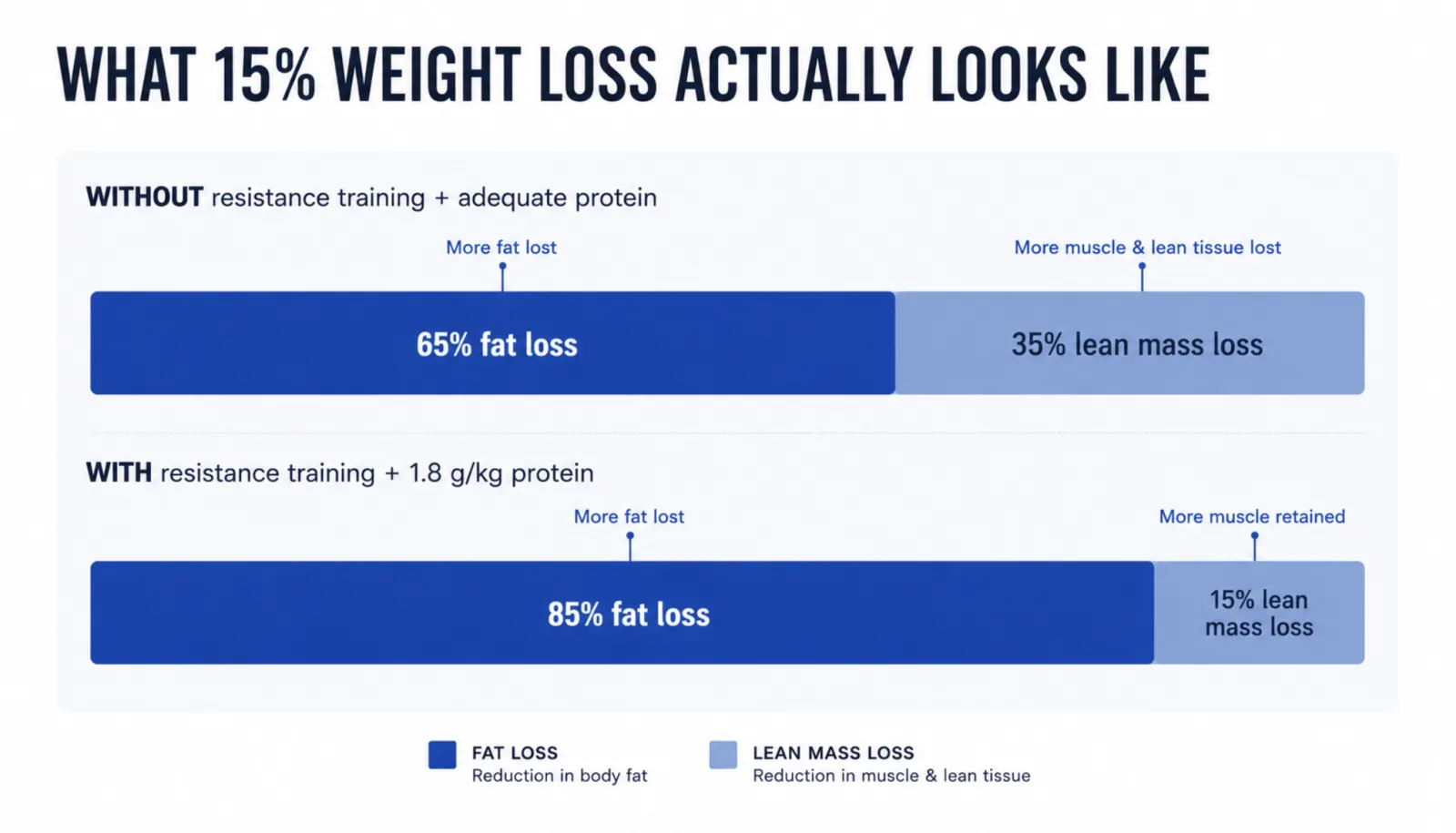
Across the major GLP-1 and dual-agonist trials, roughly 25–40% of total weight lost has been documented as lean mass — muscle, water, glycogen — rather than fat. Adequate protein intake, resistance training, and in some research protocols adjunct peptides like growth hormone secretagogues can shift that ratio toward a higher proportion of fat loss.
What 15% weight loss on a GLP-1 actually looks like
Lean mass loss
That has real consequences. Lean mass loss reduces resting metabolic rate, which makes long-term weight maintenance harder. The research community’s response: combine incretin therapy with muscle-preserving inputs — higher protein intake during the active loss phase, structured resistance training, and increasingly peptides like tesamorelin that bias the body toward fat oxidation.
A protocol producing 15% weight loss with 85% as fat is meaningfully different from one producing 20% weight loss with only 65% as fat. Ask not just how much weight a compound produces, but what the body composition outcome looks like.
04 · Side
What the side effect picture actually looks like
Across the incretin family, the dominant side effects are gastrointestinal — nausea, vomiting, diarrhea, constipation — most pronounced during dose escalation and resolving for most participants at a stable dose. In the major trials, nausea affected roughly 40 to 50% of participants at some point, with most cases mild to moderate and resolving within weeks of reaching a stable dose.
Beyond the GI profile: pancreatitis (uncommon but serious), gallbladder events, acute kidney injury, and a thyroid tumor signal that has generated regulatory warnings around medullary thyroid carcinoma. Personal or family history of medullary thyroid cancer or MEN-2 syndrome is treated as a contraindication across the class.
Growth hormone secretagogues like tesamorelin have a different profile: injection-site reactions, fluid retention, joint discomfort, and increases in fasting glucose. Amylin analogues mirror much of the incretin GI picture.
Rushing dose escalation is the single largest predictor of early discontinuation across the incretin class. The titration schedules in the published trials are gradual for a reason — they are what made the side effect profile manageable in the data we have.
In the STEP and SURMOUNT programs, nausea and GI symptoms peaked during the first two weeks after each dose increase. Most participants who reached the target dose without discontinuation followed the published titration schedule strictly. Faster escalation correlated with higher dropout rates.
05 · Research
How research peptide access works in the UAE

In the UAE, finished pharmaceutical GLP-1 products (Ozempic, Wegovy, Mounjaro) are MOHAP-regulated prescription medications requiring a licensed clinician. Research peptides — sold as lyophilized powder at ≥99% HPLC purity with batch-specific Certificates of Analysis — are a separate regulatory category supplied for laboratory research and development use only.
Local sourcing solves several real problems. Heat stability during transit: peptides are temperature-sensitive, and lyophilized vials transiting through high-temperature customs holding areas can lose potency before arrival. UAE-domestic shipping with same-day dispatch sidesteps that problem entirely.
Documentation matters more than most researchers initially appreciate. A peptide is only as useful as its purity verification. HPLC results, mass-spec verification, and batch-specific COAs are what allow research data to be reproducible. See our Certificate of Analysis library for batch verification examples.
06 · Think
How to think about stacking and protocol design
Most published clinical research on weight loss peptides has studied single compounds. The research community has increasingly moved toward stacked protocols, combining compounds from different mechanism families on the logic that addressing weight loss through multiple independent pathways produces additive rather than overlapping effects.
The most-studied stack is GLP-1 plus amylin: semaglutide combined with cagrilintide (CagriSema) has produced phase 2 outcomes approaching or exceeding tirzepatide monotherapy. A second class combines incretins with growth hormone secretagogues like tesamorelin — the hypothesis being that GLP-1 drives weight loss while the secretagogue biases body composition toward fat over muscle.
07 · Questions
Frequently asked questions
Which weight loss peptide produces the most weight loss in research? +
What is the difference between weight loss and fat loss on these peptides? +
Are these peptides legal to obtain in the UAE? +
How long does it take to see results in published research? +
Can these peptides be stacked safely in research? +
What happens when a weight loss peptide protocol ends? +
Are research peptides the same as the pharmaceutical versions? +
How should weight loss peptides be stored in UAE conditions? +

08 · References
References
- Wilding JPH et al. Once-weekly semaglutide in adults with overweight or obesity (STEP 1). NEJM 2021. Link
- Jastreboff AM et al. Tirzepatide once weekly for the treatment of obesity (SURMOUNT-1). NEJM 2022. Link
- Jastreboff AM et al. Triple-hormone-receptor agonist retatrutide for obesity — Phase 2 trial. NEJM 2023. Link
- Enebo LB et al. Cagrilintide with semaglutide safety + PK/PD. The Lancet 2021. Link
- Stanley TL et al. Tesamorelin on visceral fat and liver fat. JAMA Internal Medicine 2014. Link
- Lee C et al. MOTS-c promotes metabolic homeostasis. Cell Metabolism 2015. Link
- Smits MM, Van Raalte DH. Safety of semaglutide. Frontiers in Endocrinology / PMC 2021. Link
- Wilding JPH et al. Weight regain after withdrawal of semaglutide (STEP 4 extension). JAMA 2022. Link
- Harvard Health / CDC. Serious side effects from semaglutide are uncommon. 2024. Link
Was this article helpful?

🔬 Related Research Peptides
Explore Research-Grade Peptides
HPLC-verified, lab-tested peptides for your scientific research. Fast delivery across the UAE.
Browse All PeptidesRelated Articles



Emirates Peptides Research Team
A dedicated coalition of biochemists and clinical researchers focusing on advanced peptide synthesis and pharmacological applications. All data is verified against current clinical trials.
FROM INSTAGRAM