
Blog
Glow Blend vs Klow Blend: Which Multi-Peptide Vial Fits Your Research Model? (2026)
 ·
·
16 min read
·
·
16 min read
- Key Facts at a Glance
- What each vial actually contains
- Why these four peptides get stacked at all
- Formulation logic: breadth vs fourth-axis coverage
- Blends vs ordering singles
For laboratory research and development purposes. Not for human consumption. Not approved for therapeutic use. Educational comparison for qualified research buyers.
Glow Blend is a 70 mg three-peptide vial (BPC-157, TB-500, GHK-Cu). Klow Blend keeps the same core and adds 10 mg KPV — 80 mg total, four peptides. This guide compares formulation, research logic, handling, and procurement for UAE laboratory buyers.
02 · Each
What each vial actually contains
Peptide mass composition — Glow (70 mg)
Peptide mass composition — Klow (80 mg)
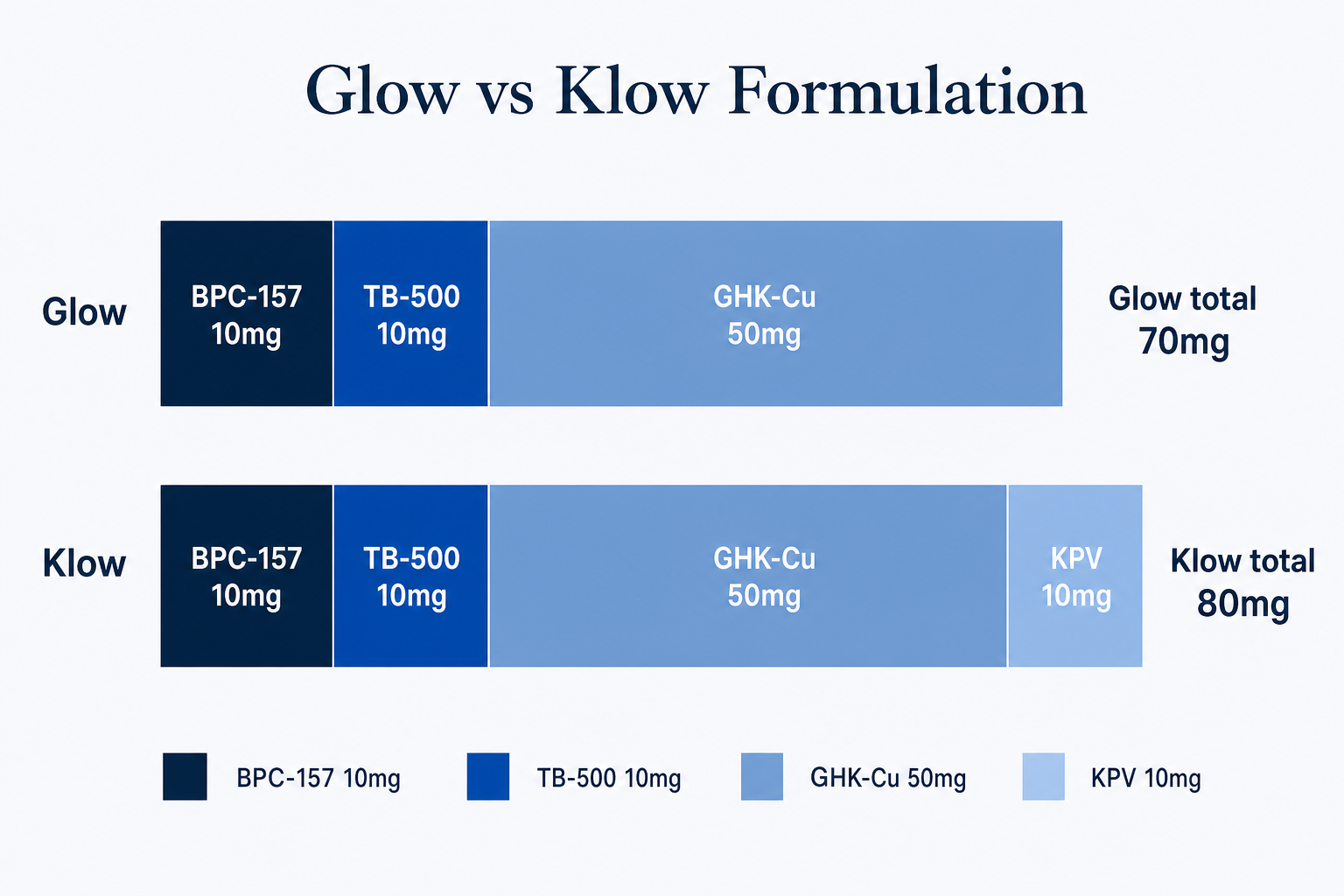
Formulation comparison chart
Before any mechanism talk, lock in the numbers. Formulation differences only matter when you know what is in the lyophilized cake.
| Component | Glow Blend | Klow Blend |
|---|---|---|
| BPC-157 | 10 mg | 10 mg |
| TB-500 (Thymosin Beta-4 fragment) | 10 mg | 10 mg |
| GHK-Cu | 50 mg | 50 mg |
| KPV | — | 10 mg |
| Total peptide mass per vial | 70 mg | 80 mg |
Glow Blend (SKU EP-BPC157TB500GHKCU) is a three-peptide stack: repair sequences plus a copper peptide at the highest mass fraction. Klow Blend (SKU EP-BPC1572) keeps the same BPC, TB, and GHK-Cu amounts and adds KPV, a tripeptide (Lys-Pro-Val) studied in preclinical models for inflammatory and gut-barrier signaling.
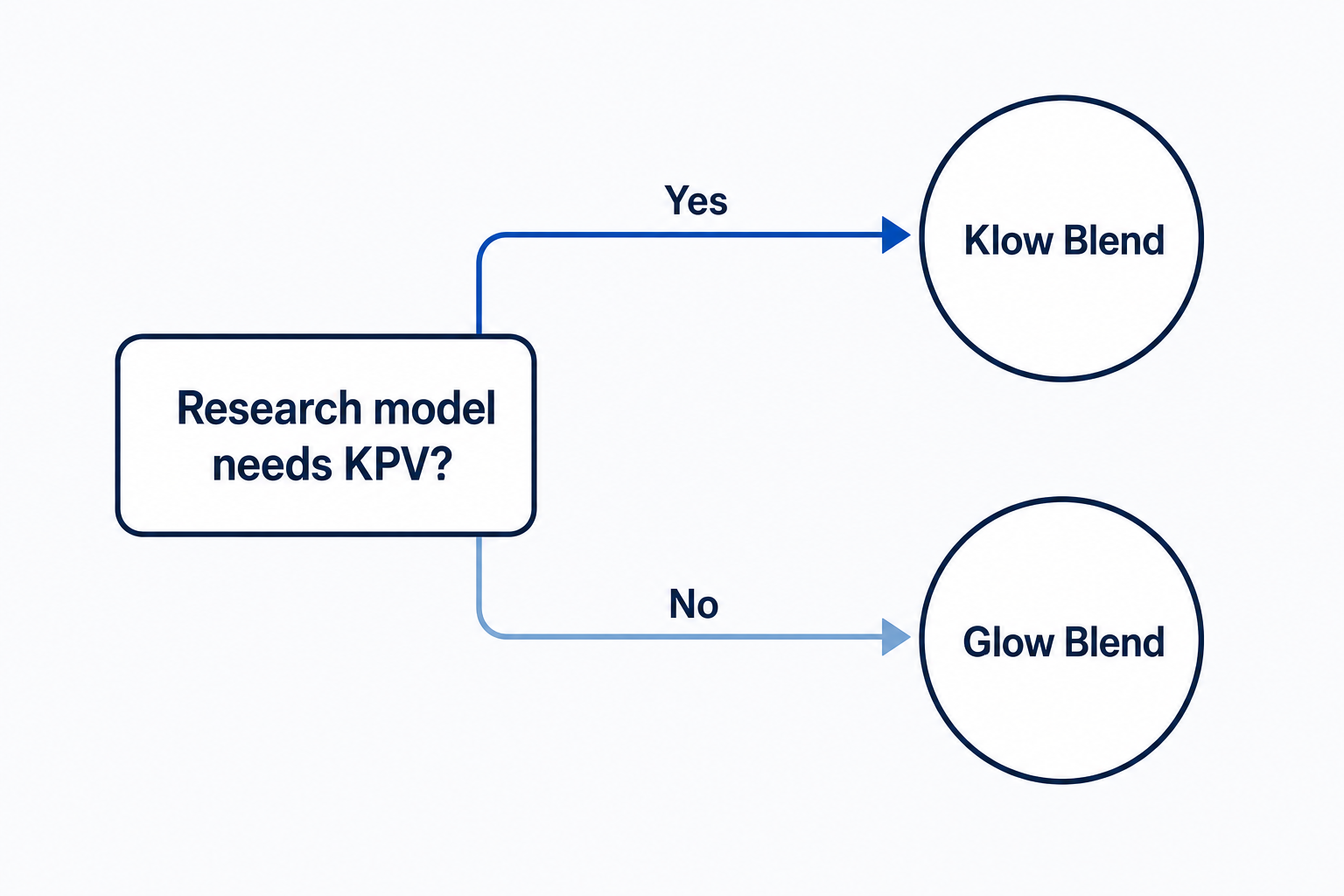
That single row — the KPV column — is the entire product split. Everything else in this comparison flows from whether your model needs that fourth compound in the same vial.
03 · Four
Why these four peptides get stacked at all
Latest research insights. No spam, ever.
BPC-157
BPC-157 is a synthetic pentadecapeptide derived from a gastric protein sequence. Preclinical literature has explored its role in angiogenesis, fibroblast migration, and growth-factor pathway modulation in soft-tissue injury models. It is one of the most frequently cited peptides in tissue-repair research, which explains its presence in virtually every “recovery blend” on the market.
It is not a dominant mass fraction in either blend (10 mg of 70–80 mg total), but it anchors the repair narrative for both SKUs. In blend design, BPC-157 is the “named” repair peptide buyers search for — even when GHK-Cu supplies most of the mass.
TB-500
TB-500 typically refers to a fragment of thymosin beta-4 associated with actin binding and cell migration in animal studies. Researchers pair it with BPC-157 when the experimental question spans multiple repair pathways — angiogenesis and cytoskeletal remodeling are different mechanisms, and combining them in one vial lets a single reconstitution step feed both lines of inquiry.
Both blends carry TB-500 at 10 mg, matching BPC-157 gram-for-gram. That 1:1 BPC/TB ratio is a common industry convention; it is not evidence that those doses are optimal for every model — only that both SKUs share the same convention.
GHK-Cu
GHK-Cu is a copper-binding tripeptide with a long research history in extracellular matrix remodeling, collagen gene expression, and fibroblast behavior in vitro. At 50 mg, it is the majority mass in both vials (~71% of Glow, ~62.5% of Klow).
That ratio matters for two practical reasons:
- Reconstitution concentration — most of what you dissolve is GHK-Cu.
- Copper handling — GHK-Cu chelates copper; storage, light exposure, and repeated freeze-thaw cycles affect copper peptides differently than plain linear sequences.
If your readout is matrix-heavy (collagen markers, fibroblast assays, skin-equivalent models), both blends bias toward GHK-Cu by design. Glow is slightly more GHK-dominant on a percentage basis because it lacks the extra 10 mg KPV.
KPV (Klow only)
BPC-157
Same repair core as Glow.
TB-500
Same migration axis as Glow.
GHK-Cu
Same matrix peptide as Glow.
KPV
Inflammatory-modulation axis — the only addition vs Glow.
June 2026 summary: Glow (70 mg, three peptides) fits repair-and-matrix models without a dedicated inflammatory arm. Klow (80 mg, four peptides) adds 10 mg KPV to the same BPC/TB/GHK core — choose it only when your protocol needs KPV in the same vial. Deep dives: Glow UAE guide · Klow UAE guide.
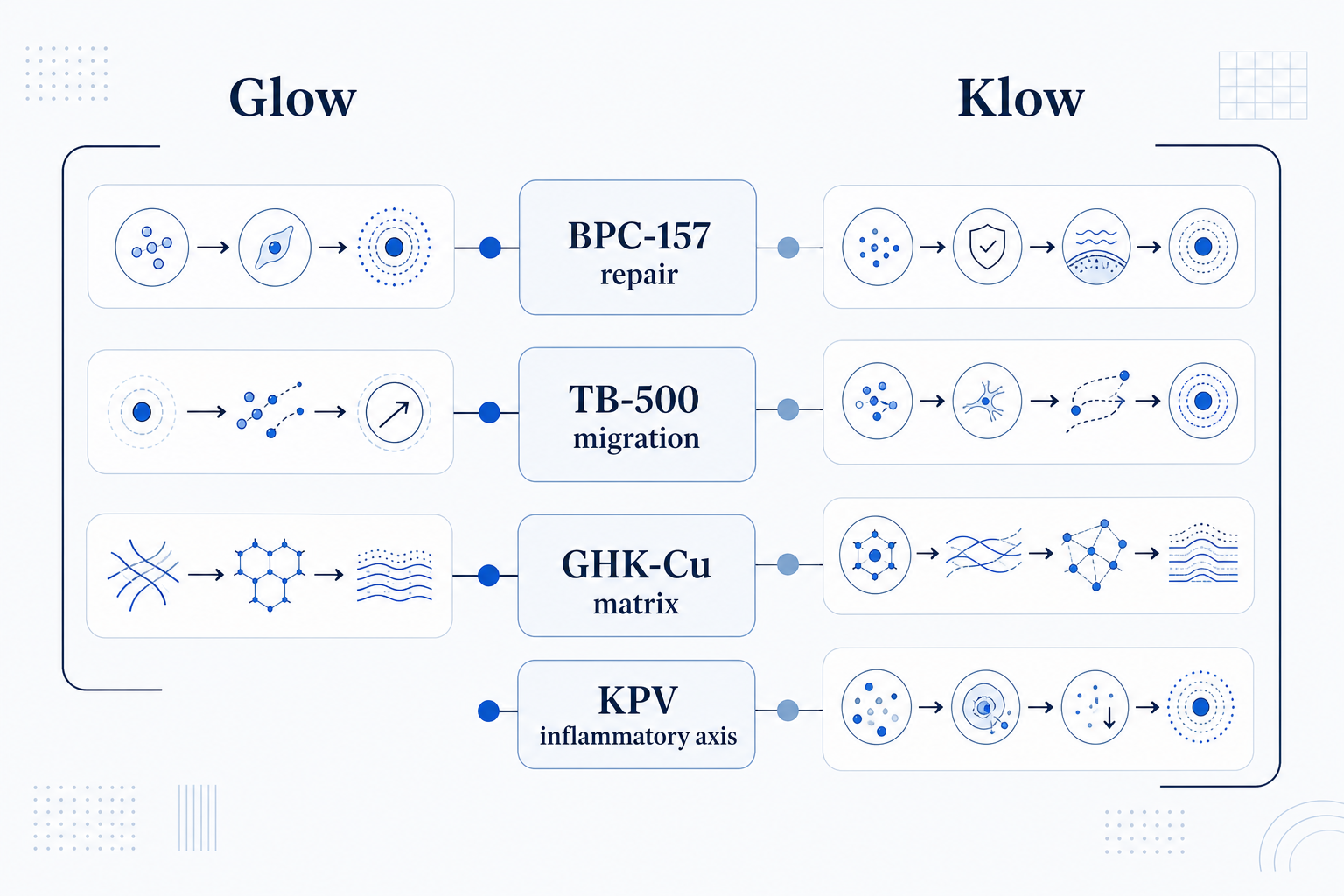
Mechanism pathways — Glow vs Klow
KPV is the differentiator. It is a short alpha-MSH-related tripeptide investigated in rodent models of colitis, intestinal inflammation, and NF-κB pathway modulation. It does not replace BPC or TB; it adds a parallel anti-inflammatory axis that Glow does not include.
Researchers running gut-barrier models, inflammatory co-morbidity arms, or IBD-adjacent preclinical work often source KPV as a standalone. Klow Blend bundles it so you do not manage a fourth vial — at the cost of a more complex formulation and a higher total peptide load per reconstitution.
04 · Formulation
Formulation logic: breadth vs fourth-axis coverage
Glow Blend answers the question: “I want the standard repair + matrix stack in one vial.”
Three peptides, three mechanism families, no inflammatory specialist. For exploratory work where you are mapping which pathway drives your phenotype, Glow keeps the variable count lower. Fewer components means simpler attribution when something moves in your assay.
Klow Blend answers a different question: “I want the repair + matrix stack and an inflammatory modulator in the same reconstitution.”
It is not a “stronger” Glow. It is Glow plus KPV. The repair and matrix fractions are unchanged. You gain 10 mg of KPV and 10 mg of total vial mass. If your model has no inflammatory or gut-barrier component, that extra peptide is dead weight — not harmful in a research framing, but irrelevant to your endpoints.
A useful mental model:
Glow
= repair dual-stack + copper matrix emphasis
Klow
= same repair dual-stack + copper matrix + inflammatory tripeptide
Neither replaces single-compound controls. If you need to isolate KPV’s contribution, you still want a KPV-only vial in a parallel arm.
05 · Blends
Blends vs ordering singles
Both Glow and Klow are fixed-ratio combination products. That is their value and their constraint.
| Approach | Advantage | Tradeoff |
|---|---|---|
| Glow or Klow blend | One reconstitution, one lot number, faster technician workflow | Cannot change BPC:TB:GHK ratio without switching SKU |
| Singles (BPC, TB, GHK-Cu, KPV) | Full dose flexibility, cleaner mechanistic attribution | Four cold-chain items, four COAs, compounding error risk |
| BPC/TB two-peptide blend | Leaner when GHK-Cu is not needed | No matrix peptide in the same vial |
Labs running publication-grade mechanism work often keep singles for attribution arms and use blends for operational cohorts where the fixed ratio matches the protocol. That hybrid approach is valid: Glow or Klow for the main line, singles for the “which component drove the effect?” substudy.
Order volume matters too. A CRO running twelve parallel injury models may prefer one blend SKU to reduce receiving and inventory complexity. A university lab testing one hypothesis about KPV may buy Klow once and never stock Glow.
06 · Protocol
Protocol design: controls and confounds
Blend selection should happen at protocol design, not mid-study. The confounds are obvious but easy to ignore under procurement pressure.
Minimum control arms to document:
- Vehicle control — diluent only, matched handling.
- Single-peptide controls — at least one, for the peptide whose mechanism you need to defend in a grant or ethics review.
- Combination vs sum-of-parts — if you claim synergy, you need data showing the blend outperforms equimolar singles mixed at reconstitution (not assumed).
Switching from Glow to Klow mid-cohort introduces a fourth compound and a new lot — two confounds at once. If both profiles are scientifically interesting, run parallel cohorts from day one with separate randomization lists.
Dose reporting: Always report total peptide mass per administration and per-peptide mass derived from the label (10/10/50 or 10/10/10/50). Reviewers increasingly reject “one vial per week” language without mass accounting.
07 · Reconstitution
Reconstitution and lab handling
Both blends ship as lyophilized powder and reconstitute with bacteriostatic water (0.9% benzyl alcohol) for multi-dose research use, or sterile water for single-use preparations — follow your institutional SOP.
Shared considerations:
GHK-Cu fraction
Because GHK-Cu dominates mass, swirl gently; avoid vigorous shaking that can foam and denature sensitive peptides.
Cold chain
Store lyophilized vials at 2–8 °C. After reconstitution, refrigerate and protect from light; copper peptides are photosensitive.
Volume math
Total peptide mass differs (70 mg vs 80 mg). If you standardize on a fixed reconstitution volume (e.g., 2 mL BAC water), Klow produces a slightly higher aggregate concentration. Adjust aliquot calculations accordingly; do not assume identical molarity per μL between SKUs.
Aliquot example (illustrative only — not dosing guidance): Reconstituting 70 mg Glow in 2.0 mL yields 35 mg/mL total peptide; 80 mg Klow in 2.0 mL yields 40 mg/mL. Per-component concentrations scale with the fixed ratios in the table above.
Where Klow asks a bit more discipline:
Adding KPV introduces a fourth analytical target if you run identity/purity checks on the reconstituted solution. HPLC methods that resolve three peptides may need adjustment for four. Labs with established Glow protocols cannot copy-paste the same validation checklist without adding a KPV peak assignment.
Glow’s three-component profile is simpler for method development — one fewer peak to integrate, one fewer reference standard to source for in-house QC.
08 · Research
Research models: where each blend tends to land
This section describes common preclinical framing from published literature. It is not a recommendation to use these products for any purpose outside qualified research.
Glow Blend tends to fit when:
- The primary endpoints are soft-tissue repair kinetics (tendon, ligament, muscle injury models) without a dedicated inflammatory arm.
- You are running matrix readouts — hydroxyproline content, collagen I/III expression, fibroblast scratch assays — and want GHK-Cu in the same solution as BPC/TB.
- You prefer fewer variables in an exploratory phase before committing to a four-compound stack.
- Your lab is standardizing handling SOPs across technicians; three-peptide validation is faster to document.
Klow Blend tends to fit when:
- The model includes intestinal inflammation, barrier permeability, or colitis-adjacent phenotypes where KPV appears in the literature as a modulator.
- You would otherwise purchase KPV separately and want one reconstitution for a combined repair + anti-inflammatory protocol.
- You are comparing stacked vs single-agent arms and need KPV present without adding another vial to the cold chain.
- Your COA and identity workflow already covers four peptides — or you are willing to extend it.
When neither is the right tool
- You need only BPC-157 and TB-500 without GHK-Cu → the two-peptide BPC/TB blend is the leaner SKU.
- You need high-dose KPV without repair peptides → standalone KPV vials give cleaner attribution.
- You need GHK-Cu alone for cosmetic-matrix research → a single-compound GHK-Cu vial avoids carrying BPC/TB mass you will not use.
Blends trade convenience for compositional fixedness. That is the deal.
09 · Sourcing
Sourcing, COA, and lot consistency
Multi-peptide vials raise a procurement question single peptides avoid: does the certificate of analysis report each component?
For research buyers in the UAE and wider GCC, lot-to-lot consistency matters more when one SKU represents four analytical targets. Minimum expectations for either blend:
Identity
confirmed per peptide (mass spec or HPLC retention vs reference)
Purity
reported per component or for the composite with peak deconvolution
Endotoxin
within your model’s threshold if used in cell or animal work
Residual solvents / moisture
suitable for lyophilized storage
When comparing Glow and Klow from any supplier — not only Emirates Peptides — ask whether the COA shows individual peptide quantities matching the label claim (10/10/50 for Glow; 10/10/10/50 for Klow). A COA that only reports “total peptide content” is insufficient for a multi-component research product.
Emirates Peptides positions both blends as GMP-sourced research materials with batch documentation; verify the current lot’s COA before protocol lock-in.
1
Klow is Glow’s three-peptide core plus 10 mg KPV. BPC-157, TB-500, and GHK-Cu amounts are unchanged between SKUs.
10 · Side-By-Side
Side-by-side decision matrix
Which blend fits your model?
| Factor | Glow Blend | Klow Blend |
|---|---|---|
| Peptide count | 3 | 4 |
| Total mass | 70 mg | 80 mg |
| BPC-157 / TB-500 | 10 mg / 10 mg each | 10 mg / 10 mg each |
| GHK-Cu | 50 mg (~71% of vial) | 50 mg (~62.5% of vial) |
| KPV | Not included | 10 mg |
| Mechanism breadth | Repair + matrix | Repair + matrix + inflammatory axis |
| QC complexity | Lower (3 peaks) | Higher (4 peaks) |
| Best when | Exploratory repair/matrix work | Models needing KPV in the same stack |
| SKU | EP-BPC157TB500GHKCU | EP-BPC1572 |
11 · Questions
Frequently asked questions
Is Klow just an upgraded Glow? +
Can I switch mid-study? +
Which is easier for a new lab? +
Do I need both in stock? +
What about building the stack manually from singles? +
Does Klow cost more because it has more peptide? +
Can I use the same reconstitution volume for both SKUs? +
What should appear on a research-grade COA? +
Are these products approved for human use in the UAE? +
12 · Bottom
Bottom line
Glow Blend and Klow Blend share a name rhythm and a shelf category. They diverge on one factual point: Klow contains KPV; Glow does not. Everything else — identical BPC and TB doses, identical GHK-Cu mass, lyophilized format, repair-and-matrix research positioning — is shared infrastructure.
Choose Glow when three peptides cover your endpoints and you want the simpler formulation. Choose Klow when your model genuinely needs KPV in the same vial as BPC-157, TB-500, and GHK-Cu. If you are unsure whether inflammation belongs in the protocol, that uncertainty usually means start with Glow, add KPV as a standalone if the data points you there, and only move to Klow when combining in one reconstitution is worth the fourth analytical target.
That is the comparison in one sentence: same repair core, optional inflammatory fourth.
13 · Procurement
Procurement notes for UAE research buyers
Shipping, storage, and documentation expectations in the UAE differ from EU or US domestic supply chains. Multi-peptide blends amplify those differences because a customs or institutional review that questions one component can hold the entire vial.
Documentation: Keep the COA, invoice, and SDS together per lot. For four-component Klow, confirm each peptide appears on the COA before your ethics or procurement committee reviews the order. Glow’s simpler profile usually clears administrative review faster when the committee is unfamiliar with peptide stacks.
Storage on arrival: Dubai and Abu Dhabi ambient temperatures exceed cold-chain safety margins for much of the year. Treat same-day refrigerator storage as mandatory, not best practice. Lyophilized cakes tolerate brief transit at controlled room temperature if the supplier shipped with ice packs; do not leave vials in a vehicle or non-cooled receiving area.
Re-order timing: Blend SKUs move faster than niche singles. If your protocol runs 12-week animal arms, calculate vial consumption from total peptide mass (70 or 80 mg per vial) and reorder before you are on the last lyophilized unit. Running out mid-cohort and substituting a new lot introduces a batch confound even when the label claim is identical.
Institutional attribution: University and CRO models in the GCC increasingly ask which compounds are in a “combination product.” Glow and Klow are fixed-ratio combinations — disclose the full ingredient list in grant and ethics paperwork up front. Reviewers who see “peptide blend” without composition detail will delay approval.
Same-day dispatch: When ordering from a UAE-based supplier, confirm cut-off times and cold-chain packaging for summer months. A blend order held overnight in ambient heat is a stability risk for lyophilized product even before reconstitution.
14 · Analytical
Analytical chemistry: what your QC team should expect
If your lab runs incoming identity testing — and multi-peptide buyers should — expect different chromatographic profiles.
Glow (three components): A reverse-phase HPLC method with UV detection at 214 nm typically resolves BPC-157, TB-500, and GHK-Cu with distinct retention times when the method is developed for composite samples. GHK-Cu’s copper coordination can shift retention slightly versus the apo peptide; use reference material that matches the metalated form.
Klow (four components): KPV’s short tripeptide structure elutes close to other small peptides in generic methods. Method development may require gradient adjustment or MS detection to confirm Lys-Pro-Val identity unambiguously. Do not assume a Glow-validated method transfers without a KPV peak assignment study.
Mass spectrometry: MALDI or ESI-MS on the reconstituted solution can confirm molecular weights per component. For blends, total-ion-count spectra get crowded; extracted-ion chromatograms per m/z are cleaner for lot-release documentation.
Purity interpretation: A single “≥98%” line on a COA may refer to the dominant GHK-Cu fraction, not every component. Ask suppliers whether purity is reported per peptide or as a weighted average. Per-peptide reporting is the research-grade standard for multi-component vials.
Stability notes: Mixed peptides in one solution can interact over time — especially copper peptides with thiol-containing sequences. Document time-from-reconstitution in your SOP and avoid storing reconstituted blend aliquots longer than your validation data supports.
15 · Literature
Literature context without overclaiming
Each blend component has independent PubMed footprints. BPC-157 and thymosin beta-4 fragments appear extensively in rodent injury models. GHK-Cu has decades of in vitro matrix literature. KPV’s preclinical work clusters around intestinal inflammation and NF-κB modulation in animal models.
None of that literature authorizes human use of these research products. It informs which models researchers choose, not clinical outcomes. When you write internal protocol justifications, cite the preclinical mechanism that matches your endpoint — angiogenesis, migration, matrix gene expression, or inflammatory cytokine reduction — and keep the RUO boundary explicit in every document the IRB or IACUC sees.
Glow maps cleanly to repair + matrix citations. Klow adds a second literature cluster (KPV / inflammatory) that you should cite separately when defending the four-peptide design. Mixing citations without distinguishing which compound supports which claim weakens protocol reviews.
16 · Glossary
Glossary
| Term | Definition |
|---|---|
| BPC-157 | Synthetic pentadecapeptide studied in soft-tissue repair and angiogenesis models. |
| TB-500 | Research name for a thymosin beta-4 fragment associated with actin binding and cell migration. |
| GHK-Cu | Copper-chelating tripeptide (Gly-His-Lys) studied in extracellular matrix and fibroblast research. |
| KPV | Tripeptide (Lys-Pro-Val) investigated in inflammatory and gut-barrier preclinical models. |
| Lyophilized cake | Freeze-dried peptide powder in a vial before reconstitution. |
| COA | Certificate of Analysis — batch-specific purity and identity documentation. |
| RUO | Research Use Only — not for human or veterinary diagnostic or therapeutic use. |
17 · Research
Related research guides
If this comparison helped narrow your SKU, these companion topics usually come next in procurement workflows:
- Glow Blend UAE guide — handling, storage, and COA expectations for the three-peptide SKU.
- Klow Blend UAE guide — four-component validation and when KPV justifies the stack.
- BPC-157 + TB-500 blend — leaner two-peptide option when GHK-Cu is not required.
- GHK-Cu research overview — matrix endpoints and copper-peptide stability.
- KPV standalone — when inflammatory mechanism work needs attribution without repair peptides.
Internal links from this pillar to those cluster posts strengthen site architecture and help buyers who land on “Glow vs Klow” before they know which single-product guide they need.
18 · References
References
- Sikiric P et al. Stable gastric pentadecapeptide BPC 157: novel therapy in gastrointestinal tract. Curr Pharm Des. 2011. PubMed
- Seiwerth S et al. BPC 157 and blood vessels. Curr Pharm Des. 2014. PubMed
- Goldstein AL et al. Thymosin beta-4: actin-sequestering protein moonlights to repair injured tissues. Ann NY Acad Sci. 2012. PubMed
- Malinda KM et al. Thymosin beta-4 accelerates wound healing. Ann NY Acad Sci. 2007. PubMed
- Pickart L et al. GHK peptide as a natural modulator of multiple cellular pathways in skin regeneration. BioMed Res Int. 2015. PubMed
- Pickart L, Margolina A. Regenerative and protective actions of the GHK-Cu peptide. Int J Mol Sci. 2018. PubMed
- Brzoska T et al. Alpha-melanocyte-stimulating hormone and related tripeptides: biochemistry, antiinflammatory and protective effects in vitro and in vivo. Endocr Rev. 2008. PubMed
- Kannengiesser K et al. Melanocortin-derived tripeptide KPV inhibits inflammatory signaling in intestinal epithelial cells. PLoS One. 2014. PubMed
- Getting SJ et al. Melanocortin peptides inhibit production of proinflammatory cytokines. J Neuroimmunol. 1999. PubMed
- Dalmasso G et al. PepT1-mediated tripeptide KPV uptake reduces intestinal inflammation. Gastroenterology. 2008. PubMed
- Chang CH et al. Pentadecapeptide BPC 157 enhances the growth hormone receptor expression in tendon fibroblasts. Molecules. 2014. PubMed
- Gwyer D et al. Gastric pentadecapeptide body protection compound BPC 157 and its role in accelerating musculoskeletal soft tissue healing. Cell Tissue Res. 2019. PubMed
This article is an educational summary of publicly available research compound information. Emirates Peptides does not provide medical advice, dosing guidance, or treatment recommendations. All products are sold for laboratory research use only.
Was this article helpful?

🔬 Related Research Peptides
Explore Research-Grade Peptides
HPLC-verified, lab-tested peptides for your scientific research. Fast delivery across the UAE.
Browse All PeptidesRelated Articles


Emirates Peptides Research Team
A dedicated coalition of biochemists and clinical researchers focusing on advanced peptide synthesis and pharmacological applications. All data is verified against current clinical trials.
FROM INSTAGRAM