Blog
TB-500 UAE: Complete Research Guide — Tissue Repair, Angiogenesis and Where to Buy (2026)


For research use only. Material is supplied as a lyophilized reference compound with HPLC purity verification.
- Key Facts at a Glance
- What Is TB-500?
- How Does TB-500 Work?
- TB-500 Research: Key Studies and Findings
- TB-500 vs BPC-157: Complementary Mechanisms
Among the research peptides studied for tissue repair and recovery, TB-500 occupies a uniquely important position. As a synthetic analogue of Thymosin Beta-4 — a peptide naturally present in virtually every cell of the human body — TB-500 is involved in one of the most fundamental processes in biology: the organisation and mobilisation of actin, the structural protein that forms the skeleton of every cell and drives cellular movement during repair.
For UAE researchers investigating musculoskeletal recovery, wound healing, and tissue regeneration, TB-500 is one of the most well-evidenced and mechanistically understood repair peptides available. This guide covers the science, key research, dosing protocols, and where to buy pharmaceutical-grade TB-500 in Dubai and across the UAE.
02
What Is TB-500?
🔬 Research-grade peptides referenced in this article:
TB-500 is a synthetic peptide analogue of Thymosin Beta-4 (Tβ4) — specifically the active fragment responsible for its tissue repair and cell migration properties. The key sequence in TB-500 is LKKTETQ (Lys-Lys-Thr-Glu-Thr-Gln) — a 7-amino acid actin-binding domain that retains the biological activity of the full 43-amino acid Thymosin Beta-4 molecule at a fraction of its molecular weight.
Thymosin Beta-4 itself is one of the most abundant intracellular peptides in mammals, present at high concentrations in blood platelets, wound fluid, and most tissues. It was first identified in the thymus gland in the 1960s during research into immunological peptides, but its role as a master regulator of actin dynamics and tissue repair was not fully appreciated until decades later.
03 · Work
How Does TB-500 Work?
Latest research insights. No spam, ever.
TB-500’s primary mechanism centres on actin sequestration and G-actin regulation. Actin exists in two forms: globular G-actin (monomeric) and filamentous F-actin (polymerised). The ratio between these forms determines how readily cells can reorganise their cytoskeleton for movement — which is essential for tissue repair.
- Actin sequestration: TB-500 binds G-actin, regulating its availability for polymerisation and controlling the dynamic balance between G-actin and F-actin in cells
- Cell migration promotion: By modulating actin dynamics, TB-500 promotes the migration of endothelial cells, keratinocytes, and fibroblasts to injury sites — the critical first step in repair
- Angiogenesis: TB-500 promotes new blood vessel formation by stimulating endothelial cell migration and tube formation — restoring vascular supply to damaged tissue
- Anti-inflammatory activity: Research shows TB-500 downregulates inflammatory cytokines including TNF-α and IL-6, facilitating the transition from inflammatory to proliferative repair phases
- Stem cell recruitment: TB-500 has been shown to promote the migration of progenitor and stem cells from bone marrow to sites of tissue damage — supporting regeneration beyond simple repair
- Scarring reduction: By modulating the inflammatory and remodelling phases of healing, TB-500 research models consistently show reduced fibrosis and scar formation compared to controls
04 · Research
TB-500 Research: Key Studies and Findings
Cardiac Repair
Some of the most compelling TB-500 research comes from cardiac biology. A landmark study published in Nature demonstrated that Thymosin Beta-4 stimulated the migration of epicardial progenitor cells into the damaged myocardium following cardiac injury, promoting cardiomyocyte survival and regeneration. This finding established TB-500 as one of the few peptides with genuine cardiac regenerative potential in research models.
Wound Healing
TB-500’s wound healing properties are among its most extensively documented effects. Research has demonstrated accelerated closure of dermal wounds, improved keratinocyte and fibroblast migration, enhanced angiogenesis at wound margins, and reduced scar formation across multiple wound models. A Phase 2 clinical trial in diabetic foot ulcers showed statistically significant improvements in wound closure rates with topical Thymosin Beta-4 application.
Tendon and Ligament Repair
Like BPC-157, TB-500 has been extensively studied in tendon injury models. Research demonstrates improved tendon cell migration to injury sites, enhanced collagen synthesis, and superior functional recovery compared to controls. TB-500 is considered complementary to BPC-157 in tendon research — BPC-157 initiates growth factor signalling while TB-500 mobilises the repair cells that respond to those signals.
Eye and Corneal Healing
Thymosin Beta-4 has been investigated as a treatment for corneal wounds and dry eye disease. A Phase 2 trial demonstrated significant improvements in corneal healing and symptom scores in patients with neurotrophic keratopathy treated with Tβ4 eye drops — one of the few clinical applications of Thymosin Beta-4 research to advance to human trials.
05 · BPC-157
TB-500 vs BPC-157: Complementary Mechanisms
| Property | TB-500 | BPC-157 |
|---|---|---|
| Primary mechanism | Actin dynamics, cell migration | Growth factor receptor upregulation |
| Angiogenesis | Endothelial cell migration | VEGF signalling, vessel formation |
| Anti-inflammatory | Cytokine downregulation | NO modulation, inflammation resolution |
| Tissue range | Cardiac, tendon, skin, cornea | Tendon, gut, muscle, bone, nerve |
| Stem cell effects | Progenitor cell recruitment | Fibroblast and tenocyte proliferation |
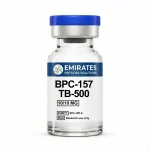
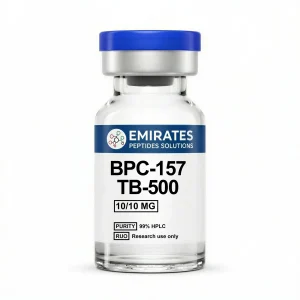
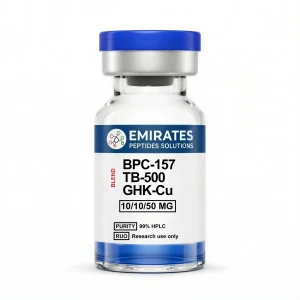
Emirates Peptides offers TB-500 individually and as a pre-blended BPC-157 + TB-500 combination vial for researchers who use both compounds together.
06 · Dosing
TB-500 Dosing Protocol (Research Reference)
For research reference only. Not approved for human use.
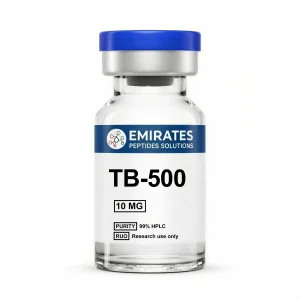
In animal research models, TB-500 has been administered at doses of 2–5 mg/kg via subcutaneous injection, typically 2-3 times per week during active injury models. Emirates Peptides supplies TB-500 in 10mg vials of lyophilised powder. Reconstitute with bacteriostatic water and use our peptide calculator.
Storage Guidelines
Lyophilised:
2-8°C, protected from light
Reconstituted:
2-8°C, use within 28 days
Avoid freeze-thaw cycles
07
Where to Buy TB-500 in the UAE
- ✅ COA-verified, ≥99% purity
- ✅ 10mg vials
- ✅ Fast delivery to Dubai, Abu Dhabi and all UAE emirates
- ✅ GCC shipping available
- ✅ Cash on delivery in Dubai
08 · Questions
Frequently Asked Questions
What is the difference between TB-500 and Thymosin Beta-4?
TB-500 is the synthetic peptide analogue containing the key active fragment (LKKTETQ) of Thymosin Beta-4. It is more practical for research use than the full 43-amino acid Thymosin Beta-4 molecule due to easier synthesis and equivalent biological activity in the key repair pathways.
Is TB-500 better used alone or with BPC-157?
Research suggests they are more effective together due to complementary mechanisms. BPC-157 initiates growth factor signalling and angiogenesis while TB-500 mobilises the repair cells that respond to those signals. The combination is the most studied repair peptide stack in the field.
Is TB-500 legal in the UAE?
TB-500 is supplied strictly for research use and is not a controlled substance in the UAE.
What is the typical TB-500 research dose?
In animal research models, TB-500 has been administered at 2–5 mg/kg via subcutaneous injection, 2–3 times per week during active injury models. Cardiac and corneal research uses different dosing schedules tailored to the endpoint.
How long does TB-500 take to show effects in research models?
Wound healing endpoints accelerate within the first 7–14 days of dosing. Tendon research models typically report functional improvement at 3–4 weeks. Cardiac progenitor cell migration in pre-clinical models is observable within days of administration in active-injury settings.
Does TB-500 stack with GHK-Cu?
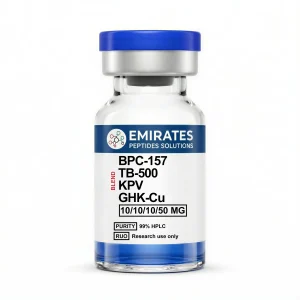
Yes — TB-500, BPC-157, and GHK-Cu form the classic Glow Blend research stack used in skin-and-tissue regeneration studies. BPC-157 sends growth-factor signals, TB-500 recruits cells, GHK-Cu drives collagen synthesis at the rebuilding site.
How is TB-500 stored after reconstitution?
Refrigerated at 2–8 °C, protected from light, used within 28 days. Avoid freeze-thaw cycles — repeated freezing fragments the peptide and reduces activity.
Has TB-500 ever been tested in human clinical trials?
Thymosin Beta-4 (the parent molecule of TB-500) has advanced to Phase 2 human trials in two indications: topical application for diabetic foot ulcer wound healing, and eye drops for neurotrophic keratopathy (corneal disease). Both showed statistically significant improvements. The synthetic TB-500 fragment itself has not been tested in human trials.
Disclaimer: For laboratory research use only. Not approved for human use. Not medical advice.
Was this article helpful?

🔬 Related Research Peptides
Explore Research-Grade Peptides
HPLC-verified, lab-tested peptides for your scientific research. Fast delivery across the UAE.
Browse All PeptidesRelated Articles


Selected Research References
Selected scientific references for research context only. Products remain for laboratory research use and are not for human use.
- Thymosin beta4 accelerates wound healing
- Thymosin beta 4: A novel corneal wound healing and anti-inflammatory agent
- Thymosin beta4 Promotes Dermal Healing
- Thymosin beta4: actin-sequestering protein moonlights to repair injured tissues
- Thymosin beta4 enhances endothelial cell differentiation and angiogenesis

Emirates Peptides Research Team
A dedicated coalition of biochemists and clinical researchers focusing on advanced peptide synthesis and pharmacological applications. All data is verified against current clinical trials.