
Blog
5-Amino-1MQ UAE: NNMT Inhibitor Research Guide and Where to Buy in Dubai (2026)
 ·
·
5 min read
·
·
5 min read

For research use only. Material is supplied as a lyophilized reference compound with HPLC purity verification.
- Key Facts at a Glance
- What Is 5-Amino-1MQ?
- How Does 5-Amino-1MQ Work?
- 5-Amino-1MQ Research: Key Findings
- 5-Amino-1MQ vs Other Metabolic Research Compounds
Among the newer research compounds gaining traction in metabolic and longevity science, 5-Amino-1MQ occupies a unique position. Unlike most research compounds that work through peptide receptor pathways, 5-Amino-1MQ is a small molecule inhibitor that targets a specific enzyme — NNMT (Nicotinamide N-methyltransferase) — whose dysregulation has been linked to obesity, metabolic syndrome, and cellular aging. For UAE researchers investigating metabolism and fat biology, 5-Amino-1MQ is one of the most mechanistically interesting compounds emerging from recent research.
02
What Is 5-Amino-1MQ?
5-Amino-1MQ (5-Amino-1-methylquinolinium) is a small molecule inhibitor of NNMT — nicotinamide N-methyltransferase. NNMT is an enzyme that methylates nicotinamide (a form of vitamin B3) using S-adenosylmethionine (SAM) as the methyl donor. When NNMT is overactive — as it is in adipose tissue in obesity and metabolic disease — it depletes SAM and disrupts methylation balance, leading to epigenetic dysregulation and impaired NAD+ metabolism.
5-Amino-1MQ was developed as a highly selective NNMT inhibitor — blocking this dysregulated enzyme to restore normal methylation homeostasis and NAD+ availability in metabolically active tissues.
03 · Work
How Does 5-Amino-1MQ Work?
Latest research insights. No spam, ever.
- NNMT inhibition: Directly blocks NNMT enzyme activity in adipose and other metabolically active tissues
- SAM conservation: By blocking NNMT, 5-Amino-1MQ preserves SAM — the universal methyl donor used in hundreds of epigenetic and metabolic reactions
- NAD+ pathway restoration: NNMT inhibition redirects nicotinamide back into the NAD+ biosynthesis pathway, increasing cellular NAD+ availability
- Adipocyte differentiation inhibition: Research shows 5-Amino-1MQ reduces differentiation of pre-adipocytes into mature fat cells, potentially limiting adipose expansion
- Fat oxidation enhancement: Studies demonstrate increased fatty acid oxidation in adipose tissue following NNMT inhibition
- Epigenetic remodelling: Restored SAM availability allows normal DNA and histone methylation, potentially reversing obesity-associated epigenetic changes in adipose tissue
04 · Research
5-Amino-1MQ Research: Key Findings
Obesity and Fat Cell Biology
The foundational research on 5-Amino-1MQ was published by researchers at Weill Cornell Medicine. Studies in diet-induced obese mouse models demonstrated that 5-Amino-1MQ treatment significantly reduced body weight, adipose tissue mass, and metabolic dysfunction markers — without changes to food intake. The mechanism was traced directly to NNMT inhibition in white adipose tissue, with downstream effects on fat cell size and number.
NAD+ and Metabolic Restoration
By redirecting nicotinamide away from NNMT and back into NAD+ biosynthesis, 5-Amino-1MQ effectively increases intracellular NAD+ levels in a tissue-targeted manner. This complements systemic NAD+ supplementation and may be particularly relevant in adipose tissue, where NNMT overactivity specifically depletes NAD+ precursors.
Muscle Mass Preservation
Research has suggested 5-Amino-1MQ may help preserve lean muscle mass during caloric restriction or weight loss — an important consideration in metabolic research where preserving muscle while losing fat is a key endpoint.
05 · Other
5-Amino-1MQ vs Other Metabolic Research Compounds
| Compound | Target | Mechanism | Primary Research Area |
|---|---|---|---|
| 5-Amino-1MQ | NNMT enzyme | Enzyme inhibition, SAM/NAD+ restoration | Fat biology, obesity, epigenetics |
| GLP-3 | GLP-1/GIP/Glucagon receptors | Receptor agonism, appetite suppression | Weight loss, metabolic disease |
| MOTS-c | AMPK / mitochondria | Energy sensing, glucose metabolism | Metabolic aging, exercise performance |
| NAD+ | Sirtuin cofactor | Energy carrier, DNA repair | Cellular aging, metabolism |
06 · Research
Research Dosing (Reference)
For research reference only. Not approved for human use.
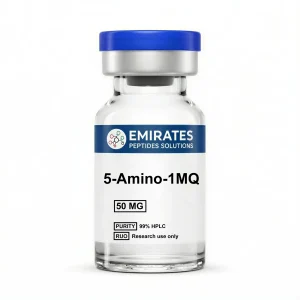
In published animal model studies, 5-Amino-1MQ has been administered orally at doses of approximately 100-200mg/kg/day. Emirates Peptides supplies 5-Amino-1MQ in 50mg vials of high-purity lyophilised powder. Reconstitute with bacteriostatic water per our peptide calculator.
Storage
Lyophilised:
2-8°C, protected from light
Reconstituted:
2-8°C, use within 28 days
07
Where to Buy 5-Amino-1MQ in the UAE
- ✅ COA-verified, ≥99% purity
- ✅ 50mg vials
- ✅ Fast delivery to Dubai, Abu Dhabi and all UAE emirates
- ✅ GCC shipping available
- ✅ Cash on delivery in Dubai
08 · Questions
Frequently Asked Questions
Is 5-Amino-1MQ a peptide?
No. 5-Amino-1MQ is a small-molecule enzyme inhibitor, not a peptide. It’s structurally a methylquinolinium compound that binds the active site of NNMT (Nicotinamide N-methyltransferase). It’s grouped with research peptides because it’s used in similar metabolic and longevity research contexts.
What does NNMT do that makes it a research target?
NNMT methylates nicotinamide using S-adenosylmethionine (SAM) as the methyl donor. In healthy tissue this is fine, but in obese adipose tissue NNMT becomes over-active and depletes both SAM and NAD+ pools — disrupting epigenetic methylation balance and impairing sirtuin function. Inhibiting NNMT restores these pools.
Is 5-Amino-1MQ taken orally or injected?
Orally — this is unique among Emirates Peptides products. Because 5-Amino-1MQ is a small molecule, it survives gastric passage and is absorbed through the gut wall. No reconstitution or syringe needed.
What is the typical 5-Amino-1MQ research dose?
Pre-clinical research has used 5–10 mg/kg in animal studies. Translated to human research scale, this typically falls in the 50–150 mg/day range, taken orally. Always reference published protocols matched to the research endpoint.
How does 5-Amino-1MQ relate to NAD+ research?
NNMT consumes nicotinamide that would otherwise be converted to NAD+. By inhibiting NNMT, 5-Amino-1MQ preserves the nicotinamide pool available for NAD+ biosynthesis. This makes it a natural research pair with NAD+ supplementation — two complementary approaches to restoring cellular NAD+ levels.
Is 5-Amino-1MQ legal in the UAE?
5-Amino-1MQ is supplied strictly for laboratory research use and is not a controlled substance in the UAE.
Disclaimer: For laboratory research use only. Not approved for human use. Not medical advice.
Was this article helpful?

🔬 Related Research Peptides
Explore Research-Grade Peptides
HPLC-verified, lab-tested peptides for your scientific research. Fast delivery across the UAE.
Browse All PeptidesRelated Articles


Selected Research References
Selected scientific references for research context only. Products remain for laboratory research use and are not for human use.
- Nicotinamide N-methyltransferase inhibition mitigates obesity-related metabolic dysfunction
- Development and validation of LC-MS/MS assay for 5-amino-1-methyl quinolinium in rat plasma
- Small molecule inhibitor of nicotinamide N-methyltransferase shows anti-proliferative activity in HeLa cells
- Potent Inhibition of Nicotinamide N-Methyltransferase by Alkene-Linked Bisubstrate Mimics

Emirates Peptides Research Team
A dedicated coalition of biochemists and clinical researchers focusing on advanced peptide synthesis and pharmacological applications. All data is verified against current clinical trials.