
Blog


For research use only. Material is supplied as a lyophilized reference compound with HPLC purity verification.
- Key Facts at a Glance
- GHRH analogue → GH/IGF-I → body-composition endpoints
- Why male researchers keep searching “visceral fat”
- What the Phase 3 and extension data actually report
- VAT vs SAT vs lean mass — reading the body-composition stack
Last updated: 14 Jul 2026 · Reviewed by the Emirates Peptides Research Team · 17-minute read · 17 sources cited
Tesamorelin is a synthetic growth hormone–releasing hormone (GHRH) analogue studied extensively for visceral adipose tissue (VAT) reduction — especially in HIV-associated lipodystrophy trials where men often formed the majority of enrolled participants. This article reviews published VAT biology, Phase 3 evidence, VAT-versus-SAT outcomes, and the limits of extrapolating those programmes to other populations. Emirates Peptides supplies Tesamorelin for laboratory research only — this is not a prescribing guide and not personal belly-fat advice.
Dose figures below (including 2 mg daily subcutaneous schedules used in Phase 3 programmes) are published clinical-trial parameters for specific labelled populations. Research-use Tesamorelin from Emirates Peptides is not an approved medicine, not interchangeable with branded pharmaceutical product, and not instructions for personal administration.
01 · Mechanism
GHRH analogue → GH/IGF-I → body-composition endpoints
Visceral fat is the measured target in the pivotal corpus — not “weight loss” as a marketing synonym.
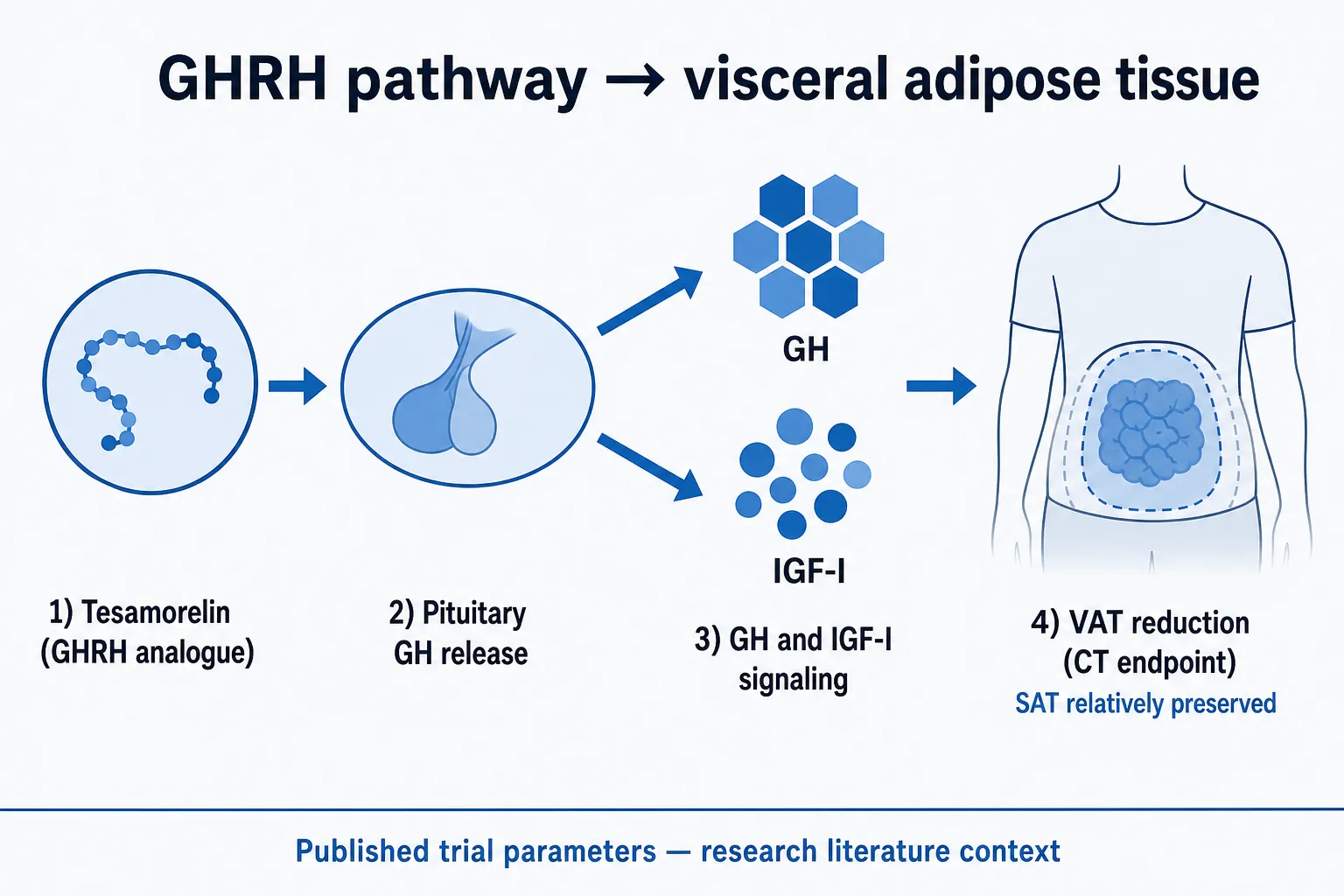
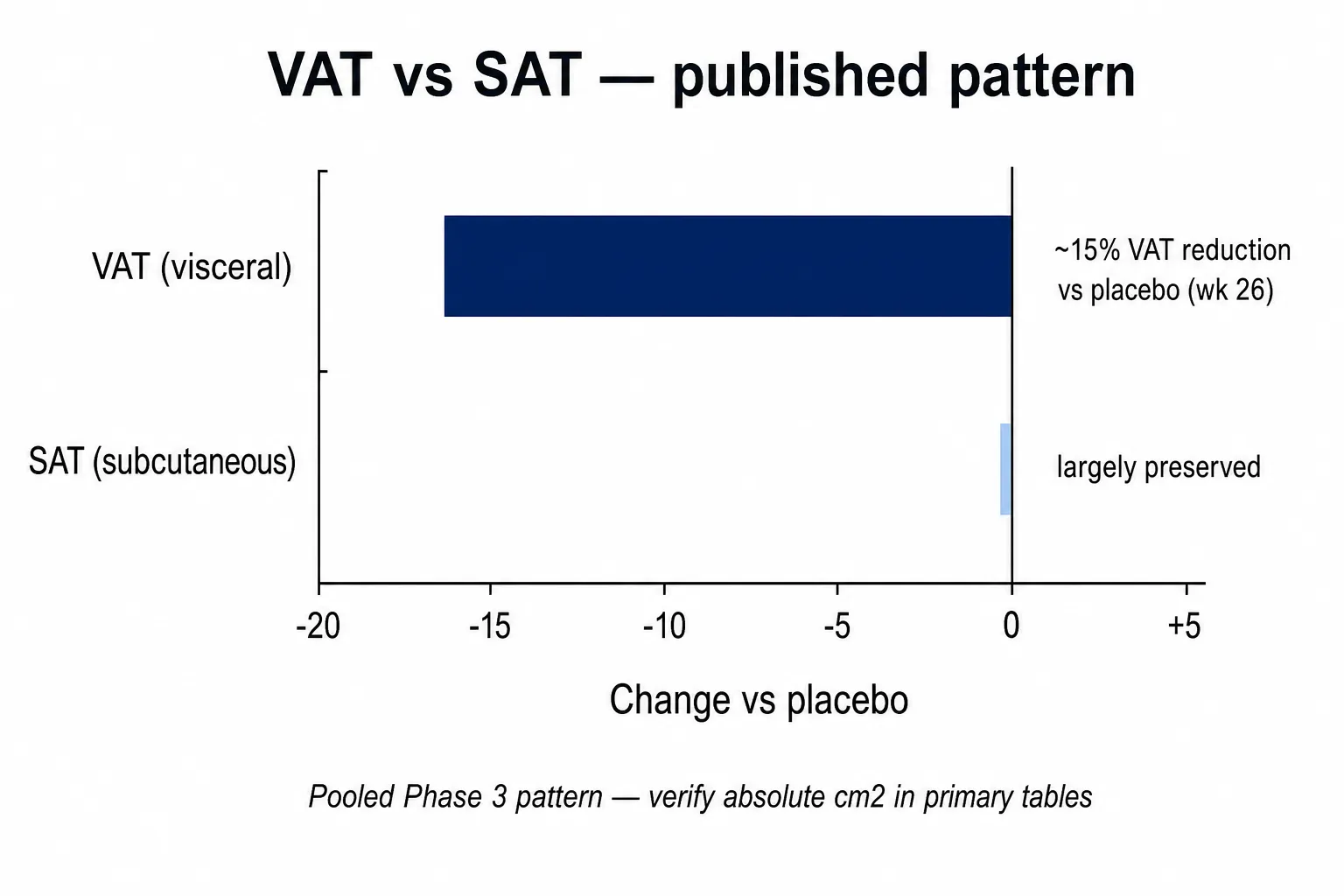
Unlike direct GH administration literature, GHRH-analogue design aims to work through physiologic GH secretion pathways. That distinction shows up in trial safety monitoring (IGF-I rises are expected pharmacodynamic signals) and in body-composition patterning: several analyses report VAT reduction without equivalent SAT loss — a depot-specific pattern that matters for cardiovascular-risk research framing.
For identity and UAE supply context, start with the Tesamorelin UAE guide and the product page. Broader weight-management peptide taxonomy (different receptor classes) sits in the weight-loss peptides research guide.
02 · Men & VAT
Why male researchers keep searching “visceral fat”
Latest research insights. No spam, ever.
Android fat distribution and trial demographics — not a lifestyle protocol.

Visceral adipose tissue surrounds intra-abdominal organs and is more strongly associated with metabolic risk markers than subcutaneous fat in epidemiologic research. Male (“android”) fat patterning therefore drives a large share of VAT-related search intent. HIV-associated lipodystrophy programmes additionally concentrated abdominal fat accumulation under antiretroviral therapy — the population where Tesamorelin’s pivotal evidence was generated.
Pivotal Tesamorelin trials enrolled predominantly men with HIV-associated lipodystrophy, with CT-defined baseline VAT and prespecified glucose exclusions. Effect sizes from those programmes should not be extrapolated to healthy male athletes or general obesity populations — the source literature does not support that transfer.
03 · Phase 3
What the Phase 3 and extension data actually report
Prefer pooled CT endpoints over anecdote.
| Source | Population | Key imaging / metabolic note |
|---|---|---|
| Falutz et al., NEJM (NCT00123253) | HIV + excess abdominal fat; ~86% men | 26-week VAT % change primary; lipids and IGF-I secondary |
| Pooled Phase 3 analysis PMID 20554713 | Two multicenter Phase 3 programmes | ~−15.4% VAT treatment effect wk 26; SAT largely preserved |
| Stanley et al., JAMA PMID 25038357 | HIV abdominal fat; mixed sex, smaller N | VAT and liver-fat reductions over 6 months |
| Meta-analytic summaries (recent) | Pooled RCTs | VAT, trunk fat, waist, hepatic fat signals with known AE patterns |
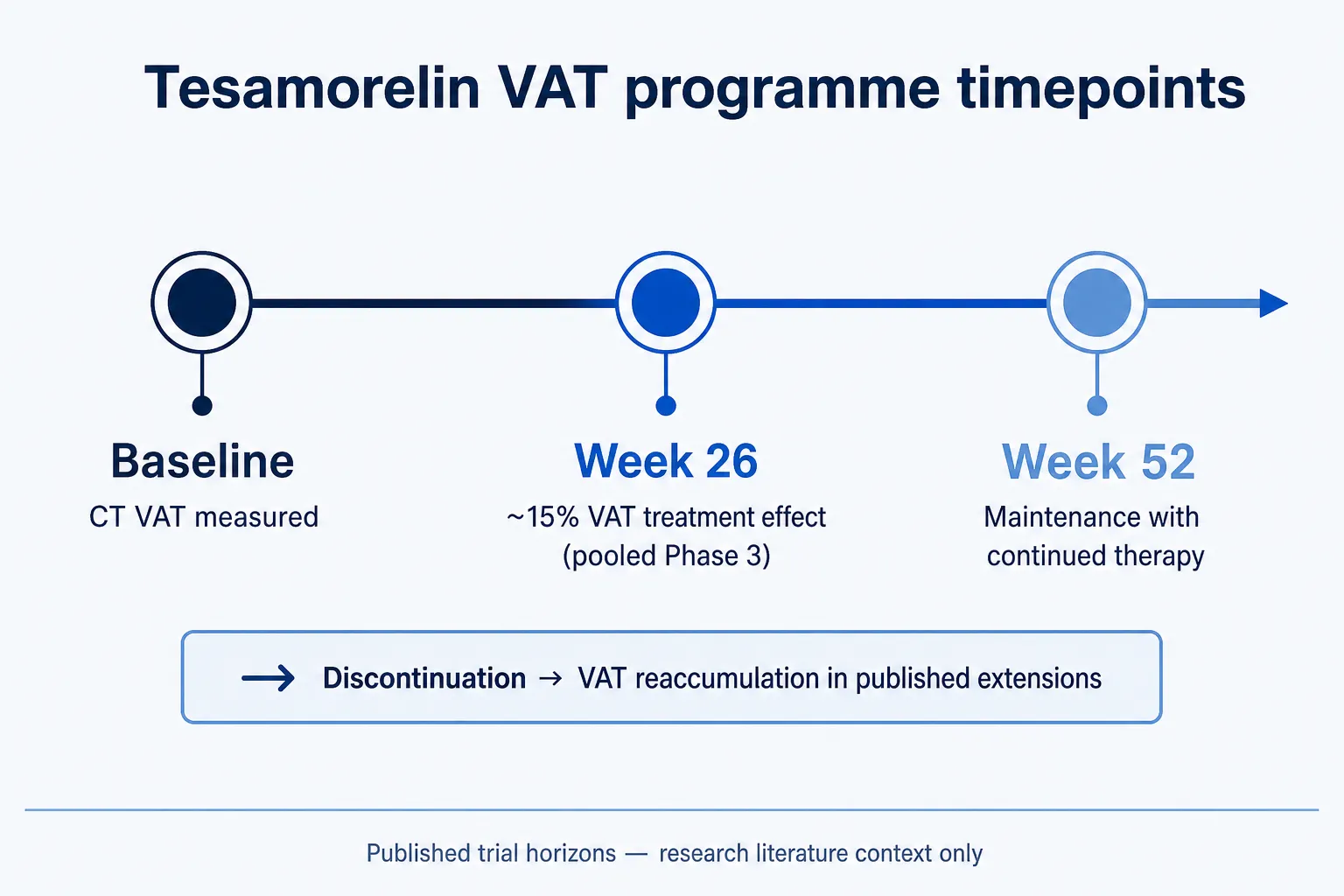
Extension data show that continued therapy can maintain VAT reductions, while discontinuation is associated with VAT reaccumulation in published follow-up — a durability pattern researchers should cite when designing washout arms. Always pull absolute cm² changes and confidence intervals from the primary tables rather than paraphrasing blog summaries.
04 · Composition
VAT vs SAT vs lean mass — reading the body-composition stack
Preferential visceral reduction is the distinctive published pattern.
05 · Comparison
Tesamorelin vs CJC-1295 / Ipamorelin research framing
Same broad GH-axis neighbourhood — different evidence maturity.
| Axis tool | Evidence maturity for VAT imaging | Research note |
|---|---|---|
| Tesamorelin | High within HIV lipodystrophy RCTs | CT VAT primary endpoints; IGF-I PD marker |
| CJC-1295 ± Ipamorelin | Lower for VAT-specific RCTs | GH-axis research stack; different documentation needs — CJC product |
06 · UAE
UAE research supply and documentation
COA, cold chain, and category clarity.
07 · Observations
Safety observations reported in trials
Pharmacovigilance signals — not personal monitoring advice.
08 · Limits
Extrapolation limits outside the pivotal populations
HIV lipodystrophy evidence ≠ general male visceral-fat therapy.
03b · Depth
How VAT was measured — and why cm² beats belt size
Imaging methodology is part of the evidence, not a footnote.
Single-slice CT VAT area (commonly referenced around the L4 vertebral level in this literature) reduces a three-dimensional depot to a reproducible 2D metric. That choice enables multicenter pooling but also means protocol writers must match slice selection rules when comparing across papers. Dual-energy X-ray absorptiometry (DXA) trunk-fat estimates and MRI hepatic-fat fractions answer adjacent questions; do not merge them into one “belly fat %” without stating modality.
Preferential VAT reduction with relative SAT preservation is the distinctive published pattern. Mechanistically, visceral adipocytes and subcutaneous adipocytes differ in adrenergic receptor profiles, inflammatory cytokine output, and portal venous drainage into the liver — which is why VAT and hepatic steatosis endpoints often travel together in later Tesamorelin imaging work. Stanley et al. (JAMA) explicitly paired VAT and liver-fat readouts in a smaller randomised cohort.
Male majority enrolment (~86% in the NEJM Phase 3 report) improves precision for men inside that HIV lipodystrophy sampling frame. It does not prove Tesamorelin is biologically male-specific. Women in the same programmes still contribute safety and efficacy data; sex-stratified tables, when published, should be preferred over assuming uniform effect sizes.
IGF-I rise is a pharmacodynamic expectation under GHRH-analogue exposure. Trial programmes monitored glucose parameters because GH-axis activation can shift carbohydrate handling. Some analyses noted early fasting-glucose bumps that were not always sustained as clinically meaningful differences at later visits — always read the time-course, not a single AE bullet. Arthralgia, myalgia, and injection-site reactions recur across pooled summaries.
Durability matters for research design: extension data associating continued therapy with maintained VAT reduction, and discontinuation with reaccumulation, imply that washout arms and follow-up imaging schedules are not optional cosmetics. If a new laboratory or observational protocol borrows these effect sizes, it must also borrow the time horizon (26–52 weeks in pivotal frames) or justify a shorter window with a different endpoint biology.
Category discipline for UAE researchers: branded pharmaceutical Tesamorelin for labelled indications is not the same SKU as research-use lyophilised material. Citations of Phase 3 percentages belong in literature reviews; they are not reconstitution recipes for RUO vials and not personal “visceral fat protocols” for healthy men.
04b · Depth
How to read a Tesamorelin VAT paper without over-claiming
A checklist for literature-to-protocol translation.
Start with inclusion criteria: HIV status, ART exposure, waist or VAT thresholds, diabetes exclusions, and sex mix. Then capture the primary imaging definition (slice level, software, reader blinding). Only then record the week-26 or week-52 treatment effect. Skipping straight to “15% VAT loss” is how secondary blogs invent universal male protocols.
Compare SAT and lean-mass rows beside VAT. Preferential visceral reduction is the interesting signal; if a summary omits SAT, treat it as incomplete. For hepatic fat, note spectroscopy vs MRI-PDFF vs other methods — Stanley’s lipid-to-water percentage is not identical to every steatosis score used elsewhere.
Safety extraction should list injection-site events, musculoskeletal symptoms, IGF-I excursions above assay reference ranges, and glucose timepoints. Distinguish transient week-2 shifts from week-26 between-group differences. That discipline prevents both alarmism and complacency.
Finally, write an explicit non-bridging sentence into any UAE research memo: Phase 3 pharmaceutical evidence in lipodystrophy ≠ reconstitution guidance for research-use Tesamorelin ≠ advice for healthy men seeking aesthetic waist change. The Tesamorelin UAE guide and product documentation remain the supply-side references; the NEJM/JAMA/pooled papers remain the evidence-side references.
If comparing against CJC-1295/Ipamorelin research discussions, keep evidence-maturity language honest: GH-axis neighbourhood shared, VAT-imaging RCT depth not shared. That comparison helps buyers and researchers ask better questions without implying therapeutic equivalence.

09 · FAQ
Frequently asked questions
Does Tesamorelin reduce visceral fat in men?
Published Phase 3 programmes in HIV-associated excess abdominal fat — cohorts that were predominantly male — show significant CT-measured VAT reductions versus placebo. That is population-specific clinical evidence, not a general recommendation for healthy men or research-use self-administration.
What dose was used in Phase 3 trials?
Pivotal programmes commonly used 2 mg subcutaneous daily for 26 weeks (with extension arms). Cite this only as a published trial parameter for the studied indication — not as personal dosing guidance for research-supply material.
Is VAT the same as belly fat?
Colloquial “belly fat” mixes visceral and subcutaneous depots. Trials primary-endpoint VAT on imaging; SAT changes were typically smaller. Waist circumference is a related but coarser measure.
How is Tesamorelin different from CJC-1295?
Both touch GH-axis biology, but Tesamorelin has a large VAT-imaging RCT corpus in a defined medical population. CJC-1295/Ipamorelin discussions usually sit in research-stack literature with different evidence density for VAT endpoints.
Does Emirates Peptides sell pharmaceutical Tesamorelin for patients?
No. Emirates Peptides supplies research-use material for laboratory work only. It is not a pharmacy substitute for regulated medicine.
Did trials only include men?
No. Women were enrolled, but men were the majority in several large reports. Sex should be treated as a covariate when reviewing outcomes.
What happens to VAT if therapy stops in published extensions?
Published follow-up indicates VAT reductions are better maintained with continued therapy and tend to reaccumulate after discontinuation. See primary extension tables for exact figures.
Is liver fat part of the Tesamorelin story?
Stanley et al. (JAMA) reported VAT and hepatic fat reductions in a smaller HIV abdominal-fat RCT. Treat hepatic endpoints as supportive literature, not as a standalone indication claim for research supply.
10 · References
References and research sources
- Falutz J, et al. Metabolic effects of a growth hormone–releasing factor in patients with HIV. N Engl J Med. NEJM · NCT00123253
- Falutz J, et al. Effects of tesamorelin… pooled Phase 3 analysis. PMID 20554713
- Stanley TL, et al. Effect of tesamorelin on visceral fat and liver fat… JAMA. 2014. PMID 25038357
- ClinicalTrials.gov. Effects of Growth Hormone Releasing Hormone in HIV. NCT01263717
- Recent meta-analysis of Tesamorelin RCTs on body composition and hepatic fat (verify current PMID when citing formally).
- Grinspoon SK / MGH group reviews on HIV lipodystrophy and VAT biology (verify selected review).
- Emirates Peptides. Tesamorelin UAE guide.
- Emirates Peptides. CJC-1295 + Ipamorelin UAE guide.
- Emirates Peptides. Weight-loss peptides research guide.
- IGF-I assay and GH-axis monitoring principles in endocrine research protocols (institutional SOP).
- CT VAT quantification methodology notes (L4 single-slice conventions used in many trials).
- ART-associated lipodystrophy clinical overviews (context for pivotal population).
- Peptide cold-chain handling — EP storage guide.
- ICH / laboratory peptide stability principles.
- WADA / sports-peptide status lists — verify annually if athletic research populations are involved.
Glossary
| Term | Definition (research context) |
|---|---|
| VAT | Visceral adipose tissue — intra-abdominal fat depot quantified on imaging. |
| SAT | Subcutaneous adipose tissue — beneath the skin; often preserved relative to VAT in Tesamorelin analyses. |
| GHRH | Growth hormone–releasing hormone. |
| IGF-I | Insulin-like growth factor I — pharmacodynamic marker of GH-axis activation. |
| RUO | Research use only. |
Related reading
Disclaimer: For laboratory research use only. Not for human administration. Not approved therapeutic use. Trial doses cited as published parameters only.
Was this article helpful?

🔬 Related Research Peptides
Explore Research-Grade Peptides
HPLC-verified, lab-tested peptides for your scientific research. Fast delivery across the UAE.
Browse All PeptidesRelated Articles




Emirates Peptides Research Team
A dedicated coalition of biochemists and clinical researchers focusing on advanced peptide synthesis and pharmacological applications. All data is verified against current clinical trials.
FROM INSTAGRAM