Blog
GHK-Cu UAE: Copper Peptide Research Guide — Skin Regeneration and Where to Buy (2026)


For research use only. Material is supplied as a lyophilized reference compound with HPLC purity verification.
- Key Facts at a Glance
- What Is GHK-Cu?
- How Does GHK-Cu Work?
- GHK-Cu Research: Key Studies & Findings
- Who Uses GHK-Cu? Female vs Male Research Applications
In the world of skin biology and cellular regeneration research, few compounds have a research history as rich and well-documented as GHK-Cu. First identified in human plasma in 1973 by biochemist Loren Pickart, this naturally occurring copper peptide complex has accumulated one of the most impressive evidence bases of any cosmetic and regenerative research compound — over 50 years of published research spanning skin repair, gene expression, antioxidant defence, hair follicle biology, and wound healing.

What Is GHK-Cu?
🔬 Research-grade peptides referenced in this article:
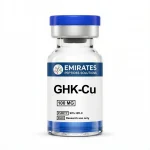
GHK-Cu is a small naturally-occurring tripeptide that carries a copper ion into cells — and copper is the cofactor that switches on dozens of repair-related enzymes.
GHK-Cu is a naturally occurring tripeptide-copper complex consisting of three amino acids — Glycine, Histidine, and Lysine (GHK) — chelated with a copper (II) ion. Its full chemical name is Copper(II) glycyl-L-histidyl-L-lysine. GHK-Cu is naturally present in human plasma, saliva, and urine, and is produced locally in skin following injury as part of the wound healing response.
GHK-Cu levels in plasma decline significantly with age — from approximately 200 ng/mL at age 20 to less than 80 ng/mL by age 60 — a decline that parallels the deterioration of skin quality, wound healing capacity, and tissue repair efficiency. This age-related decline has made GHK-Cu a central subject in skin aging and regenerative medicine research.

How Does GHK-Cu Work?
Latest research insights. No spam, ever.
Six parallel mechanisms — collagen synthesis, MMP regulation, antioxidant defence, gene expression, follicle stimulation, and wound healing — all triggered by a single copper-loaded tripeptide.
GHK-Cu operates through multiple complementary mechanisms that collectively make it one of the most multi-functional research peptides in dermatological science:
Collagen & elastin synthesis
Stimulates collagen types I, III, and IV plus elastin and proteoglycans — the structural proteins responsible for firmness, elasticity, and hydration.
MMP regulation
Regulates matrix metalloproteinases — clearing damaged tissue while inhibiting excessive MMP activity that degrades healthy collagen.
Antioxidant defence
Upregulates superoxide dismutase (SOD) and catalase, reducing oxidative damage from UV exposure and metabolic stress.
Gene expression
Modulates 4,192 of 13,424 human genes studied (Pickart 2018) — including repair, anti-inflammatory, and anti-cancer pathways.
Follicle stimulation
Stimulates VEGF and KGF expression in follicle research models, promoting follicle enlargement independently of DHT pathways.
Wound healing
Accelerates wound contraction, increases fibroblast activity, and promotes angiogenesis at injury sites by 2-3 fold.

Human genes modulated by GHK-Cu — approximately 31% of the 13,424 genes studied by Pickart and colleagues, an unprecedented breadth for any tripeptide.
GHK-Cu Research: Key Studies & Findings
Five decades, four major application areas — what the peer-reviewed literature actually says.
Skin Aging & Collagen Restoration
Multiple double-blind clinical studies have demonstrated GHK-Cu’s ability to reverse markers of skin aging. A landmark study published in the Journal of Cosmetic Dermatology (Leyden et al., 2002) showed that topical GHK-Cu significantly increased dermal thickness, collagen density, and skin firmness compared to placebo over a 12-week period. Skin biopsies confirmed increased collagen and elastin fibres in treated areas. A separate facial study (Finkey et al., 2005) demonstrated improvements in fine lines and wrinkle depth with daily topical application.

Gene Expression Research
One of the most striking findings in GHK-Cu research is its broad effect on gene expression. Analysis using the Broad Institute’s Connectivity Map showed GHK-Cu modulated 4,192 of 13,424 human genes — approximately 31% of the genes studied. The effect included upregulation of genes involved in tissue repair, anti-inflammatory response, and nervous system support, and downregulation of genes associated with cancer progression, inflammation, and neurodegeneration. This breadth of genomic effect is unprecedented for a tripeptide and forms the basis for GHK-Cu’s diverse research applications.
Wound Healing
Clinical research in wound healing has shown GHK-Cu significantly accelerates closure of chronic wounds, surgical incisions, and burns. A study in elderly patients with chronic diabetic ulcers showed GHK-Cu-treated wounds healed in a fraction of the control time. This is consistent with GHK-Cu’s ability to restore the wound healing capacity that declines with age — a key insight from Pickart’s original 1980s research showing that age-related decline in plasma GHK parallels impaired wound healing.

Hair Growth Research
GHK-Cu has been extensively studied for hair loss applications. Research demonstrates GHK-Cu stimulates hair follicle enlargement, increases follicle size, and promotes follicle growth factor production. Clinical studies with topical GHK-Cu formulations have shown improvements in hair density and thickness, with mechanisms attributed to VEGF upregulation, KGF stimulation, and DHT-independent follicle pathways — meaning GHK-Cu works through a fundamentally different mechanism than finasteride or minoxidil and may complement them in research stacks.

Who Uses GHK-Cu? Female vs Male Research Applications
GHK-Cu is studied across both audiences — with the literature skewing toward skin/anti-aging research (predominantly female focus) and hair/wound healing research (predominantly male focus).
Skin & anti-aging research
Collagen restoration, fine line reduction, dermal thickness, skin firmness, post-procedure recovery. Predominantly female interest.
Hair regrowth research
Follicle enlargement, density improvement, scalp microcirculation. Predominantly male interest, particularly androgenic-pattern research.
Wound & tissue repair
Surgical recovery, chronic wound research, scar minimisation. Applies across all research audiences.
Neuro & cognitive research
Gene-expression data suggests neuroprotective signalling. Earliest-stage research direction — fewer human studies.
Topical vs Injection — Which Route Is Used in Research?
Both routes appear in the literature. Topical dominates skin/hair research; subcutaneous and intradermal injection dominate systemic and wound-research protocols.
Topical (cream / serum)
Concentration typically 1-2% GHK-Cu. Studied for skin firmness, fine lines, scalp/hair. Slow onset, cumulative effect over 8-12 weeks.
Subcutaneous injection
Typical research dose 1-2 mg/day. Studied for systemic wound healing and gene-expression effects. Same delivery method as BPC-157.
Intradermal injection
Direct dermal injection. Used in mesotherapy research for facial collagen restoration. Higher local concentration than topical.

GHK-Cu Dosing Reference (Research)
Published research doses range from 1–50 mg depending on delivery route and application. The 50 mg vial is the standard for full-protocol research.
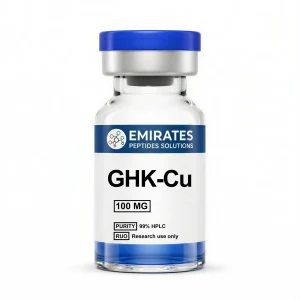
GHK-Cu has been studied via subcutaneous injection, topical application, and intradermal injection at doses ranging from 1–50 mg depending on the application. Emirates Peptides supplies GHK-Cu in 50 mg vials — the most comprehensive vial size for research protocols. Reconstitute with bacteriostatic water.
1-2 mg subcutaneous daily
Or 1-2% topical cream once or twice daily. Cycle: 8-12 weeks on, 4 weeks off.
2 mg topical scalp daily
Applied to dry scalp once daily. Minimum 12-week study window for follicle response.
2-5 mg subcutaneous daily
Higher dose for active tissue-repair research. Typical study window 4-8 weeks.
0.5-1 mg intradermal weekly
Used in localised facial research. Six-session protocol common.
Reconstitution & Storage
Reconstitution:
Add 2-5 mL bacteriostatic water to a 50 mg vial. 2 mL gives 25 mg/mL (a 1 mg dose = 4 IU on an insulin syringe).
Lyophilised storage:
2-8°C, protect from light. Stable until expiry date on vial.
Reconstituted storage:
2-8°C, use within 28 days. Solution should be clear blue (copper colour). Discard if cloudy.
Syringe:
29G or 31G insulin syringe, 0.3-0.5 mL capacity.

Expected Research Timeline
GHK-Cu is a slow-and-steady compound. Early surface effects appear in 2-4 weeks; the full collagen-restoration window is 8-12 weeks.
Hydration & tone
Subjective improvement in skin smoothness and hydration. No measurable collagen change yet.
Texture refinement
Visible reduction in fine lines and skin texture irregularities. Early hair/follicle response in scalp protocols.
Collagen & firmness
Peak collagen/elastin synthesis in published studies. Measurable dermal thickening and firmness improvement.
Maintenance phase
Continued application sustains the benefit. Studies show drop-off within 6-8 weeks of stopping topical.
Time-to-firmness window consistently reported across published topical GHK-Cu studies. Shorter for wound research; longer for hair-follicle endpoints.
Safety & Side-Effect Profile
Five decades of research show an exceptionally clean tolerability profile — but copper sensitivity and over-injection are the two known watch-outs.
GHK-Cu has an excellent safety profile across decades of research. It is naturally occurring in human plasma and has been studied extensively without significant adverse effects in research settings. The known watch-outs in the literature are:
Topical:
Mild local irritation, transient redness at application site. Resolves on its own.
Subcutaneous:
Injection-site soreness; mild blue discolouration at injection site (copper is naturally blue).
Copper sensitivity:
Subjects with Wilson’s disease or copper metabolism disorders should not be subjects in GHK-Cu research.
Chronic high doses:
Theoretical risk of copper accumulation with daily injection at 5+ mg for extended periods. Standard protocols cycle.
GHK-Cu in Research Blends
GHK-Cu pairs naturally with BPC-157 and TB-500 — the same combination shows up across skin-research and tissue-repair protocols.
GHK-Cu is a key component of two Emirates Peptides research blends:
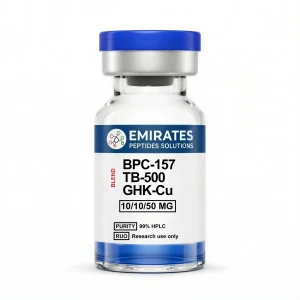
- Glow Blend — BPC-157 / TB-500 / GHK-Cu (10/10/50 mg) — skin regeneration and tissue repair focus
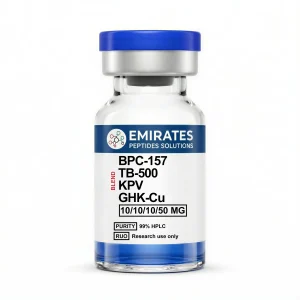
- Klow Blend — BPC-157 / TB-500 / KPV / GHK-Cu — systemic repair and anti-inflammatory focus

Where to Buy GHK-Cu in the UAE
Emirates Peptides supplies 50 mg GHK-Cu vials with HPLC verification and same-day Dubai delivery.
- ✅ COA-verified, ≥99% HPLC purity
- ✅ 50 mg high-value vials (most comprehensive vial size for research protocols)
- ✅ Fast delivery to Dubai, Abu Dhabi and all UAE emirates
- ✅ GCC shipping available
- ✅ Cash on delivery in Dubai
- ✅ Ziina UAE payments + bank transfer + cryptocurrency
Frequently Asked Questions
Quick answers to the questions researchers ask most.
Is GHK-Cu safe for skin research?
GHK-Cu has an excellent safety profile across decades of research. It is naturally occurring in human plasma and has been studied extensively in both topical and injectable forms without significant adverse effects in research settings. The most common observation in topical studies is mild transient local irritation.
Does GHK-Cu work for hair loss research?
Yes — multiple studies have demonstrated GHK-Cu promotes hair follicle growth factors (VEGF, KGF) and follicle enlargement in research models. It works through a DHT-independent pathway, meaning it complements rather than overlaps with finasteride mechanisms. Clinical research uses 12-week scalp topical protocols.
Is GHK-Cu used by men or women?
Both. GHK-Cu is genuinely dual-audience. The skin-aging and anti-aging research is predominantly female-interest; the hair-regrowth and wound-healing research is predominantly male-interest. The peptide is identical for both — only the application protocol and goals differ.
Topical or injection — which is better in research?
It depends on the research endpoint. Topical (1-2% cream) is used for surface skin and scalp/hair research. Subcutaneous injection (1-2 mg/day) is used for systemic effects and wound-healing research. Intradermal injection (mesotherapy) is used for localised facial collagen research. Each route has 20+ years of published literature.
How long until GHK-Cu shows results in research?
Hydration and tone changes are subjectively reported at 1-2 weeks. Visible fine-line reduction at 4-6 weeks. Peak collagen and elastin synthesis in published studies at 8-12 weeks. Wound-healing endpoints accelerate within 1-2 weeks of treatment initiation in chronic-wound research.
Why does GHK-Cu turn the solution blue?
Blue colour is the signature of copper coordination chemistry. Properly synthesised GHK-Cu reconstitutes to a clear sky-blue or royal-blue solution. Colourless, green, or cloudy solutions indicate impurity, non-copper-bound peptide, or degradation — and should not be used in research.
Can GHK-Cu be stacked with BPC-157 and TB-500?
Yes — this is the classic Glow Blend (BPC-157 + TB-500 + GHK-Cu) stack widely used in tissue-repair and skin-regeneration research. The three peptides act through complementary mechanisms: BPC-157 (angiogenesis), TB-500 (actin/cell migration), GHK-Cu (collagen synthesis and gene expression).
How is GHK-Cu different from regular copper supplements?
Oral copper supplements raise systemic copper levels but cannot deliver copper to specific tissues in a regulated way. GHK-Cu is the natural transport molecule that carries copper to cells with intrinsic targeting — including direct activation of the gene-expression and collagen-synthesis pathways that pure copper alone cannot trigger.
Is GHK-Cu legal in the UAE?
GHK-Cu is supplied strictly for laboratory research and is not a controlled substance in the UAE. Emirates Peptides supplies it under research-use-only terms with a batch-specific HPLC Certificate of Analysis for every vial.
What’s the difference between GHK and GHK-Cu?
GHK is the bare tripeptide (Glycyl-L-Histidyl-L-Lysine). GHK-Cu is GHK chelated with a copper(II) ion. Almost all the biological activity documented in the literature is for the copper-bound form — the copper is what activates the collagen, gene-expression, and wound-healing pathways. Plain GHK without copper has limited research-relevant activity.
References & Further Reading
Primary literature underpinning this research summary.
- Pickart L, Margolina A. Regenerative and protective actions of the GHK-Cu peptide in the light of the new gene data. International Journal of Molecular Sciences. 2018;19(7):1987. PubMed: 29986520
- Pickart L, Vasquez-Soltero JM, Margolina A. GHK and DNA: Resetting the human genome to health. BioMed Research International. 2014;2014:151479. PubMed: 25197631
- Pickart L. The human tri-peptide GHK and tissue remodeling. Journal of Biomaterials Science Polymer Edition. 2008;19(8):969-988. PubMed: 18644225
- Leyden JJ et al. Skin care benefits of copper peptide-containing facial cream. American Academy of Dermatology Meeting. 2002.
- Finkey MB, Appa Y, Bhandarkar S. Copper peptide and skin. In: Cosmeceuticals and Active Cosmetics. CRC Press. 2005.
- Mulder GD et al. Enhanced healing of ulcers in patients with diabetes by topical treatment with glycyl-l-histidyl-l-lysine copper. Wound Repair and Regeneration. 1994;2(4):259-269.
- Pickart L et al. GHK-Cu may prevent oxidative stress in skin by regulating copper and modifying expression of numerous antioxidant genes. Cosmetics. 2015;2(3):236-247.
Research-use-only disclaimer: All content on this page is provided as a research summary for laboratory professionals and educational reference. GHK-Cu is not approved by any regulatory authority for human therapeutic, prophylactic, or diagnostic use. This is not medical advice. Statements regarding research outcomes refer to published peer-reviewed studies; individual research results vary.
Was this article helpful?

🔬 Related Research Peptides
Explore Research-Grade Peptides
HPLC-verified, lab-tested peptides for your scientific research. Fast delivery across the UAE.
Browse All PeptidesRelated Articles



Emirates Peptides Research Team
A dedicated coalition of biochemists and clinical researchers focusing on advanced peptide synthesis and pharmacological applications. All data is verified against current clinical trials.
FROM INSTAGRAM