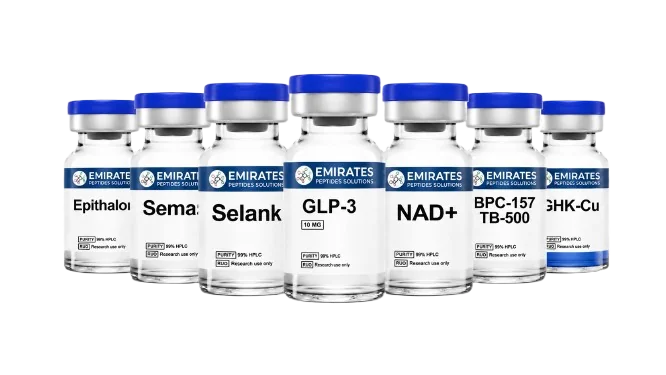

Blog


For research use only. The GLP-3 Research Pen is a catalogue presentation for laboratory research and is not for human or veterinary use.
- GLP-1 and “GLP-3” are not the same thing
- Key facts before you read further
- Five terms that are easy to confuse
- What does GLP-1 do in the body?
- Why are these products often supplied as pens?
Beginner guide · Updated 29 July 2026 · UAE research education
GLP-1 and “GLP-3” are not the same thing
People often group GLP pens, Mounjaro and triple-receptor research together. This quick map separates natural biology, named medicines and the Emirates Peptides catalogue label.
GLP-1
- A naturally occurring peptide hormone in the body.
- GLP-1 receptor signalling is the biological pathway.
- Some named medicines are designed to act at the GLP-1 receptor.
- GLP-1 is not the name of one universal pen or product.
“GLP-3” label
- An informal catalogue label used for a research presentation.
- Associated here with triple-receptor research concepts.
- Not the recognised name of a third natural GLP hormone.
- The label alone does not prove retatrutide—or any molecular identity.
Where the familiar names fit
Semaglutide
A named medicine that acts at the GLP-1 receptor. Its evidence belongs to semaglutide—not every “GLP” product.
Mounjaro / tirzepatide
Mounjaro is a brand name for tirzepatide, a named dual GIP and GLP-1 receptor medicine.
Retatrutide
A named investigational GLP-1, GIP and glucagon receptor agonist—not an automatic identity for “GLP-3.”
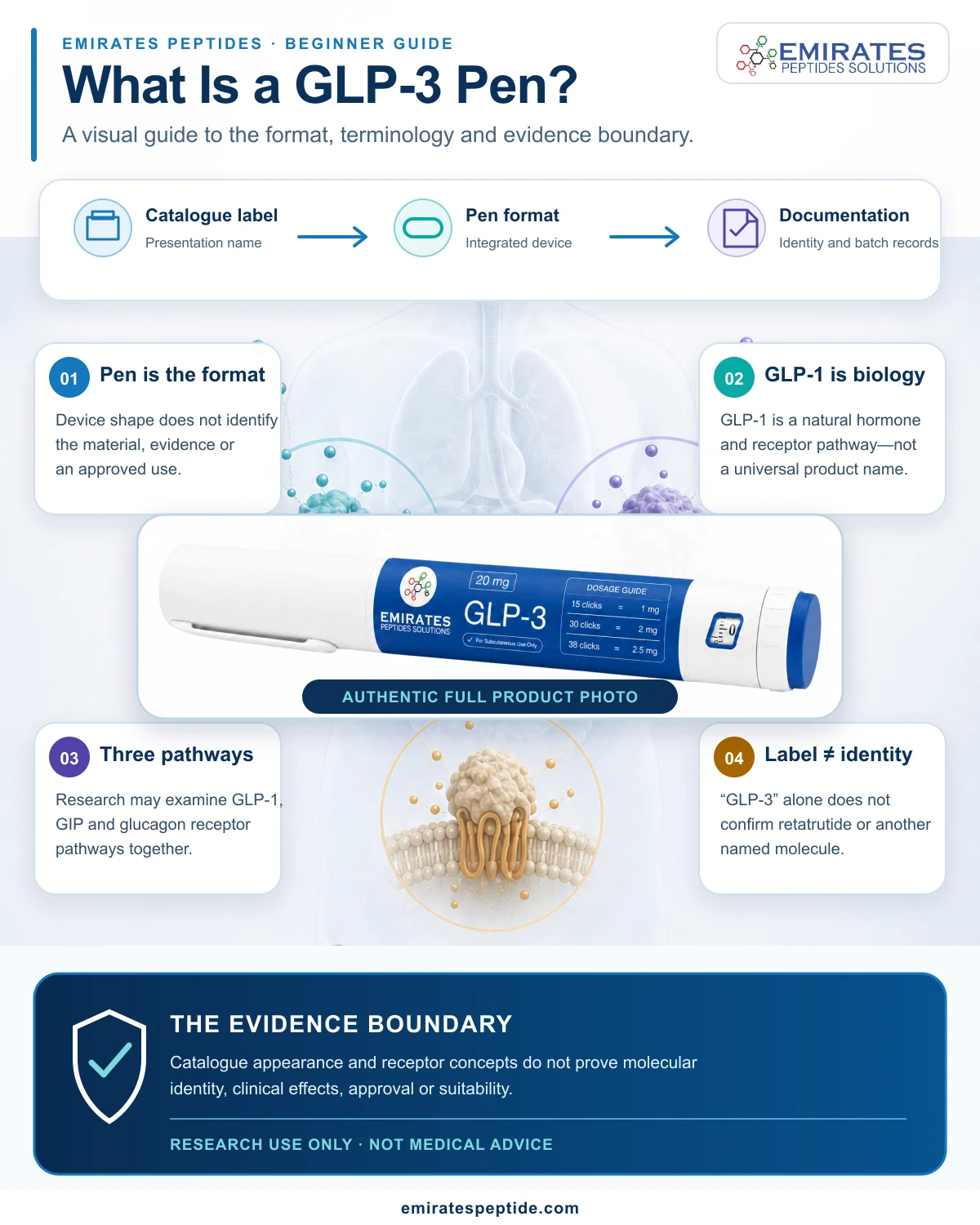
Key facts before you read further
Choose a familiar term, then open the cards that answer the most common questions.

Natural biologyGLP-1 is a naturally occurring peptide hormone and receptor pathway.
- Receptor scope
- GLP-1 receptor
- Evidence category
- Established biology; each named medicine has separate evidence
- Do not assume
- GLP-1 is one universal product or pen

Named medicineSemaglutide is a specific GLP-1 receptor agonist used in named medicines.
- Receptor scope
- GLP-1 receptor
- Evidence category
- Exact product labels, populations and clinical studies
- Do not assume
- Its evidence applies to every product described as “GLP”

Brand and named medicineMounjaro is a brand name for tirzepatide.
- Receptor scope
- GIP and GLP-1 receptors
- Evidence category
- Tirzepatide studies and the exact local product label
- Do not assume
- Mounjaro, semaglutide and “GLP-3” are interchangeable

Named investigational candidateRetatrutide is a specifically identified investigational triple-receptor agonist.
- Receptor scope
- GIP, GLP-1 and glucagon receptors
- Evidence category
- Candidate-specific published research
- Do not assume
- Every triple-receptor catalogue label identifies retatrutide

Catalogue terminology“GLP-3” is used here as an informal research catalogue label.
- Research association
- Triple-receptor research concepts
- Evidence category
- Batch and product documentation—not evidence borrowed from a named medicine
- Do not assume
- A third natural GLP hormone or automatic retatrutide identity
 Different terms. Different meanings.01 · TerminologyDifferent names ≠ the same thingGLP-1, named medicines and “GLP-3” describe different concepts.

Separate the natural hormone and pathway, a medicine class, a named medicine, an investigational candidate and a catalogue label before comparing evidence.
 Pen format ≠ identity or evidence02 · PresentationA pen is only a formatThe device shape cannot identify the evidence behind its contents.

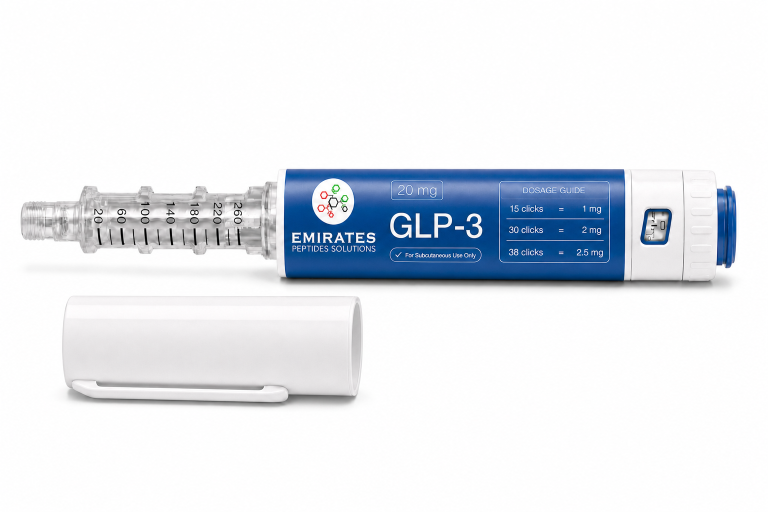
A pen can describe presentation and packaging. It does not, by appearance alone, establish molecular identity, approval, clinical effects, purity, sterility or intended use.
Named material → defined study → bounded finding03 · EvidenceEvidence follows the exact moleculeBenefits cannot jump from one medicine or study to another product.
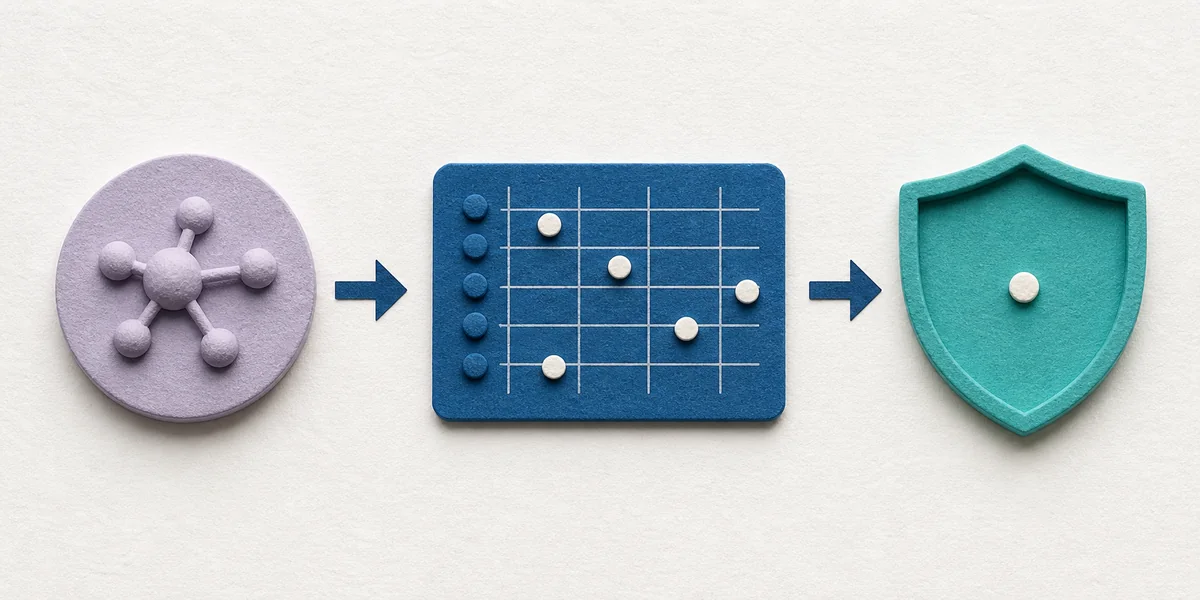
Appetite, blood-glucose, body-weight or other outcomes must remain attached to the exact named molecule, study population, protocol and jurisdiction.
Study measurement points ≠ your timeline04 · Study timingStudy length ≠ a personal timelineA measurement at week 48 or 72 is a research endpoint—not a promise.

Trials use different populations, endpoints and measurement dates. A group average at a particular week cannot predict an individual result or another product’s behaviour.
Study measurement≠Your timeline
Cannot be predicted here
Three clocks. Three different questions.05 · Three clocksTiming terms measure different thingsHalf-life, labelled schedule and study duration are not interchangeable.

Research catalogue ≠ personal treatment06 · Research statusThe Emirates pen is research-onlyIt is not presented as a prescribed diabetes or weight-management medicine.

The Emirates Peptides GLP-3 Research Pen is a laboratory catalogue presentation. It is not for human or veterinary use and does not carry a treatment indication.
Verify the exact product and current UAE information07 · UAE contextCheck the exact named product and current local statusApproval cannot be inferred from a familiar name, international article or pen shape.

For Dubai, Abu Dhabi and the wider UAE, regulatory status must be checked against the current UAE authority and the exact local product information. This guide does not confirm UAE approval for any medicine.
03 · Beginner guide
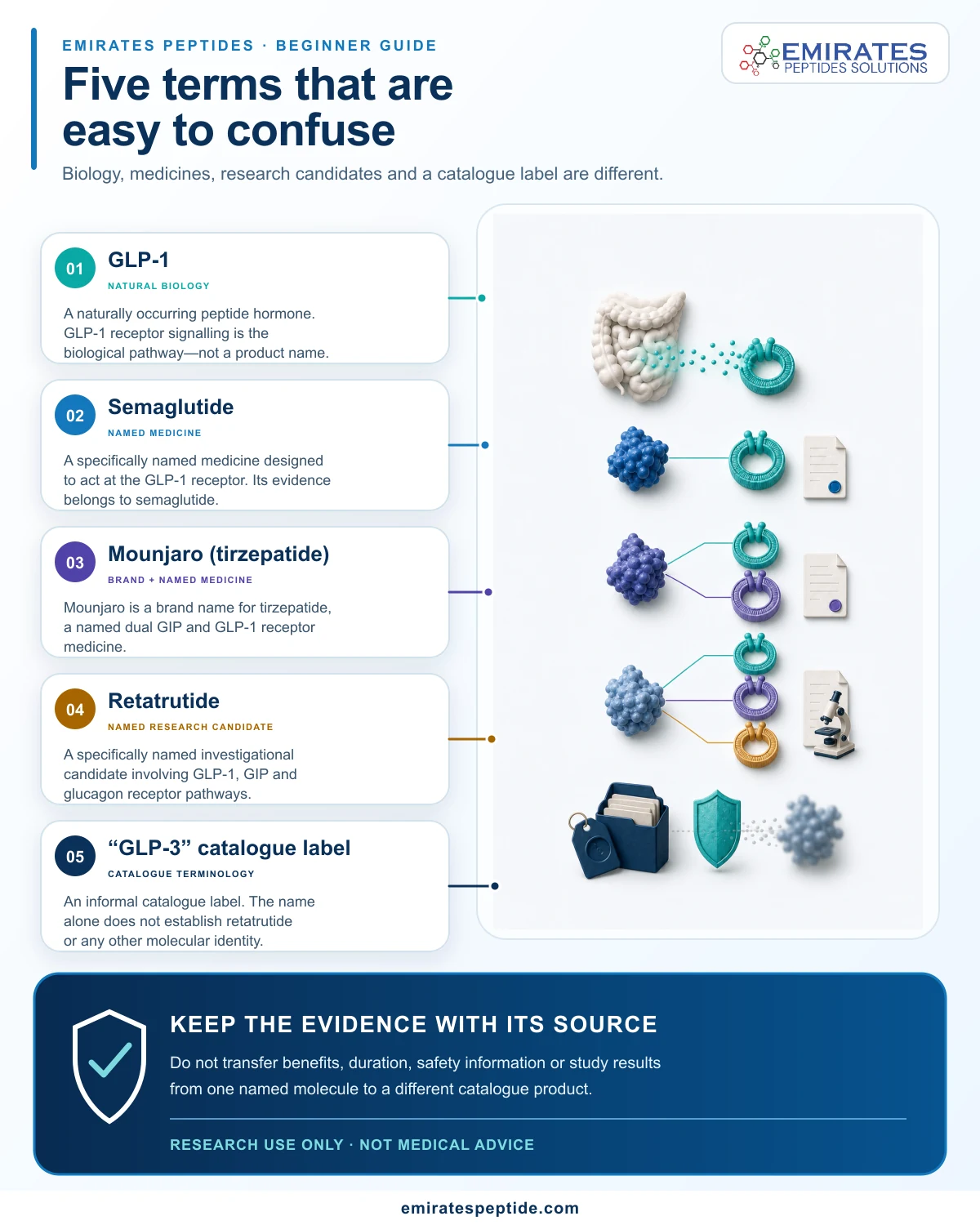
Five terms that are easy to confuse
Latest research insights. No spam, ever.
Use the surrounding explanation and cited source for the full context.
People often use “GLP” as if it were one product. It is better to separate the pathway, the medicine class, the named medicines and the research label.
| Term | What it actually means | Receptor scope | Evidence or status | What you should not assume |
|---|---|---|---|---|
| GLP-1 | A naturally occurring peptide hormone; GLP-1 receptor signalling is also the basis of a medicine class | GLP-1 receptor | Established biology; named medicines have their own evidence | GLP-1 is not a product name |
| Semaglutide | A specific GLP-1 receptor agonist used in named medicines | GLP-1 receptor | Approved for particular uses under specific product labels and jurisdictions | Its label does not apply to tirzepatide, retatrutide or a GLP-3 catalogue product |
| Mounjaro (tirzepatide) | A named medicine containing tirzepatide | GIP and GLP-1 receptors | The current US Mounjaro label covers type 2 diabetes in defined populations | Mounjaro is not a generic name for every GLP pen |
| Retatrutide | A specifically identified investigational molecule | GIP, GLP-1 and glucagon receptors | Studied in named clinical trials; still investigational as of July 2026 | Retatrutide results do not identify another material |
| GLP-3 catalogue label | An informal research-product label associated with three receptor pathways | Intended scope cannot be confirmed from the name alone | Requires product and batch documentation | It is not automatically retatrutide or an approved medicine |
This distinction is not a technicality. It prevents a result from one medicine or clinical candidate being copied onto a different product simply because both are supplied in pen-shaped devices.
04 · Beginner guide
What does GLP-1 do in the body?
Use the surrounding explanation and cited source for the full context.
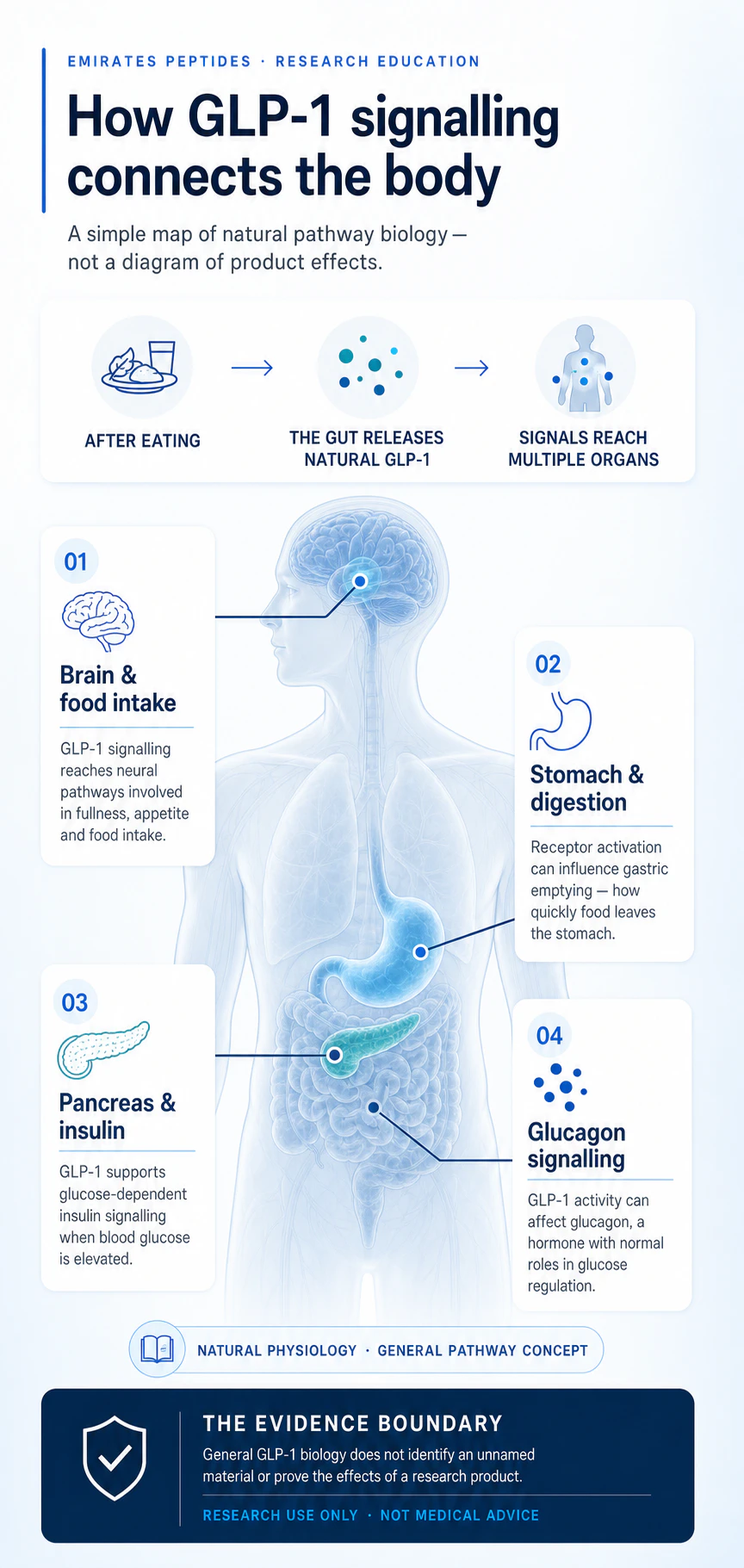
GLP-1 stands for glucagon-like peptide-1. It is a hormone released from the gut after eating. It forms part of the body’s communication system between the digestive tract, pancreas and brain.
Four ideas help explain why the pathway receives so much attention:
Brain and fullness
GLP-1 signalling reaches areas involved in appetite and food intake. This is one reason named GLP-1 medicines have been studied for body-weight management. It does not mean that every product using “GLP” in its name has a proven effect on appetite.
Stomach and digestion
GLP-1 receptor activation can slow gastric emptying, especially early in treatment with some named medicines. Gastric emptying describes how quickly food leaves the stomach. The degree and duration of this effect can differ between products and over time.
Pancreas and insulin
GLP-1 can support insulin secretion when blood glucose is elevated. The phrase “glucose-dependent” matters: the pathway’s behaviour depends partly on the glucose environment rather than acting like a simple on/off insulin switch.
Glucagon signalling
GLP-1 activity can also affect glucagon, a hormone involved in maintaining blood glucose. Glucagon is not simply “bad.” It has normal physiological roles, and this becomes particularly relevant when researchers study molecules that deliberately include glucagon-receptor activity.
These are general pathway concepts. They explain why GLP-1 biology is scientifically and medically important, but they do not establish the identity or clinical effect of an unidentified research material.
05 · Beginner guide
Why are these products often supplied as pens?
A pen can make a product look familiar because approved medicines such as some semaglutide and tirzepatide presentations also use pen devices. But the shape of the container does not determine what the product is.
A pen may combine a cartridge, protective body and external label. This can make the item easier to identify, inventory and visually inspect. It does not answer the questions that matter most:
- What is the exact molecule?
- Does the batch match its documentation?
- What does the purity result actually measure?
- Has concentration been independently verified?
- Is there evidence for stability, sterility or biological activity?
- What regulatory status applies to this exact product?
Two pens can look similar while containing different substances. Start with the exact product name and documentation, not the device shape.
06 · Beginner guide
Single, dual and triple receptor scope
Use the surrounding explanation and cited source for the full context.
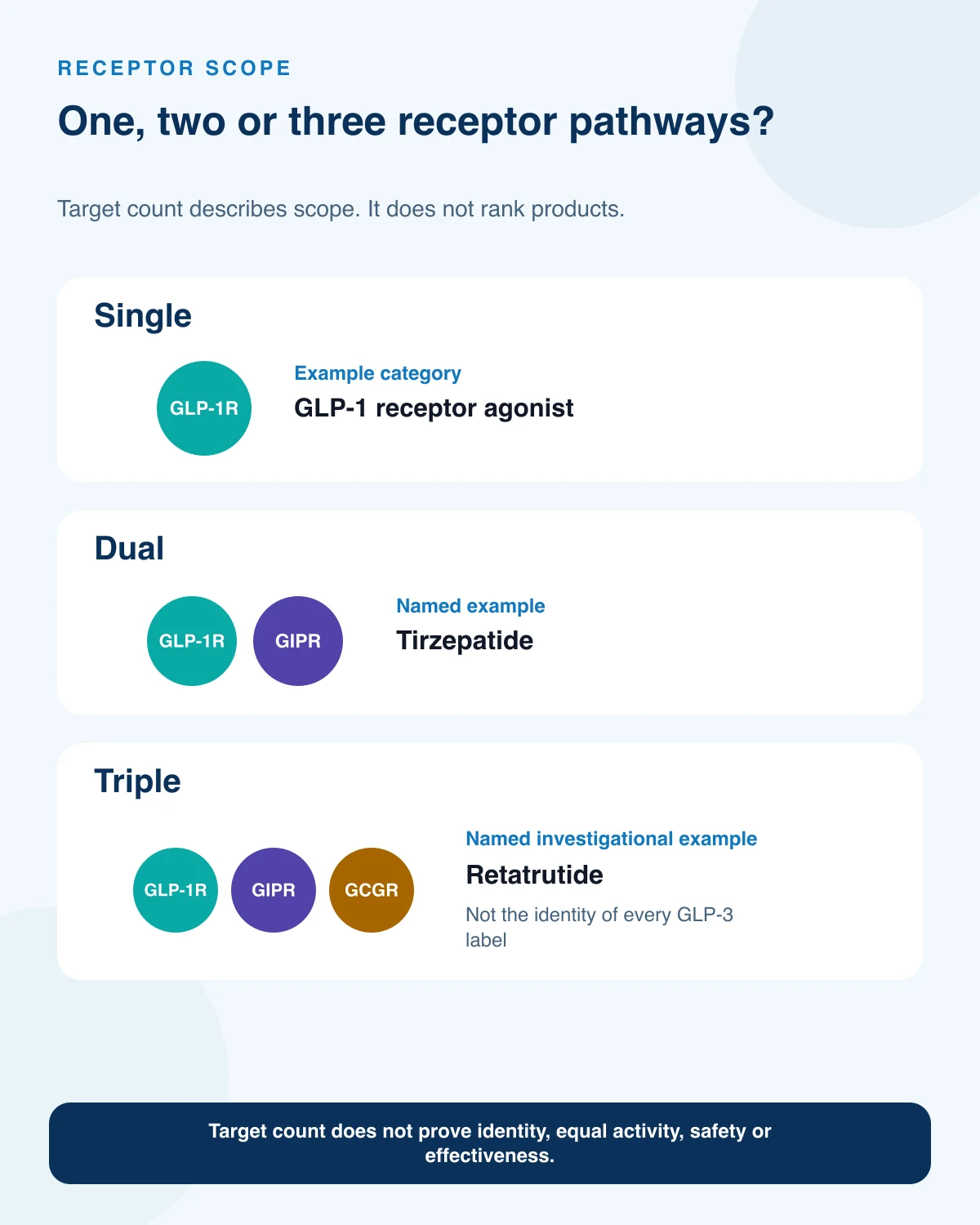
A receptor is a structure that receives a biological signal. An agonist is a molecule that activates a receptor. The terms single, dual and triple describe how many receptor pathways a named molecule is designed to engage.
Single-receptor example: semaglutide is a GLP-1 receptor agonist.
Dual-receptor example: tirzepatide activates GIP and GLP-1 receptors.
Triple-receptor example: retatrutide is designed to activate GIP, GLP-1 and glucagon receptors.
“Triple” does not automatically mean stronger, better or safer. A molecule can have a different balance of activity at each receptor. Researchers must measure that balance in defined assays. The number of targets alone does not reveal the molecule, its potency or its clinical value.
This is also why the name GLP-3 can be misleading. It looks as though it should mean “the third GLP,” but that is not its accepted meaning in human physiology. In this catalogue context, it points to a triple-pathway research idea. The exact material still requires its own evidence.
07 · Beginner guide
What benefits do people hear about?
Use the surrounding explanation and cited source for the full context.
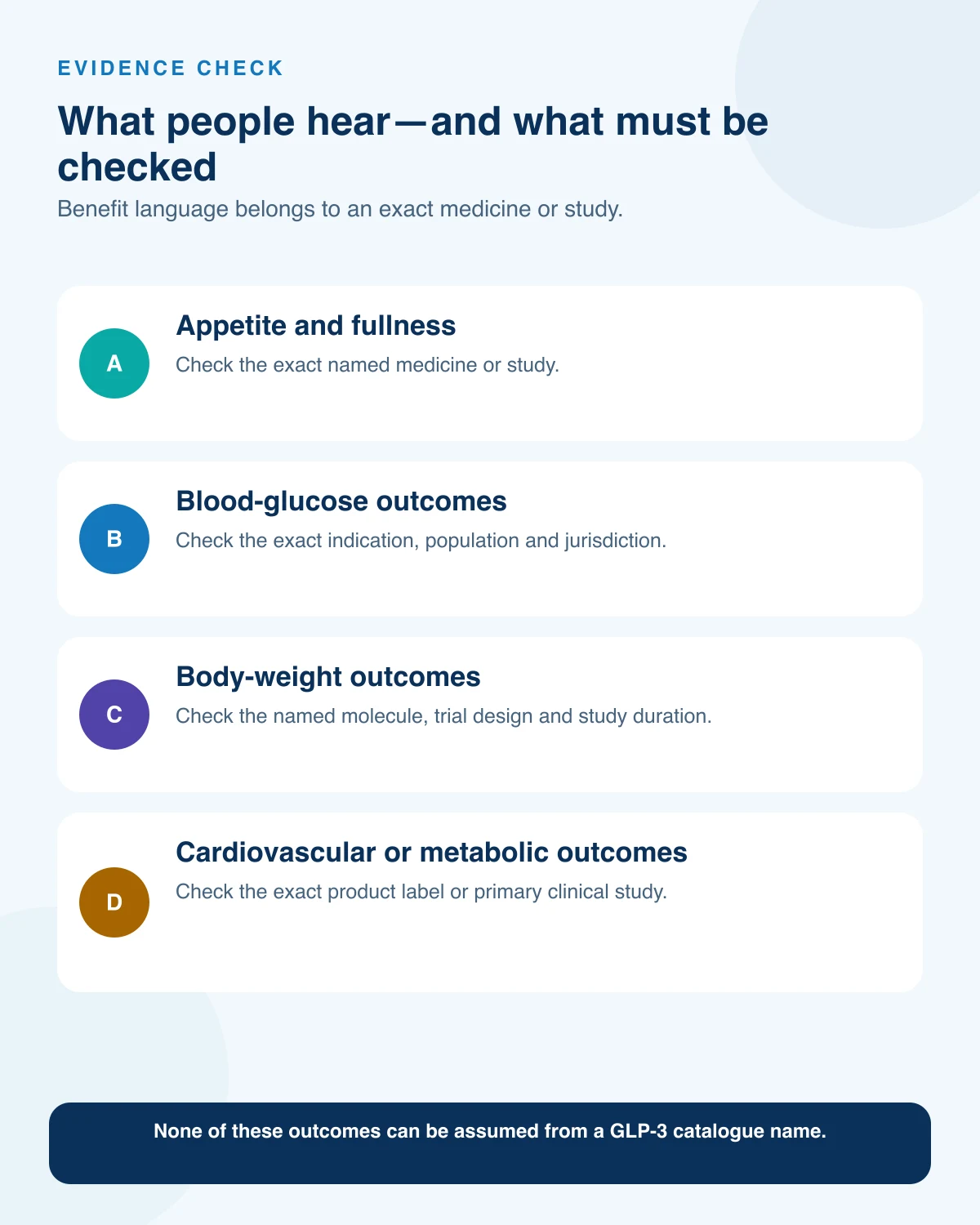
Online conversations often group several outcomes together: feeling fuller, improved glucose measurements, body-weight reduction and cardiovascular benefits. Those topics do not belong to every product carrying a similar-looking name.
Appetite and fullness
Named GLP-1 and dual GIP/GLP-1 medicines have been studied for their effects on appetite and food intake. The effect must be attributed to the exact medicine, population and study. It cannot be advertised as a benefit of the Emirates GLP-3 Research Pen.
Blood-glucose outcomes
Some named medicines are approved for type 2 diabetes in particular jurisdictions. For example, the January 2026 US Mounjaro prescribing information identifies tirzepatide as a GIP and GLP-1 receptor agonist indicated, alongside diet and exercise, to improve glycaemic control in defined people with type 2 diabetes. That is a statement about Mounjaro under a US label, not a blanket statement about GLP pens in the UAE.
Body-weight outcomes
Semaglutide, tirzepatide and retatrutide have each been studied in their own programmes. They are not the same molecule, and the studies used different populations, comparators, durations and protocols. A percentage reported in one trial is not a prediction for another medicine, and it is certainly not evidence for an unidentified catalogue product.
Cardiovascular and other metabolic outcomes
Some specific products have official indications or published outcome trials covering cardiovascular risk or other metabolic endpoints. The exact product label matters. “GLP medicines may have cardiovascular benefits” is too broad unless the article names the medicine, source, population and endpoint.
The safe way to read a benefit claim is to ask four questions: Which molecule? Which product label or study? Which population? Which jurisdiction?
08 · Beginner guide
Are GLP medicines used for diabetes?
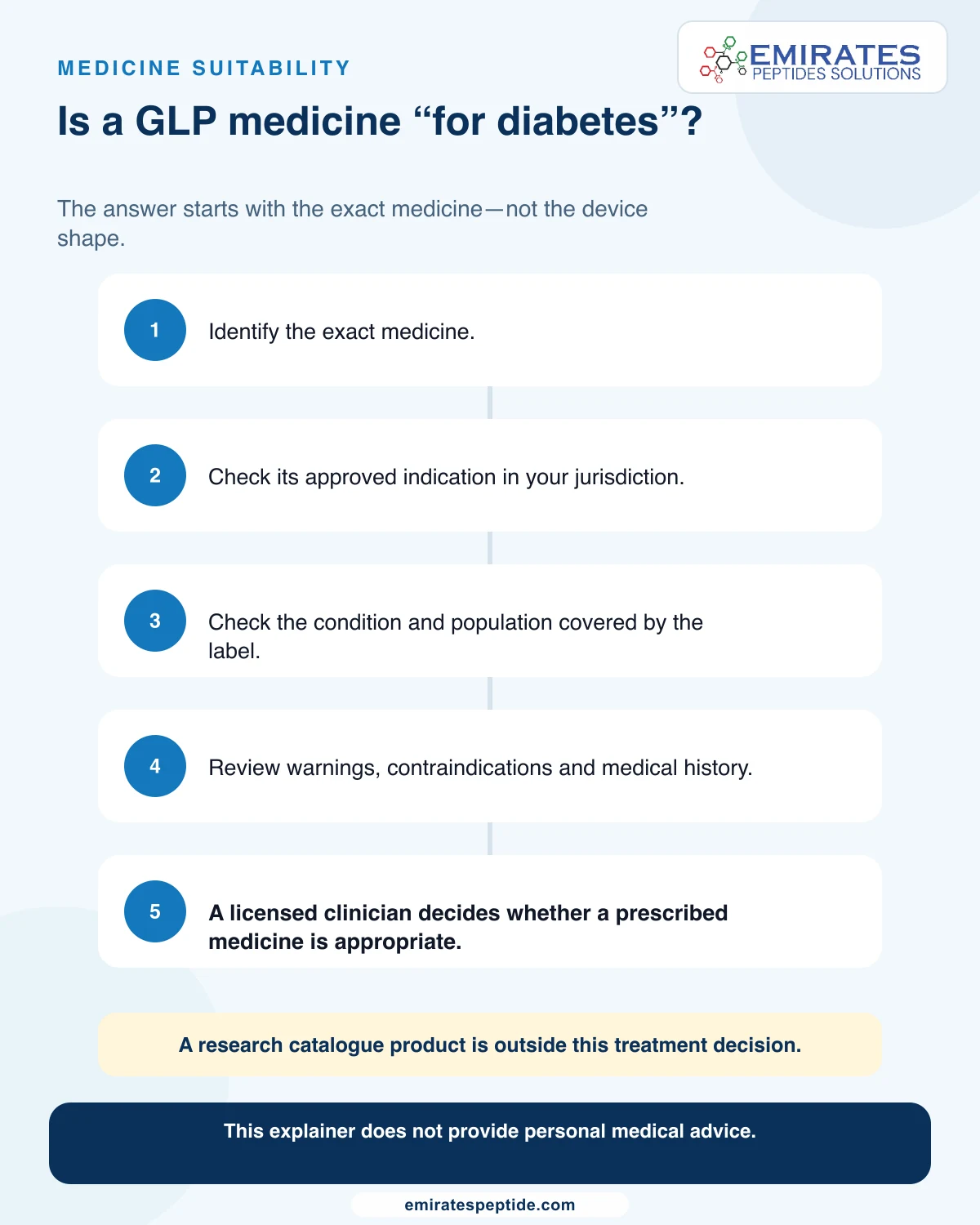
Use the surrounding explanation and cited source for the full context.
Some named GLP-related medicines are used for type 2 diabetes, but not every GLP medicine has the same indication, and a research pen is not part of a treatment decision.
Type 2 diabetes involves problems with glucose regulation, including insulin resistance and changes in insulin secretion. GLP-1 receptor medicines can support glucose-dependent insulin signalling, while tirzepatide combines GIP and GLP-1 receptor activity. Their approved uses, age groups, warnings and contraindications are set out in their own product information.
Type 1 diabetes is a different condition involving autoimmune loss of insulin-producing beta cells. Readers should not assume that information about type 2 diabetes applies to type 1 diabetes.
For a person asking, “Could a GLP medicine be suitable for me?”, the correct route is:
- Identify the exact approved medicine.
- Check the current indication in the relevant country.
- Review the diagnosis, medical history, other medicines and contraindications.
- Discuss the decision with a licensed clinician.
This article cannot perform that assessment. More importantly, the process above does not turn the Emirates GLP-3 Research Pen into a diabetes product. It remains a research-only catalogue item.
09 · Beginner guide
How long do GLP medicines last?
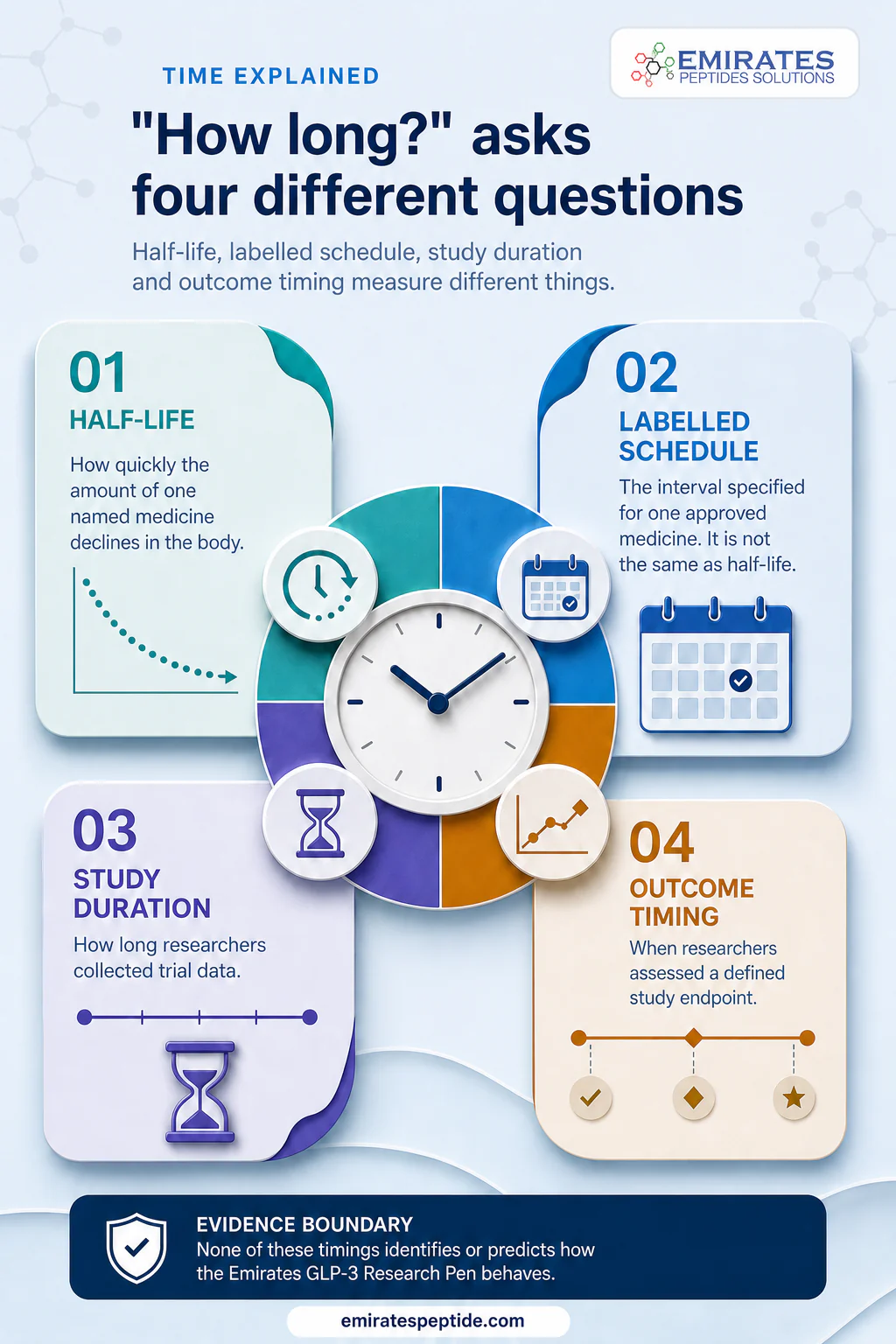
Use the surrounding explanation and cited source for the full context.
“How long does it last?” sounds like a simple question, but it can refer to at least four different things.
Half-life
Half-life is the time required for the amount of a named drug in the body to fall by roughly half. The 2026 US Wegovy label describes semaglutide as having an elimination half-life of approximately one week. The 2026 US Mounjaro label describes tirzepatide as having a half-life of approximately five days.
Those figures help explain the pharmacokinetics of those named medicines. They do not tell us how a product labelled GLP-3 behaves.
Labelled dosing interval
The schedule on an approved medicine’s label is not the same as its half-life. This article does not reproduce dosing or administration instructions.
Study duration
A clinical trial may follow participants for 40, 48 or 72 weeks. That number tells you how long the study collected data. It does not mean an individual will experience a particular outcome at the same time.
Outcome timeline
Researchers choose specific times to measure changes in glucose, body weight or other endpoints. A result at week 24 and a result at week 48 answer different questions. Study averages also hide variation between participants.
There is therefore no responsible evidence-based answer to “How long does the Emirates GLP-3 Pen work?” The catalogue name and pen format do not establish pharmacokinetics, labelled frequency or clinical duration.
10 · Beginner guide
What has retatrutide research reported?
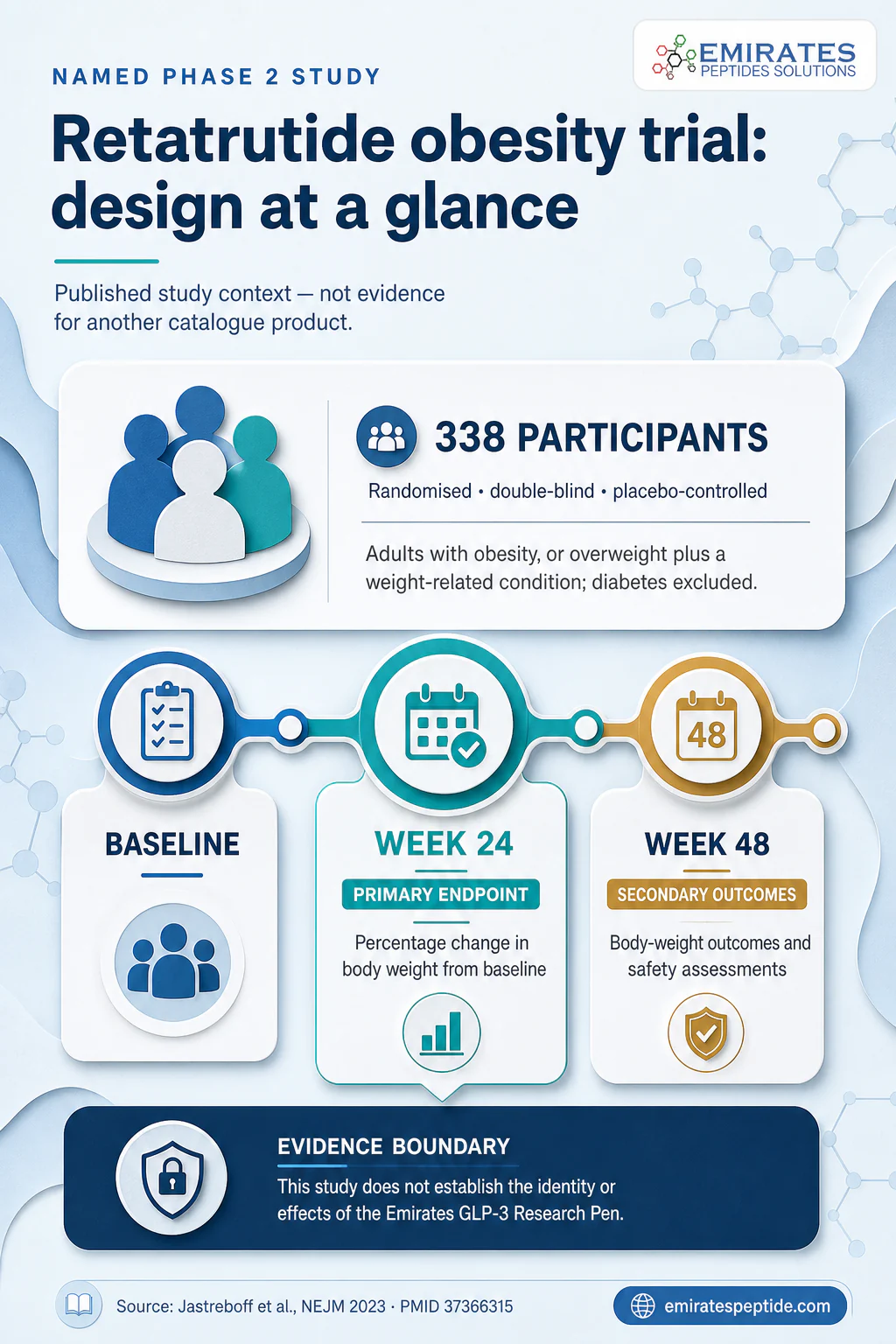
Use the surrounding explanation and cited source for the full context.
Retatrutide is relevant because it is a named triple agonist. It is not relevant as proof of what is inside every product labelled GLP-3.
In the 2023 phase 2 trial titled Triple-Hormone-Receptor Agonist Retatrutide for Obesity – A Phase 2 Trial, 338 adults were followed for 48 weeks. The study reported changes in body weight across specified retatrutide groups and placebo. Gastrointestinal events were the most common adverse events, and dose-dependent increases in heart rate were observed.
The study tells us about retatrutide in that population, under that protocol. It does not authenticate a catalogue product, prove batch identity or predict what another material will do.
As of July 2026, Lilly continues to describe retatrutide as investigational and not approved by any regulatory agency. Sponsor announcements about Phase 3 programmes may be useful updates, but a press release is not the same as a complete peer-reviewed report.
For readers, the practical rule is simple: if a graph comes from a retatrutide trial, its title, source and warning should all say retatrutide. It should never be captioned as a result of “the GLP-3 Pen.”
11 · Beginner guide
Side effects and warnings
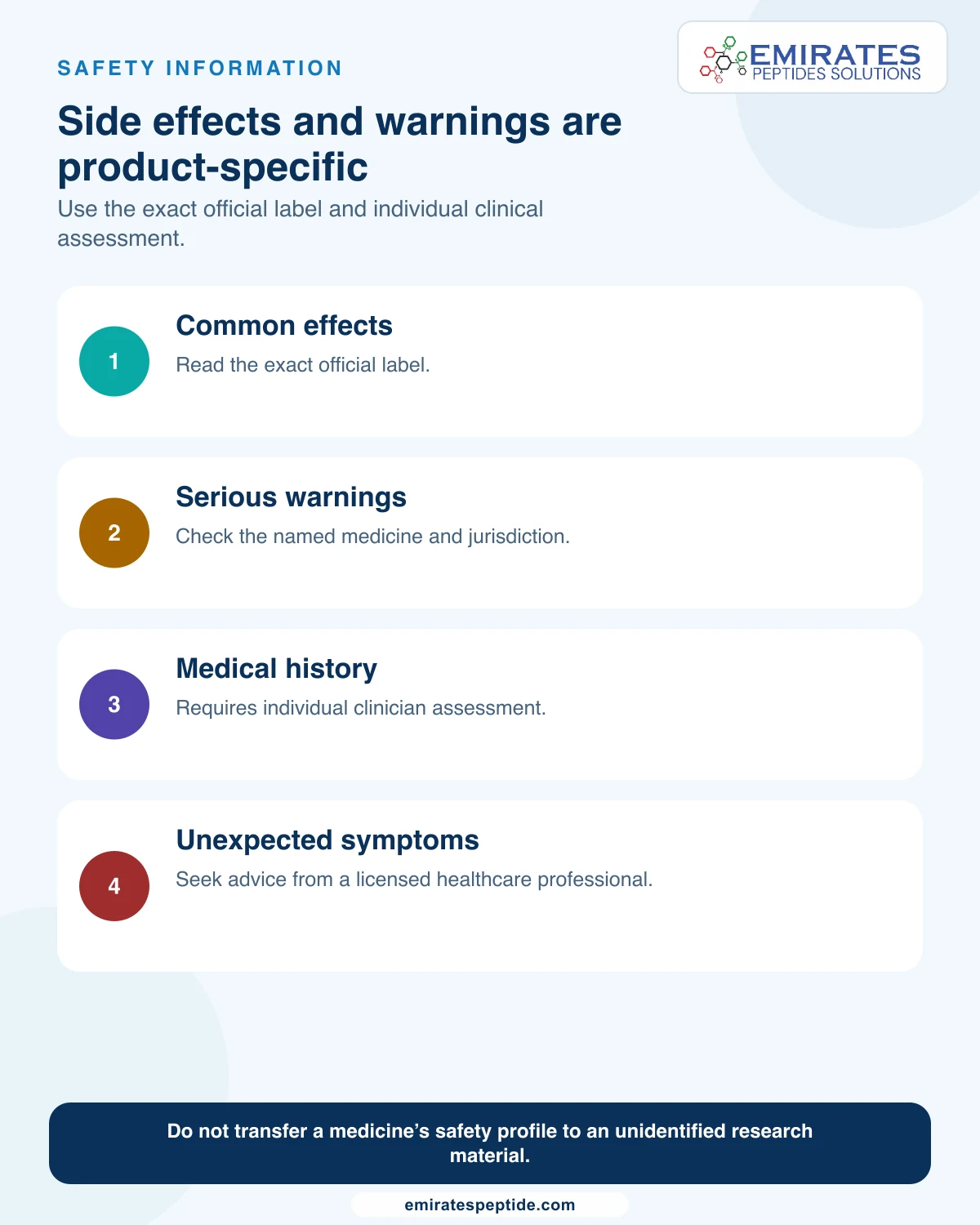
Use the surrounding explanation and cited source for the full context.
Named GLP-1 and GIP/GLP-1 medicines can cause side effects, but the details vary by product and label. Commonly reported effects in major trials and official labels include gastrointestinal symptoms such as nausea, diarrhoea, vomiting, constipation or abdominal discomfort.
Official labels also contain more serious warnings and contraindications. Depending on the exact medicine, these can cover matters such as pancreatitis, gallbladder disease, dehydration-related kidney problems, severe gastrointestinal reactions, hypoglycaemia when combined with certain glucose-lowering medicines, hypersensitivity and specific thyroid-tumour warnings based on rodent findings.
This is not a complete safety list. A person considering an approved medicine needs the current local product information and an individual clinical assessment. Pregnancy, medical history, other medicines and the reason for treatment can materially change that assessment.
A named medicine’s safety information also cannot be used to declare an unidentified material safe. “Similar pathway” does not mean identical composition, manufacturing quality, pharmacokinetics or adverse-effect profile.
12 · Beginner guide
Who can use an approved GLP medicine?
There is no single answer for the whole category. Eligibility depends on the exact medicine and the indication approved in the relevant jurisdiction.
One named product may have an indication for type 2 diabetes. Another may have a weight-management indication for adults meeting specific criteria. A different product may have additional cardiovascular or metabolic indications. The same active ingredient can also appear under different brand names with different labels.
A clinician reviews much more than a person’s interest in weight loss. The assessment can include diagnosis, age, body-mass criteria where relevant, previous treatment, gastrointestinal history, pancreatic or gallbladder history, kidney function, pregnancy considerations, family history, current medicines and the risk of interactions or hypoglycaemia.
This section is about approved medicines. It does not identify anyone who should use the Emirates GLP-3 Research Pen, which is not for personal use.
13 · Beginner guide
Why evidence cannot jump between products
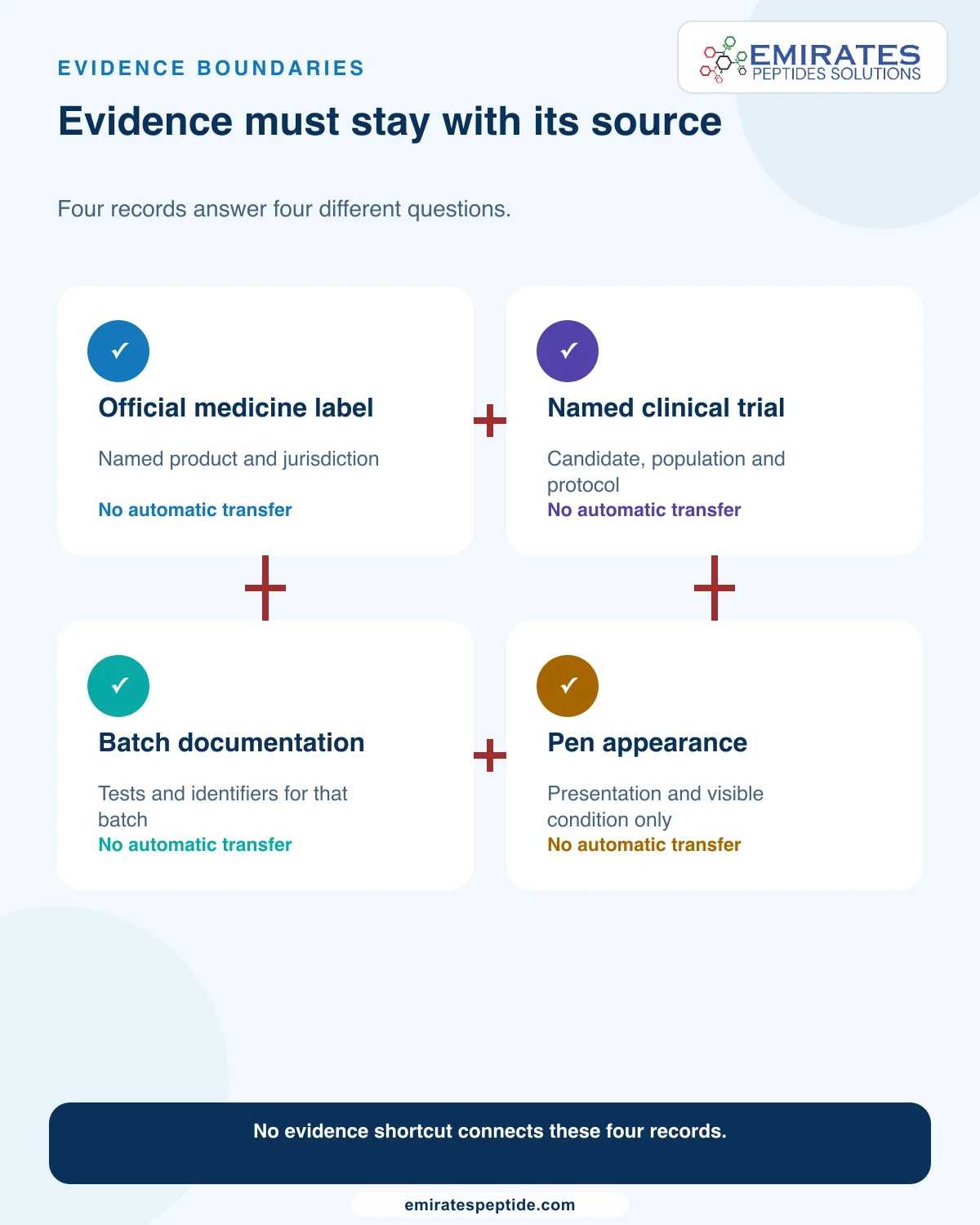
Use the surrounding explanation and cited source for the full context.
Four kinds of evidence often appear together online, even though they answer different questions.
| Evidence source | What it can support | What it cannot support by itself |
|---|---|---|
| Official medicine label | Current authorised uses, warnings and pharmacology for that named product in that jurisdiction | Claims about a different medicine, jurisdiction or research product |
| Named clinical trial | Results and adverse events for the studied candidate, population and protocol | Guaranteed individual outcomes or equivalence to another material |
| Product and batch documentation | Reported identity, purity, concentration or traceability information for the specified batch, depending on the tests supplied | Clinical effectiveness, medical suitability or another batch’s quality |
| Pen photograph or visual inspection | External presentation, visible label and obvious physical damage | Molecular identity, purity, sterility, activity, approval or safety |
This separation protects readers from a common online shortcut: starting with a result from semaglutide, tirzepatide or retatrutide and ending with a sales claim for a different product.
14 · Beginner guide
The Emirates Peptides GLP-3 Research Pen
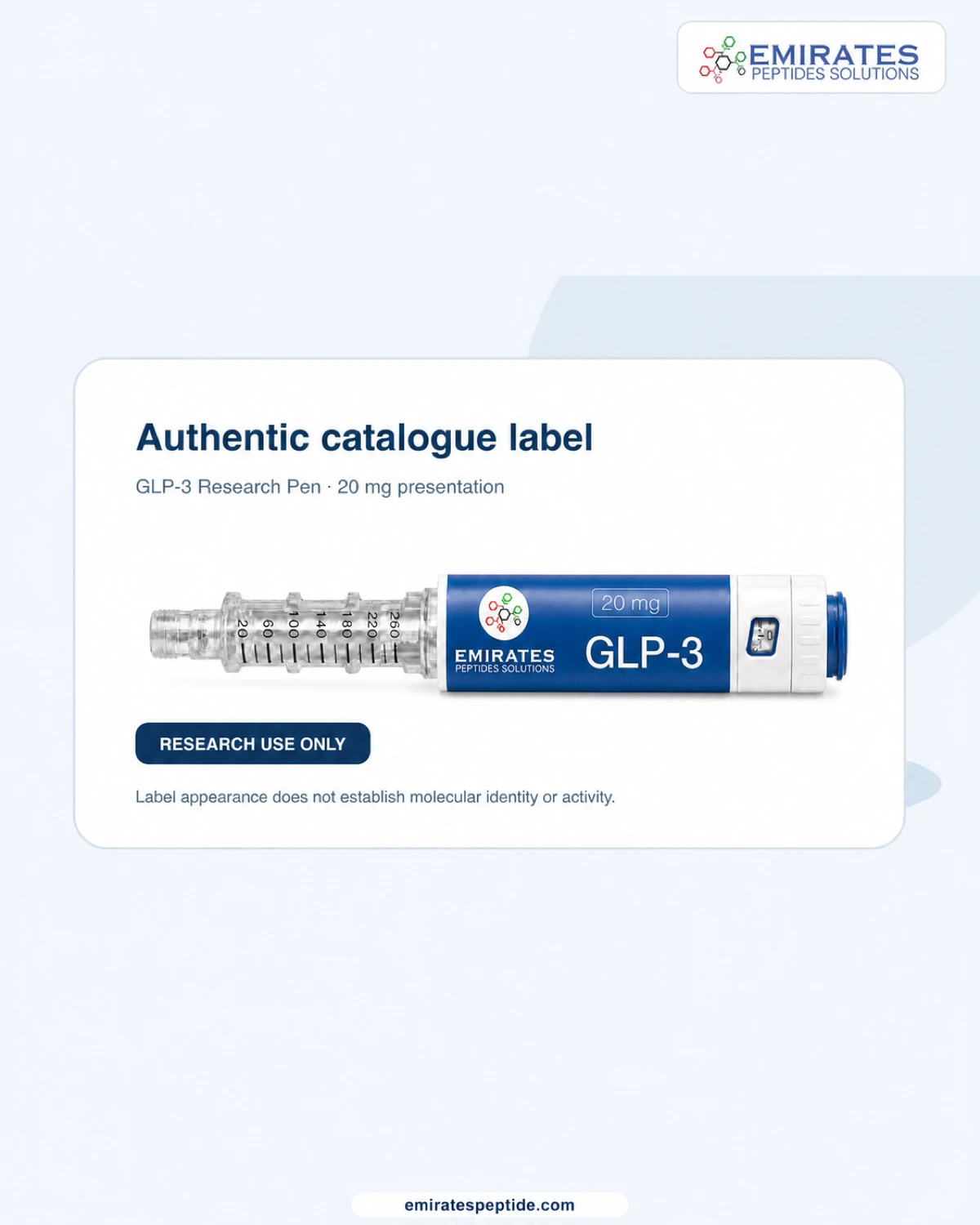
Use the surrounding explanation and cited source for the full context.
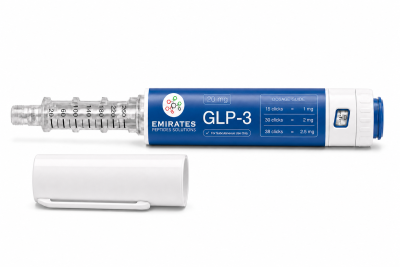
The Emirates Peptides listing describes a research pen with 20 mg of labelled research material in a 3 ml integrated cartridge format. The product page may also show the external device, inspection area and catalogue presentation.
These are format facts. They do not tell a reader that the pen is a medicine, that it contains retatrutide, that it produces a clinical benefit or that the labelled content represents a human dose.
For qualified laboratory research, useful records can include:
- Exact catalogue name.
- Labelled content and cartridge volume.
- Batch or lot identifier.
- Matching certificate or analytical documentation.
- Receipt date and package condition.
- Storage instruction and temperature record.
- Any expiry or retest information supplied.
Identity, purity, concentration, sterility, stability and biological activity are separate claims. A purity percentage cannot establish all of them. A clean photograph cannot establish any of them.
Readers can view the live GLP-3 Pen 20 mg research listing to check its current catalogue status. Availability can change, so this guide uses Check current availability rather than making a permanent stock promise.
15 · Beginner guide
What should Dubai and Abu Dhabi readers know?
The meaning of GLP-1, tirzepatide or retatrutide does not change between Dubai and Abu Dhabi. The same evidence boundaries apply throughout the UAE.
Location matters mainly for the practical context of the search. A reader may be looking for a basic explanation, trying to compare terms, checking a product format or reviewing laboratory documentation. This page answers those questions without making a claim that a research product is approved for treatment in the UAE.
For a laboratory receiving temperature-sensitive research material, an authorised receiver, suitable monitored storage and prompt inspection are sensible parts of a documented workflow. Product and batch instructions should control the actual process. A general article cannot replace them.
Readers comparing research categories may also find the existing GLP-3 vs semaglutide guide and Cagrilintide vs GLP-3 research comparison useful. Those pages should be read as category comparisons, not personal treatment recommendations.
16 · Beginner guide
Common mistakes to avoid
“GLP-3 must be the next version of GLP-1”
No. GLP-1 is a recognised hormone. GLP-3 is used here as an informal catalogue label associated with triple-receptor research.
“GLP-3 means retatrutide”
No. Retatrutide is a named molecule. The GLP-3 label alone does not establish that identity.
“Three receptors must be better than two”
No. Receptor count does not rank effectiveness or safety. Balance, potency, molecule design, evidence and clinical context all matter.
“A pen means it is an approved medicine”
No. A pen is a container and device format. Approval belongs to the exact product and jurisdiction.
“A 48-week study tells me when I will see a result”
No. Study duration, measurement points and individual response are different things.
“Research-only wording makes clinical claims acceptable”
No. A disclaimer does not turn unsupported treatment or outcome claims into responsible information.
17 · Beginner guide
The simple takeaway
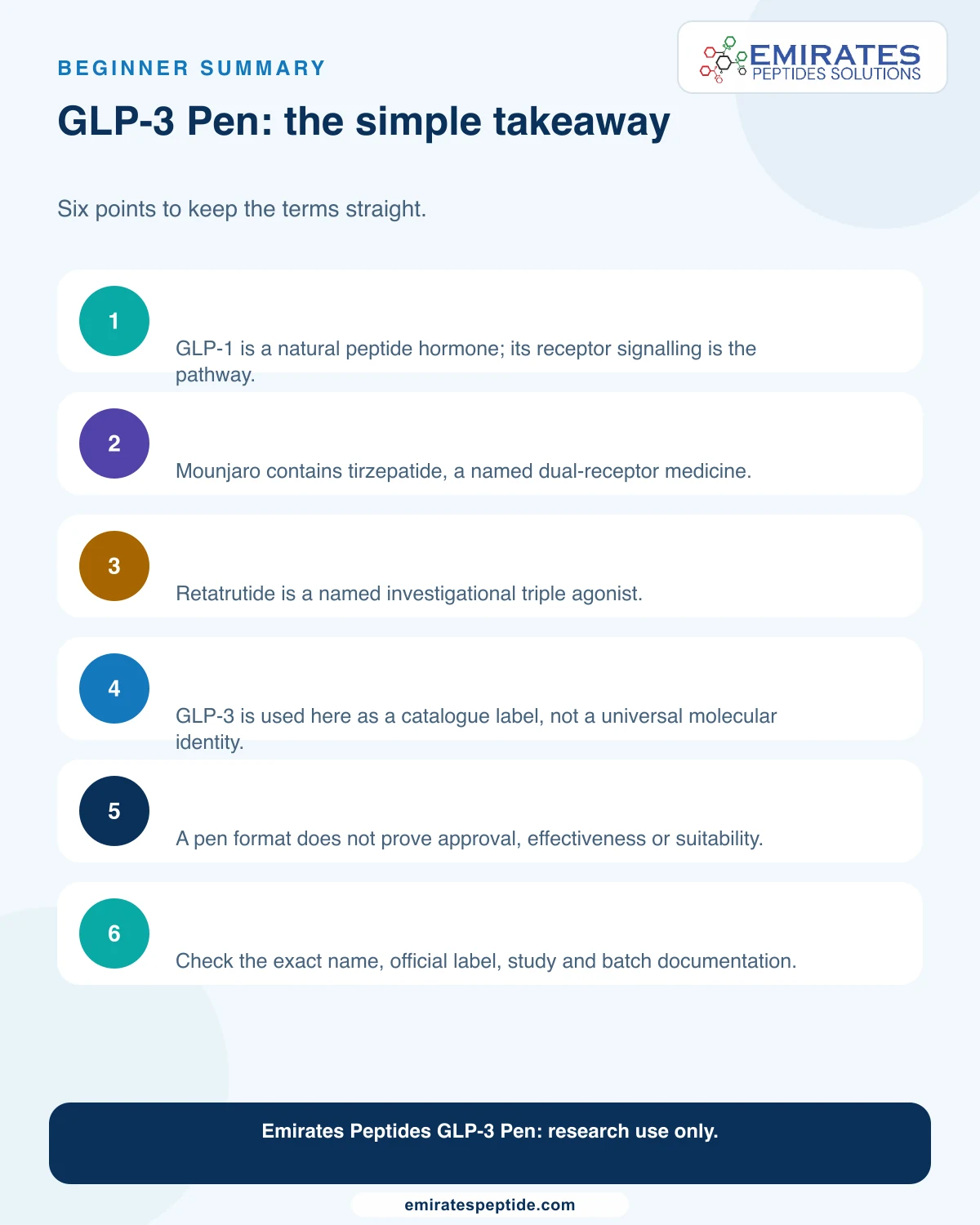
Use the surrounding explanation and cited source for the full context.
GLP-1 is a naturally occurring peptide hormone, and GLP-1 receptor signalling is the biological pathway. Semaglutide is a named GLP-1 receptor medicine. Mounjaro contains tirzepatide, a named dual GIP/GLP-1 receptor medicine. Retatrutide is a named investigational triple agonist.
The Emirates Peptides GLP-3 Research Pen is different: GLP-3 is an informal catalogue label associated with triple-receptor research. The label and pen shape do not establish a named-drug identity, medical use or expected duration.
For treatment questions, use the exact local medicine label and speak with a licensed clinician. For qualified laboratory research, use the exact catalogue record, batch documentation and current product listing.
18 · Beginner guide
Frequently asked questions
What is GLP-3 in simple words?
On the Emirates Peptides listing, GLP-3 is an informal catalogue label associated with research involving GLP-1, GIP and glucagon receptor pathways. It is not the accepted name of a third natural GLP hormone or a complete molecular identity.
Is GLP-3 the same as GLP-1?
No. GLP-1 is a recognised hormone and receptor pathway. GLP-3 is used here as a research catalogue label. It should not be described as a stronger or newer version of GLP-1.
Is GLP-3 the same as Mounjaro?
No. Mounjaro is a brand name for the medicine tirzepatide, a dual GIP and GLP-1 receptor agonist. A GLP-3 catalogue label does not identify tirzepatide.
Is GLP-3 another name for retatrutide?
No equivalence should be assumed. Retatrutide is a specifically identified investigational triple agonist. The GLP-3 label alone does not establish that a product contains retatrutide.
What does GLP-1 do in the body?
GLP-1 is involved in communication between the gut, pancreas and brain. It can influence glucose-dependent insulin signalling, glucagon signalling, gastric emptying, fullness and food intake. These are general pathway concepts, not proof about an unidentified product.
Why are GLP products supplied in pens?
A pen is one way to package a cartridge and device. It may make presentation and identification more convenient, but the format does not prove molecular identity, approval, effectiveness, sterility or safety.
Are GLP medicines used for diabetes?
Some named GLP-1 or GIP/GLP-1 medicines have approved type 2 diabetes indications in specific jurisdictions. The exact product label matters. The Emirates GLP-3 Research Pen is not presented as a diabetes medicine.
Are all GLP medicines approved for weight management?
No. Indications differ by active ingredient, brand and jurisdiction. A medicine used for type 2 diabetes should not automatically be described as approved for weight management, and a research product has no treatment indication.
How long do GLP medicines remain active?
It depends on the exact molecule. Official US labels describe semaglutide as having a half-life of approximately one week and tirzepatide approximately five days. Those figures do not establish the behaviour of a GLP-3 catalogue product.
How quickly do GLP study outcomes appear?
There is no universal timeline. Trials use different populations, endpoints and measurement dates. A study average at a particular week cannot predict an individual result or the behaviour of another product.
Who can use an approved GLP medicine?
Eligibility depends on the exact medicine, current local indication, diagnosis, medical history, contraindications and clinician assessment. This article cannot decide whether a medicine is appropriate for a particular person.
What side effects are associated with named GLP medicines?
Gastrointestinal effects such as nausea, diarrhoea, vomiting or constipation are commonly reported with several named medicines. Serious warnings and contraindications differ, so readers need the current official label and individual medical advice.
Does a research pen have the same evidence as an approved medicine?
No. An approved medicine has evidence and regulatory information tied to its exact product and jurisdiction. A research pen’s catalogue name, appearance and batch documents answer different questions.
What does 20 mg / 3 ml describe?
It describes the labelled total research content and cartridge volume of the Emirates Peptides catalogue format. It is not a human dose or administration recommendation.
Is the Emirates Peptides GLP-3 Pen for personal use?
No. The Emirates Peptides listing presents the product for qualified laboratory research only. It is not for human consumption, veterinary use or therapeutic use.
Where can UAE readers check current availability?
Use the live Emirates Peptides GLP-3 Pen 20 mg product page. Catalogue status can change, so the live listing is more reliable than a stock statement inside an article.
19 · Beginner guide
Official labels and primary references
- US Food and Drug Administration. MOUNJARO (tirzepatide) Injection, for subcutaneous use — Prescribing Information. Revised January 2026. https://www.accessdata.fda.gov/drugsatfda_docs/label/2026/215866s009lbl.pdf
- US Food and Drug Administration. WEGOVY (semaglutide) tablets and injection — Prescribing Information. 2026. https://www.accessdata.fda.gov/drugsatfda_docs/label/2026/215256s029lbl.pdf
- Jastreboff AM, et al. Triple-Hormone-Receptor Agonist Retatrutide for Obesity – A Phase 2 Trial. New England Journal of Medicine. 2023. PMID: 37366315. DOI: 10.1056/NEJMoa2301972. https://pubmed.ncbi.nlm.nih.gov/37366315/
- Frías JP, et al. Tirzepatide versus Semaglutide Once Weekly in Patients with Type 2 Diabetes. New England Journal of Medicine. 2021. PMID: 34170647. DOI: 10.1056/NEJMoa2107519. https://pubmed.ncbi.nlm.nih.gov/34170647/
- Wilding JPH, et al. Once-Weekly Semaglutide in Adults with Overweight or Obesity. New England Journal of Medicine. 2021. PMID: 33567185. DOI: 10.1056/NEJMoa2032183. https://pubmed.ncbi.nlm.nih.gov/33567185/
- Coskun T, et al. LY3437943, a novel triple glucagon, GIP, and GLP-1 receptor agonist for glycemic control and weight loss: From discovery to clinical proof of concept. Cell Metabolism. 2022. PMID: 35985340. DOI: 10.1016/j.cmet.2022.07.013. https://pubmed.ncbi.nlm.nih.gov/35985340/
- Eli Lilly and Company. What to know about retatrutide. Medically reviewed and updated July 2026. https://www.lilly.com/news/stories/what-to-know-about-retatrutide
Was this article helpful?

🔬 Related Research Peptides
Explore Research-Grade Peptides
HPLC-verified, lab-tested peptides for your scientific research. Fast delivery across the UAE.
Browse All PeptidesRelated Articles




Emirates Peptides Research Team
A dedicated coalition of biochemists and clinical researchers focusing on advanced peptide synthesis and pharmacological applications. All data is verified against current clinical trials.
FROM INSTAGRAM