
Blog


For research use only. Material is supplied as a lyophilized reference compound with HPLC purity verification.
- Key Facts at a Glance
- Hair-cycle and miniaturization primer for peptide researchers
- GHK-Cu follicle and remodeling evidence
- What BPC-157 and TB-500 are — and are not — in hair research
- Which pathway matches your research question?
Last updated: 14 Jul 2026 · Reviewed by the Emirates Peptides Research Team · 16-minute read · 16 sources cited
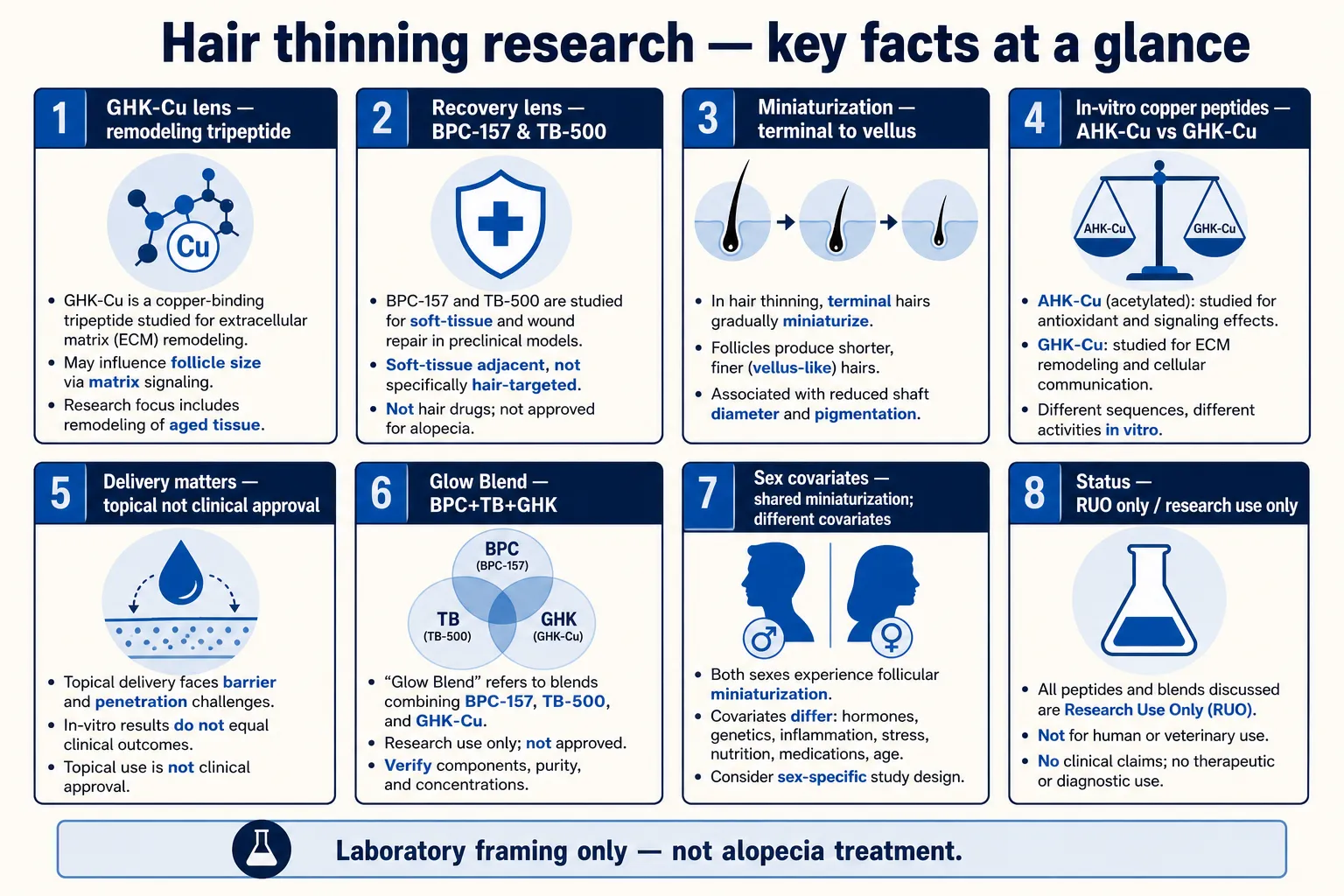
Hair-thinning research questions often collide two different peptide stories: GHK-Cu remodeling biology (follicle size, extracellular matrix, dermal papilla neighbourhood) versus recovery peptides such as BPC-157 and TB-500 (angiogenesis and cytoskeletal migration hypotheses). This article separates those pathways for female- and male-pattern thinning as research topics — not as treatments for alopecia. Emirates Peptides materials are research-use only.
Nothing here claims to regrow hair, reverse baldness, or treat androgenetic alopecia. Follicle-size and anagen-phase findings are experimental observations. Recovery peptides are not proven hair therapies.
01 · Biology
Hair-cycle and miniaturization primer for peptide researchers
Define the endpoint before choosing the peptide.
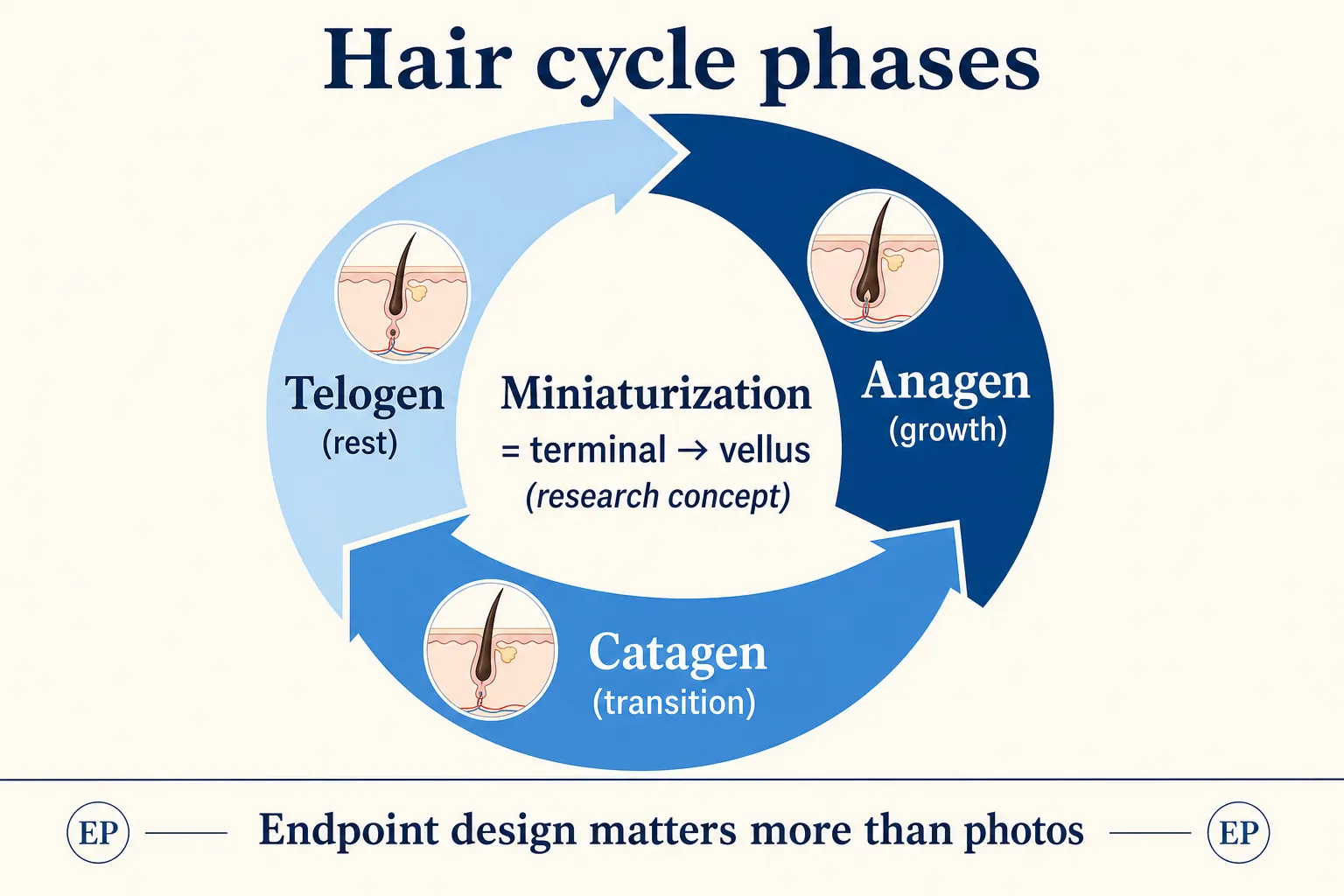
Dermal papilla signalling, bulge stem-cell quiescence, and perifollicular vascular support are the usual mechanistic neighbourhoods where peptide hypotheses get parked. If your question is ECM remodeling around the follicle, GHK-Cu literature is the closer fit. If your question is soft-tissue angiogenesis after injury, BPC-157’s preclinical corpus is richer — but that is still not a hair-loss indication.
Sibling background: GHK-Cu hair-loss research and the collagen-density draft Copper peptides & collagen after 30.
02 · GHK-Cu
GHK-Cu follicle and remodeling evidence
Latest research insights. No spam, ever.
Matrix biology with follicle-size notes — not a regrowth guarantee.
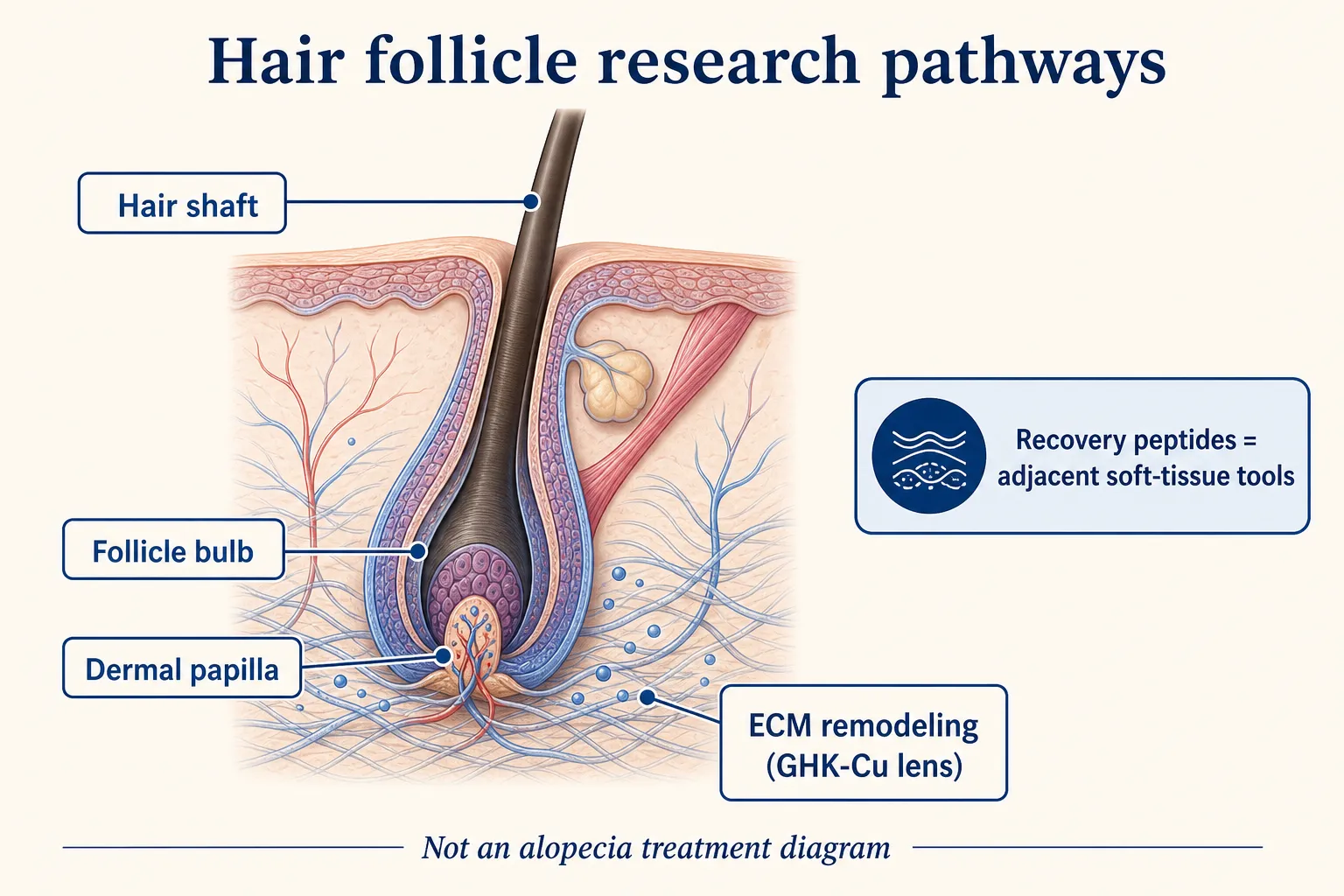
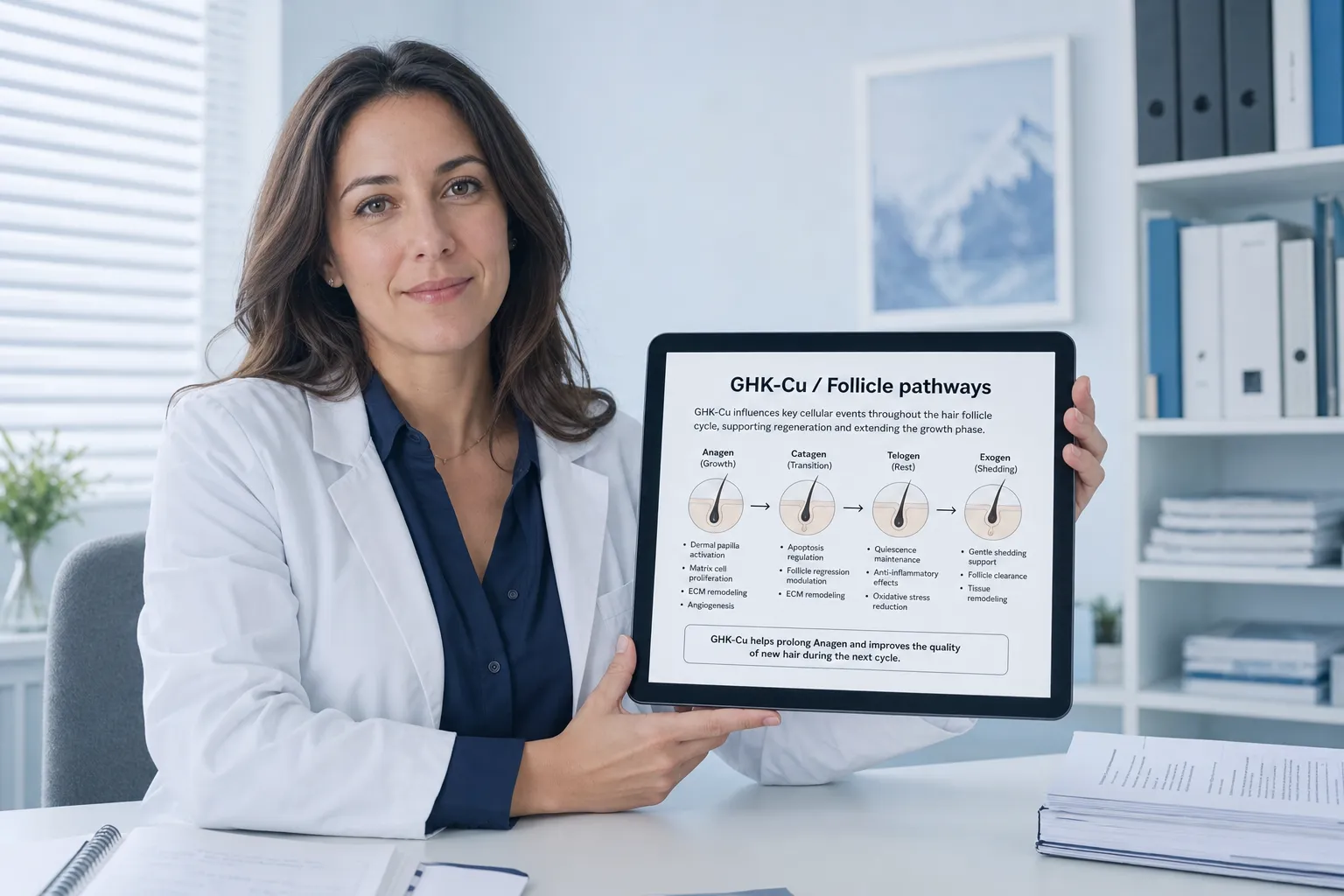
PMID 18644225 summarises tissue-remodeling actions including follicle-size signals and aged-skin cosmetic endpoints. Broader skin-regeneration reviews (2015) expand gene-modulation framing. Separately, copper-tripeptide organ-culture work (e.g. Pyo et al. on tripeptide-copper complexes and human hair elongation in vitro, PMID 17703734) supports in-vitro follicle biology interest — confirm whether each paper used GHK-Cu, AHK-Cu, or another analogue before citing into a GHK-Cu protocol.
Delivery research (including ionic-liquid microemulsion topical systems in mouse models) shows formulation can multiply local exposure and engage growth-factor / Wnt-pathway readouts. That is formulation science — not Phase 3 alopecia evidence.
03 · Recovery
What BPC-157 and TB-500 are — and are not — in hair research
Soft-tissue tools sitting next to the follicle conversation.
Use the recovery overviews for accurate pathway language: BPC-157 research overview, TB-500 tissue repair, and BPC-157 vs TB-500. Do not launder soft-tissue wound models into “male pattern baldness protocols.”
04 · Compare
Which pathway matches your research question?
Pick the tool that matches the biology question — not the loudest online stack story.
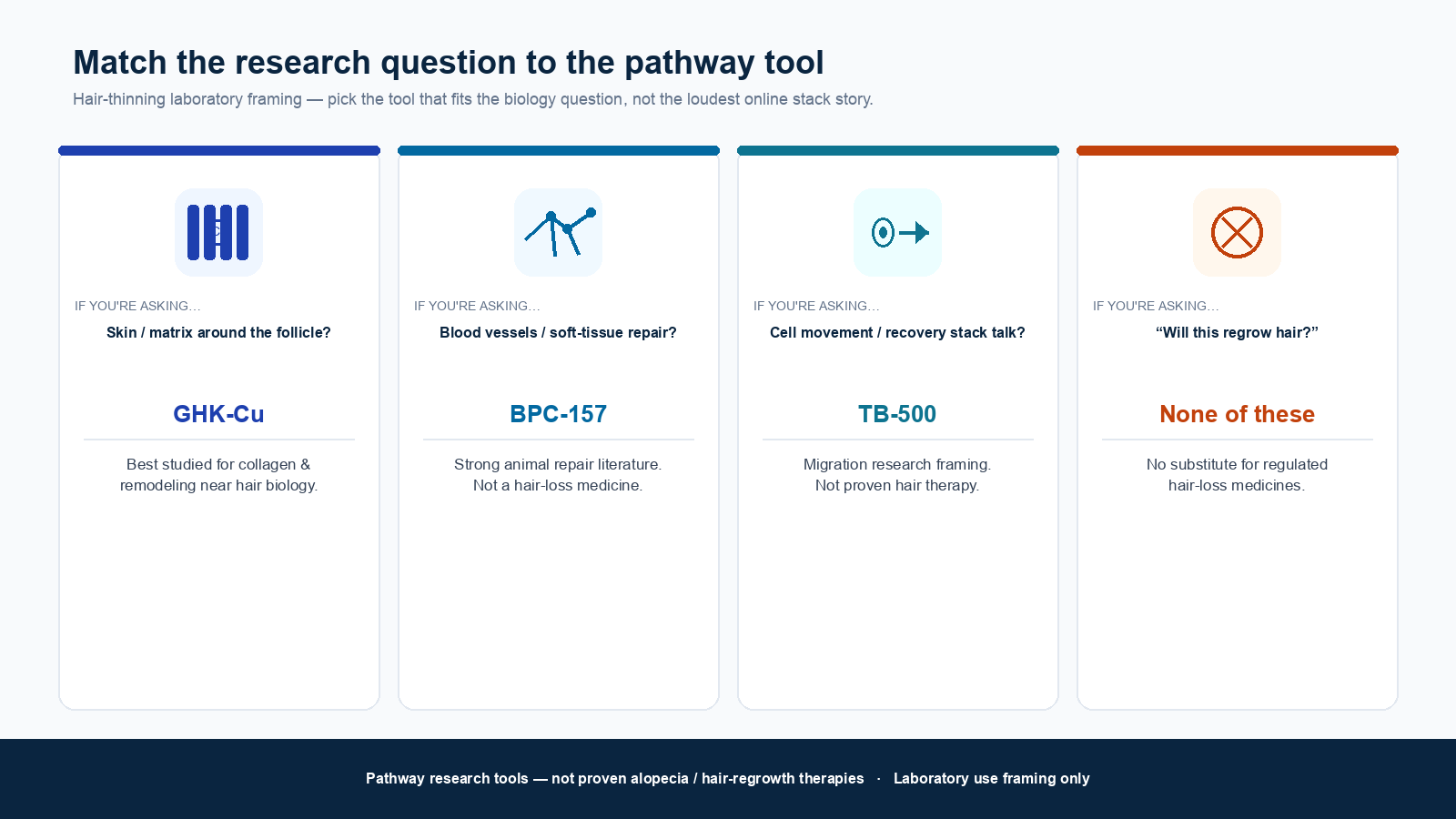
If you’re asking…
GHK-Cu
About the skin/matrix around the follicle? Best studied for collagen and remodeling near hair biology — experimental observations, not a regrowth guarantee.
If you’re asking…
BPC-157
About blood vessels or soft-tissue repair? Strong animal repair literature for angiogenesis-adjacent models — not a hair-loss medicine evidence package.
If you’re asking…
TB-500
About cell movement or “recovery stack” talk? Migration research framing (actin / cytoskeletal hypotheses). Not proven hair therapy.
If you’re asking…
None of these
“Will this regrow hair?” None of these replaces regulated hair-loss medicines. Keep research tools and approved therapies in separate lanes.
05 · Glow
Glow Blend as multi-pathway research material
Convenience combination ≠ validated hair stack.
06 · Sex
Female vs male pattern thinning as research variables
Shared miniaturization biology; different maps and covariates.
07 · UAE
Sourcing, COA, and storage
Identity first — especially for copper peptides.
08 · Design
Study-design notes for hair-peptide experiments
Pre-register endpoints or the online narrative will write them for you.
04b · Depth
Choosing follicle endpoints that survive peer review
If photography is your only readout, you do not yet have a peptide hair study.
Miniaturization — the terminal-to-vellus transition — is the shared morphologic concept behind many male- and female-pattern thinning discussions. Male-pattern maps often emphasise frontotemporal and vertex distributions with stronger androgen-signalling covariates; female-pattern presentations more often emphasise diffuse crown thinning with broader endocrine and age covariates. Peptide papers seldom publish clean sex-stratified follicle histology, so your protocol should.
GHK-Cu earns its place in hair-adjacent research through remodeling biology: collagen/elastin/GAG synthesis, MMP/TIMP balance, angiogenesis-related signals, and explicit follicle-size notes in Pickart’s tissue-remodeling synthesis. That is still experimental language. It is not a substitute for regulated alopecia pharmacotherapy evidence packages.
Copper-tripeptide organ-culture literature sometimes uses AHK-Cu or other analogues. Citing those results under a GHK-Cu methods heading is a documentation error. Write the exact sequence, counter-ion, and copper stoichiometry into the materials table.
Recovery peptides enter online “hair stack” narratives because angiogenesis (BPC-157 preclinical themes) and actin-linked migration (TB-500 / thymosin β4 neighbourhood) sound follicle-relevant. Soft-tissue wound models and follicle organogenesis are related biological territories, not identical indications. Use recovery overviews for accurate pathway wording, then refuse to launder tendon or gastric papers into alopecia claims.
Glow Blend (BPC-157 + TB-500 + GHK-Cu) is operationally convenient for multi-pathway laboratory logistics and a citation hazard if blend-level hair endpoints are asserted without component arms. At minimum, a serious design includes: GHK-Cu alone, vehicle, and — if the blend is studied — factorial or leave-one-out controls so ECM remodeling signals are not misattributed to a recovery peptide (or the reverse).
Delivery science deserves its own subsection in any topical arm. Ionic-liquid microemulsion work shows formulation can multiply local exposure and shift growth-factor / Wnt-pathway readouts in animal skin. That supports formulation R&D; it does not convert research-supply vials into clinic-ready hair medicines. Franz cells, tape-stripping depth profiles, and stability-in-vehicle tests belong beside efficacy claims.
UAE handling still gates data quality: confirm identity and HPLC documentation on receipt, protect lyophilised stock from summer heat, refrigerate working solutions, and avoid freeze–thaw that aggregates peptides and silently changes effective concentration between draws.
06b · Depth
Translational limits: from organ culture to human pattern thinning
Where the evidence ladder stops — on purpose.
Evidence ladder for hair-peptide work, bottom to top: molecular assays → dermal papilla culture → follicle organ culture → animal synchronised-cycle models → vehicle-controlled human exploratory pilots → adequately powered randomised programmes with trichoscopy/histology. Most copper-peptide and recovery-peptide citations live on the lower rungs. Saying that out loud protects readers and keeps UAE research-supply positioning intact.
Androgen signalling, prostaglandin pathways, and inflammatory perifollicular milieu dominate mainstream alopecia pharmacology discussions. GHK-Cu remodeling and recovery-peptide angiogenesis are adjacent research tools, not automatic replacements for those axes. Combination hypotheses are allowed in experimental design; unearned clinical equivalence is not.
Female vs male pattern covariates should appear in the statistical analysis plan even when the peptide is the experimental factor. Age, family history, thyroid status (when clinically available), and medication lists are noise sources that dwarf small organ-culture effect sizes if left uncontrolled in human exploratory work.
Close every hair-peptide memo with the supply sentence: Emirates Peptides GHK-Cu, BPC-157, TB-500, and Glow Blend are laboratory research materials. They are not alopecia medicines, not cosmetic hair drugs, and not personal treatment plans. Point readers to pathway guides and product documentation for identity — and to dermatology literature for clinical standards of evidence.
09 · FAQ
Frequently asked questions
Is GHK-Cu better than BPC-157 for hair thinning?
For follicle/ECM remodeling hypotheses, GHK-Cu is the closer literature fit. BPC-157 is not established as a hair-loss therapy in the same remodeling reviews. “Better” only makes sense relative to a declared mechanistic question.
Does GHK-Cu regrow hair?
Published work discusses follicle-size and remodeling signals in experimental systems. That is not the same as clinically proven hair regrowth treatment. Emirates Peptides GHK-Cu is research-use only.
Should women and men use different peptides for thinning?
Sex should be modelled as a covariate in research designs. This article does not recommend personal peptide use for either sex.
Is Glow Blend a hair formula?
No. It is a multi-peptide research combination. Hair endpoints would still require component-level controls and appropriate models.
Is AHK-Cu the same as GHK-Cu?
No. Related copper-tripeptide class, different sequence. Do not cite AHK-Cu organ-culture results as if they were GHK-Cu without labelling the analogue.
Where does TB-500 fit?
As a recovery/migration research tool — not as a validated alopecia agent. See TB-500 tissue-repair research for accurate framing.
What endpoints should a follicle study use?
Shaft elongation in organ culture, dermal papilla assays, follicle diameter histology, anagen markers, and vehicle-controlled topical delivery metrics when relevant.
Can I buy these as hair-loss treatments from Emirates Peptides?
No. Catalogue peptides are supplied for laboratory research only — not as medicines or cosmetic hair treatments.
10 · References
References and research sources
- Pickart L. The human tri-peptide GHK and tissue remodeling. PMID 18644225
- Pickart L, et al. GHK peptide as a natural modulator… skin regeneration. PMID 26236730
- Pyo HK, et al. The effect of tripeptide-copper complex on human hair growth in vitro. Arch Pharm Res. 2007. PMID 17703734
- Ionic-liquid microemulsion topical copper-peptide delivery / mouse follicle model — PMC10643103
- Dou / Margolina GHK gene-data synthesis — IJMS 2018
- Emirates Peptides. GHK-Cu hair-loss research
- Emirates Peptides. BPC-157 research overview
- Emirates Peptides. TB-500 tissue repair
- Emirates Peptides. BPC-157 vs TB-500
- Emirates Peptides. Glow Blend UAE guide
- Androgenetic alopecia pathophysiology primers (use current dermatology reviews for miniaturization definitions).
- Female pattern hair loss clinical overviews (covariate context — not peptide indications).
- Wnt/β-catenin follicle cycling reviews (mechanistic background for delivery papers).
- Peptide storage — EP guide.
Glossary
| Term | Definition (research context) |
|---|---|
| Anagen | Active hair-growth phase of the follicle cycle. |
| Miniaturization | Progressive reduction of follicle/shaft calibre in pattern thinning research. |
| Dermal papilla | Mesenchymal signalling centre at the follicle base. |
| AHK-Cu | Related copper tripeptide analogue — not identical to GHK-Cu. |
| RUO | Research use only. |
Related reading
Disclaimer: For laboratory research use only. Not for human administration. Not a treatment for hair loss or alopecia.
Was this article helpful?

🔬 Related Research Peptides
Explore Research-Grade Peptides
HPLC-verified, lab-tested peptides for your scientific research. Fast delivery across the UAE.
Browse All PeptidesRelated Articles




Emirates Peptides Research Team
A dedicated coalition of biochemists and clinical researchers focusing on advanced peptide synthesis and pharmacological applications. All data is verified against current clinical trials.