Blog


- What Is GHK-Cu?
- What Is BPC-157?
- GHK-Cu vs BPC-157: Head-to-Head
- When to Choose GHK-Cu
- When to Choose BPC-157
GHK-Cu vs BPC-157: Which Peptide Is Right for You? (2026 Comparison)
For laboratory research and development purposes. Not for human consumption. Not approved by UAE MOHAP for therapeutic use. Material is supplied as lyophilized reference compound with HPLC purity verification.
GHK-Cu vs BPC-157 compares two of the most-researched peptides in modern science: GHK-Cu, a naturally occurring copper-binding tripeptide that drives skin and hair regeneration, and BPC-157, a synthetic 15-amino-acid fragment of gastric protein that excels in tendon, ligament, gut, and nerve repair. They act on non-overlapping pathways, making them complementary rather than competitive.
The 60-second summary
- Different pathways: GHK-Cu acts in the extracellular matrix; BPC-157 acts on angiogenesis and growth-factor signaling at injury sites.
- GHK-Cu wins for skin and hair: 529+ genes modulated, strong evidence for collagen synthesis, fibroblast activation, and follicle support.
- BPC-157 wins for tissue repair: hundreds of preclinical studies on tendon, ligament, gut, and nerve healing via VEGF and angiogenesis.
- Stack is mechanistically sound: no published interaction data, but pathways are non-overlapping — emerging research frontier.
- Neither is approved for human use: all discussion refers to in vitro and preclinical animal research.
In 2026, two peptides dominate conversations across longevity clinics, research labs, and biohacking communities: GHK-Cu copper peptide and BPC-157. While both compounds have attracted serious scientific attention, they operate through fundamentally different mechanisms and target distinct biological systems.
GHK-Cu, a naturally occurring copper-binding tripeptide, has accumulated decades of research around skin rejuvenation, collagen synthesis, and gene expression modulation. BPC-157, a synthetic pentadecapeptide derived from gastric juice proteins, has emerged as a leading subject in musculoskeletal repair, gut healing, and neuroprotection research. This guide delivers a rigorous, evidence-based comparison covering mechanisms, primary research applications, key differences, and stacking considerations.
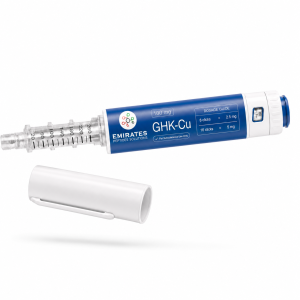
● GHK-Cu 50mg AED 170
● GHK-Cu 100mg AED 265
● BPC-157 5mg AED 120
● Glow Blend AED 620
View all peptides →
01
What Is GHK-Cu?
GHK-Cu (glycyl-L-histidyl-L-lysine copper) is a naturally occurring tripeptide first isolated from human plasma in 1973 by biochemist Loren Pickart. The peptide consists of three amino acids — glycine, histidine, and lysine — tightly bound to a copper(II) ion, earning it the informal name copper peptide or tripeptide-1 in the cosmetic industry.
In young adults, GHK-Cu circulates at concentrations of approximately 200 ng/mL in plasma. Research suggests these levels decline with age, falling sharply after age 60. This age-related decline correlates with measurable reductions in skin elasticity and collagen density, which has spurred significant interest in exogenous supplementation for anti-aging research.
529+
A landmark genomics study found GHK-Cu modulates the expression of at least 529 human genes — spanning collagen synthesis, elastin production, antioxidant enzymes, anti-inflammatory pathways, and DNA repair mechanisms.
Key areas of skin regeneration research include wound healing, fibroblast activation, and dermal remodelling. In hair biology, research suggests GHK-Cu prolongs the anagen (growth) phase of the hair cycle and stimulates follicle progenitor cells — see our GHK-Cu for hair loss guide for the full evidence map.
02
What Is BPC-157?
BPC-157 — short for Body Protection Compound 157 — is a synthetic pentadecapeptide comprising 15 amino acids (Gly-Glu-Pro-Pro-Pro-Gly-Lys-Pro-Ala-Asp-Asp-Ala-Gly-Leu-Val). It is derived from a partial sequence of human gastric juice protein BPC, originally characterised for its cytoprotective properties in the gastrointestinal tract.
Unlike GHK-Cu, BPC-157 does not occur in significant measurable concentrations in circulating plasma; its parent protein is localised to gastric tissue. The synthetic form used in research is stable in acidic environments and is the subject of hundreds of preclinical studies, predominantly in rodent models.
Research into BPC-157 has demonstrated particularly strong results in tendon and ligament healing. A 2020 study published in Biomolecules highlighted BPC-157’s ability to upregulate VEGF (vascular endothelial growth factor) and promote angiogenesis, which accelerates connective tissue vascularisation following injury. Additional research has documented positive effects on intestinal barrier function, ulcer healing, and modulation of dopamine and serotonin systems in the central nervous system.
BPC-157 has also attracted attention for neuroprotective applications. Animal studies have reported improvements in motor function recovery following nerve damage, as well as attenuation of brain lesion effects — positioning it as a candidate in neurological repair research.
03
GHK-Cu vs BPC-157: Head-to-Head
Latest research insights. No spam, ever.
The comparison below covers the most clinically relevant research dimensions side-by-side.
Research depth across nine dimensions
| Dimension | GHK-Cu | BPC-157 |
|---|---|---|
| Origin | Naturally occurring tripeptide in human plasma (Gly-His-Lys) | Synthetic 15-AA fragment of gastric juice protein BPC |
| Primary mechanism | Copper-chelating complex; upregulates collagen, elastin, antioxidant enzymes; modulates 529 genes | Activates growth hormone receptor, promotes angiogenesis, modulates GABAergic system |
| Skin benefits | Strongly studied — collagen I/III, wrinkle reduction, wound healing | Limited direct skin data; indirect anti-inflammatory benefit |
| Hair benefits | Prolongs anagen phase, activates hair follicle stem cells | No direct follicle data; may support scalp circulation |
| Recovery / healing | Wound healing, anti-inflammatory at injury sites | Tendon, ligament, muscle, nerve repair — most-studied peptide for MSK recovery |
| Anti-aging | Strong — collagen synthesis, free-radical scavenging | Indirect — gut health, systemic inflammation, neuroprotection |
| Research depth | Extensive human + animal; commercialised in cosmetics | Extensive animal; limited human clinical trials |
| Typical admin route | Topical, subcutaneous, microneedling | Subcutaneous, intramuscular, oral (emerging) |
| Stack potential | Pairs well with BPC-157 for whole-body protocols | Pairs well with GHK-Cu; combined research active |
When evaluating the copper peptide vs BPC-157 debate, the most important distinction lies in their primary biological targets. GHK-Cu operates principally in the extracellular matrix and dermal layers, where its copper-mediated activity drives collagen I and III production, activates superoxide dismutase, and reduces matrix metalloproteinase (MMP) activity. BPC-157, by contrast, exerts its most pronounced effects at injury sites: tendons, ligaments, muscle fibres, and the gastrointestinal epithelium. Its angiogenic properties accelerate tissue revascularisation, while its interaction with the growth hormone receptor pathway may explain the dramatic healing acceleration observed in animal models.
What is GHK-Cu?
What is BPC-157?
GHK-Cu for hair loss?
GHK-Cu for skin?
Glow Blend stack?
04 · Choose
When to Choose GHK-Cu
Research programmes focused on skin aging, collagen remodelling, and hair biology are best served by GHK-Cu. Its well-documented role as a collagen synthesis activator makes it the leading peptide candidate when the research question centres on dermal extracellular matrix dynamics.
For GHK-Cu for hair loss studies, the evidence base is more developed than for any comparable peptide. Multiple in vitro and animal studies have documented follicle stimulation, and the compound’s strong safety profile at research concentrations makes it accessible for mechanistic investigations.
Longevity researchers interested in systemic anti-aging protocols will find GHK-Cu’s gene expression modulation particularly noteworthy. The activation of 529 genes — including those governing antioxidant defence, DNA repair, and anti-inflammatory signalling — positions it as a potential whole-body aging modulator beyond its topical applications.
Choose GHK-Cu when research parameters include: photoaging and UV-induced collagen degradation; fibroblast and keratinocyte biology; telomere-adjacent anti-aging pathways; topical delivery mechanisms; or hair follicle cycle modulation. Researchers can buy GHK-Cu research-grade preparations from Emirates Peptides.
05 · Choose
When to Choose BPC-157
BPC-157 is the peptide of choice when the research question involves musculoskeletal repair, gastrointestinal healing, or neurological recovery. Its angiogenic and growth-factor-modulating properties create a unique profile unmatched by most other research peptides.
Tendon and ligament injury models represent BPC-157’s most replicated area of efficacy. Studies consistently demonstrate accelerated collagen fibre organisation in tendons, reduced inflammatory cytokine presence, and faster functional recovery compared to controls. For researchers investigating post-injury recovery mechanisms, BPC-157 provides a robust and extensively documented experimental tool.
Gut healing research is another established application. BPC-157 has demonstrated protective effects on the gastric mucosa, intestinal epithelium, and colon in animal models of ulcerative colitis, NSAID-induced gastric lesions, and short bowel syndrome. Its dual action — cytoprotective and angiogenic — makes it a compelling compound for gastroenterology researchers.
In neurological research, BPC-157 has shown neuroprotective effects in stroke, traumatic brain injury, and peripheral nerve damage models. Research suggests it modulates dopaminergic signalling, which has opened exploratory lines of investigation in neurological and psychiatric disorder research.
06 · Stack
Can You Stack GHK-Cu and BPC-157?
The GHK-Cu + BPC-157 stack is an emerging area of research interest. Because the two peptides act on largely non-overlapping biological pathways — GHK-Cu primarily in the extracellular matrix and BPC-157 in vascular, connective tissue, and neurological contexts — their mechanisms are complementary rather than redundant.
No published studies have specifically examined the pharmacodynamic interaction of co-administered GHK-Cu and BPC-157. However, no known mechanistic conflict exists between them. GHK-Cu’s collagen-synthesis effects and BPC-157’s angiogenic properties could theoretically create synergistic conditions for tissue repair — providing both the extracellular matrix framework and the vascular supply needed for regeneration.
Researchers considering a combined protocol should note that the administration routes may differ (GHK-Cu is frequently applied topically while BPC-157 is typically injected subcutaneously) and that stacking research remains a significant gap in the current literature. For pre-formulated research stacks combining both, see the Glow Blend (BPC-157 + TB-500 + GHK-Cu) or Klow Blend (with added KPV).
07 · Questions
Frequently asked questions
Is GHK-Cu better than BPC-157 for skin? +
Can I use GHK-Cu and BPC-157 together? +
Which peptide is better for hair loss research? +
What are the side effects of each peptide? +
Where can I buy GHK-Cu and BPC-157 in UAE? +
How are these peptides reconstituted? +
08 · References
References
- Pickart L, Vasquez-Soltero JM, Margolina A. GHK Peptide as a Natural Modulator of Multiple Cellular Pathways in Skin Regeneration. BioMed Research International, 2015. PubMed
- Pickart L, Margolina A. Regenerative and Protective Actions of the GHK-Cu Peptide in the Light of the New Gene Data. International Journal of Molecular Sciences, 2018. PubMed
- Pickart L. The human tri-peptide GHK and tissue remodeling. Journal of Biomaterials Science, Polymer Edition, 2008. PubMed
- Sikiric P, et al. Stable Gastric Pentadecapeptide BPC 157 and Wound Healing. Frontiers in Pharmacology, 2018. PubMed
- Chang CH, et al. Pentadecapeptide BPC 157 enhances the growth hormone receptor expression in tendon fibroblasts. Molecules, 2014. PubMed
- Hsieh MJ, et al. Therapeutic Potential of Pro-Angiogenic BPC157 is Associated with VEGFR2 Activation. Cardiovascular Research, 2017. PubMed
- Seiwerth S, et al. BPC 157 and Standard Angiogenic Growth Factors. Gastrointestinal Tract Healing. Current Pharmaceutical Design, 2018. PubMed
- Park JH, et al. Copper-Tripeptide and Its Pharmacological Effects in Cosmetic Use. Cosmetics, 2020. Open access review.
Was this article helpful?

🔬 Related Research Peptides
Explore Research-Grade Peptides
HPLC-verified, lab-tested peptides for your scientific research. Fast delivery across the UAE.
Browse All PeptidesRelated Articles


Emirates Peptides Research Team
A dedicated coalition of biochemists and clinical researchers focusing on advanced peptide synthesis and pharmacological applications. All data is verified against current clinical trials.