Blog

For research use only. Material is supplied as a lyophilized reference compound with HPLC purity verification.
- Key Facts at a Glance
- How copper peptides talk to collagen biology
- Why “after 30” is a research-relevant window
- What published skin-density research actually shows
- Topical literature vs lyophilised research supply
Last updated: 14 Jul 2026 · Reviewed by the Emirates Peptides Research Team · 16-minute read · 16 sources cited
GHK-Cu (glycyl-L-histidyl-L-lysine copper) is one of the most studied copper peptides in dermal extracellular-matrix research. After age 30, measurable declines in plasma GHK and progressive changes in dermal collagen architecture make “skin density” a natural research lens — not a cosmetic promise. This guide maps mechanism, age biology, published evidence, research formats, and UAE handling for laboratory work. Material from Emirates Peptides is supplied for research use only.
Figures below summarise published dermal, fibroblast, and topical research. GHK-Cu from Emirates Peptides is for laboratory and in-vitro research. Nothing here is anti-aging medical advice, a wrinkle treatment protocol, or a personal skincare prescription.
01 · Mechanism
How copper peptides talk to collagen biology
Remodeling is synthesis plus controlled breakdown — not “more collagen only.”
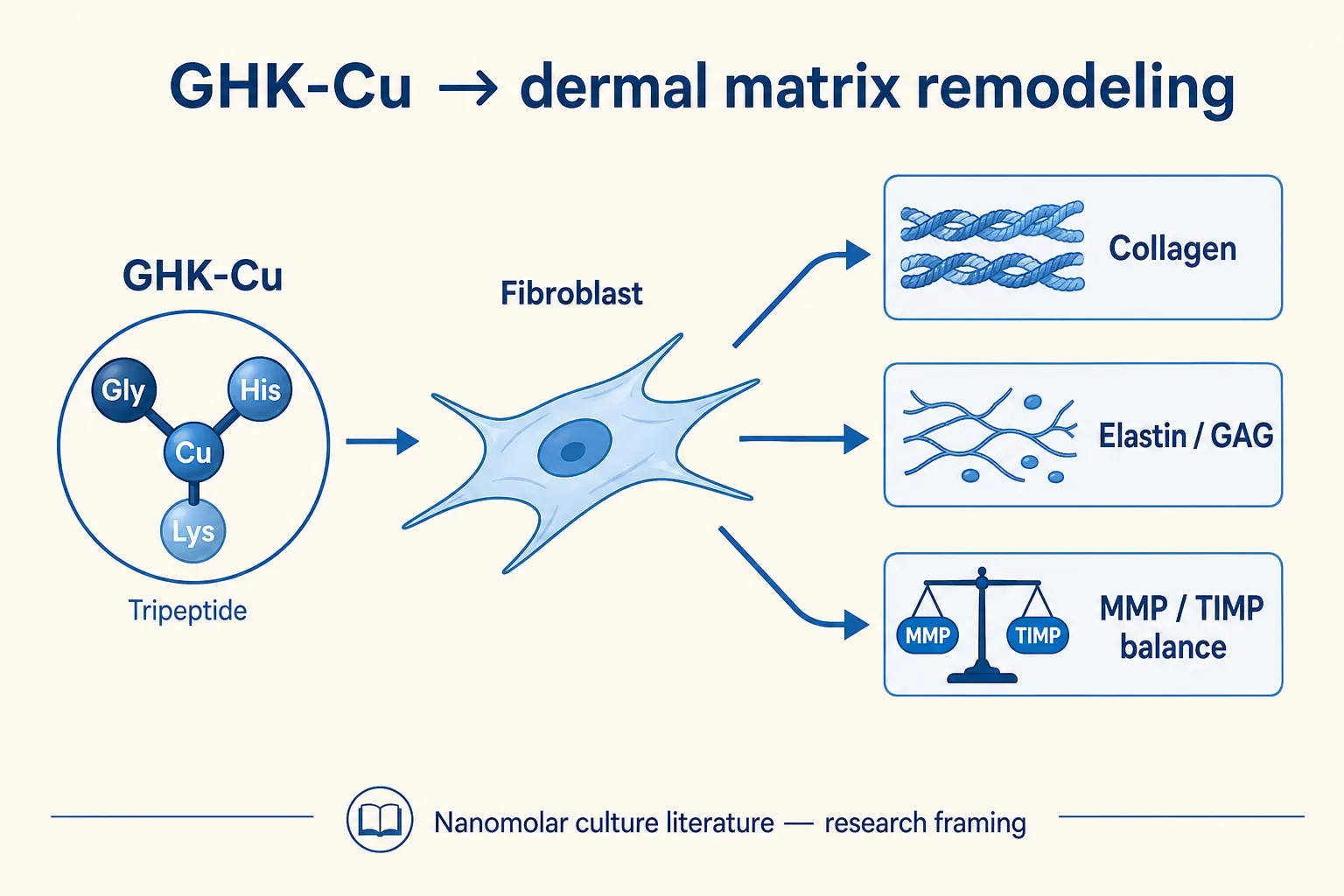
GHK binds Cu2+ with affinity comparable to the copper transport site on albumin, forming the GHK-Cu complex that dominates the research literature. Reviews by Pickart and collaborators describe chemoattraction of repair cells, antioxidant and anti-inflammatory actions, stimulation of collagen and elastin synthesis, and modulation of metalloproteinases and their inhibitors — the MMP/TIMP axis that decides whether matrix is being deposited or cleared.
Classic fibroblast work associated with Maquart, Borel, and colleagues reported collagen stimulation at very low, non-toxic nanomolar concentrations, with later papers expanding to dermatan sulfate, chondroitin sulfate, and the small proteoglycan decorin. That matters for “skin density” language: density in dermal research usually means organised extracellular matrix and tissue architecture, not a marketing synonym for “plump.”
More recent gene-expression analyses (including Dou and Margolina’s IJMS synthesis of Pickart’s gene data) frame GHK as a broad reset signal across thousands of genes rather than a single collagen switch. For researchers designing assays, that breadth is both opportunity and confounder — endpoint selection (COL1A1 protein, hydroxyproline, elastin mRNA, MMP-1/TIMP-1 ratios, dermal thickness histology) must be declared up front. Background identity and skin-focused framing also live on the GHK-Cu skin rejuvenation research guide and skin regeneration overview.
02 · Age biology
Why “after 30” is a research-relevant window
Latest research insights. No spam, ever.
Plasma GHK decline and dermal collagen turnover changes co-travel with chronological age.
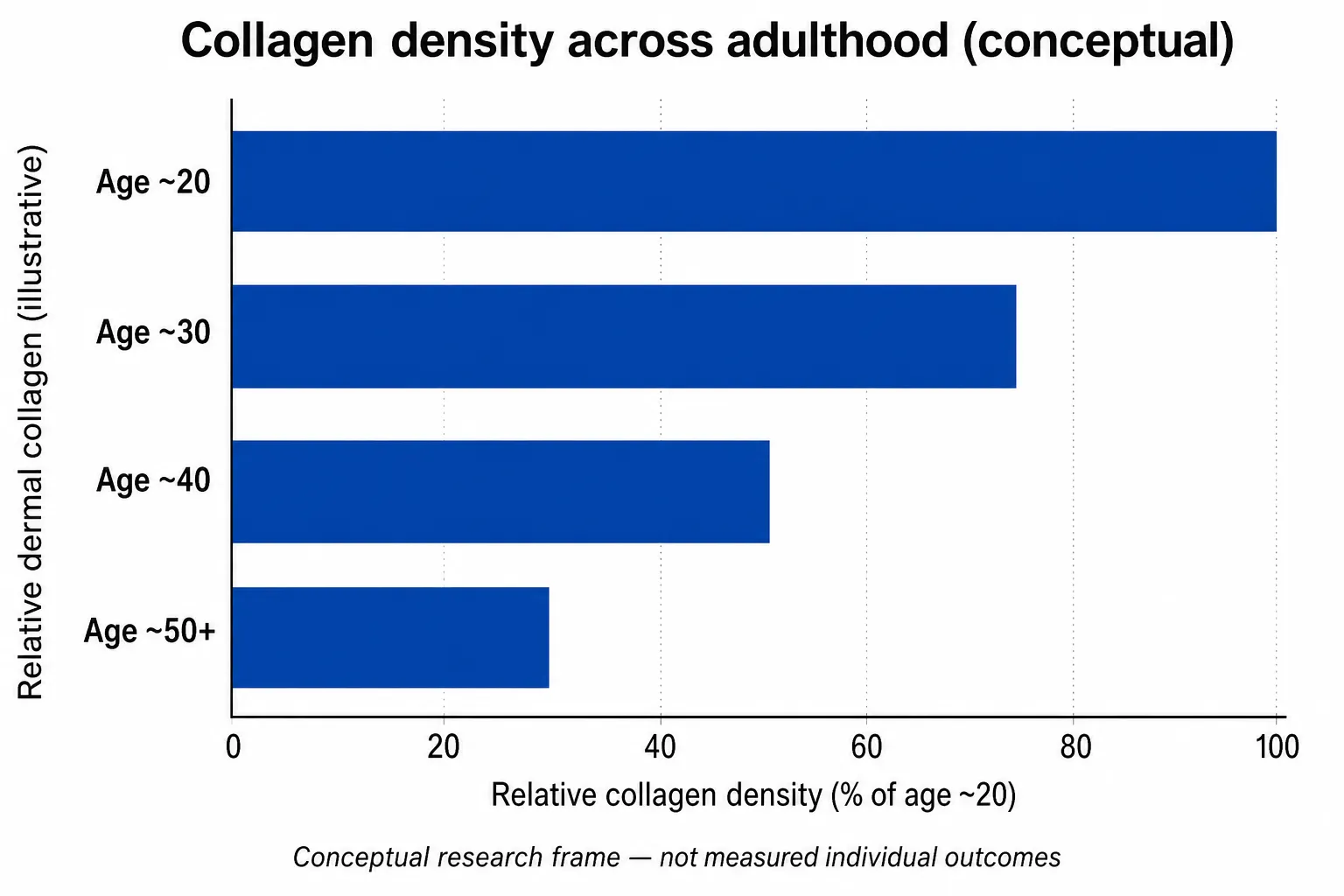
Pickart’s reviews repeatedly note that plasma GHK is high in youth and falls with age (commonly summarised as a multi-fold decline from the twenties into later decades). Separately, clinical dermatology and biomechanics literature describe age-associated reductions in dermal collagen content, fibre organisation, and mechanical firmness — with photodamage and hormonal transitions as additional variables, especially in women after the third decade.
For laboratory design, “after 30” is therefore a demographic and tissue-state hypothesis: older donor fibroblasts, photoaged explants, or reconstructed skin models may respond differently than neonatal fibroblast lines. Sex is a covariate (oestrogen decline, collagen density trajectories) that should be logged, not assumed. Do not collapse those variables into a claim that copper peptides are a women’s anti-aging treatment.
| Research variable | Why it matters after ~30 | How to document |
|---|---|---|
| Donor age / model age | Fibroblast replicative history and matrix output change with age | Cell lot age, passage, donor metadata |
| Photoexposure history | UV alters MMP load and collagen fragmentation | Explant source, UV protocol if used |
| Sex hormones | Oestrogen/androgen status modulates dermal matrix biology | Sex of donor; note cycle/menopause status if clinical tissue |
| Baseline GHK/copper status | Copper availability and peptide baseline may interact | Media copper; avoid uncontrolled copper spikes |
03 · Evidence
What published skin-density research actually shows
Strong remodeling biology; cosmetic endpoints need careful citation hygiene.
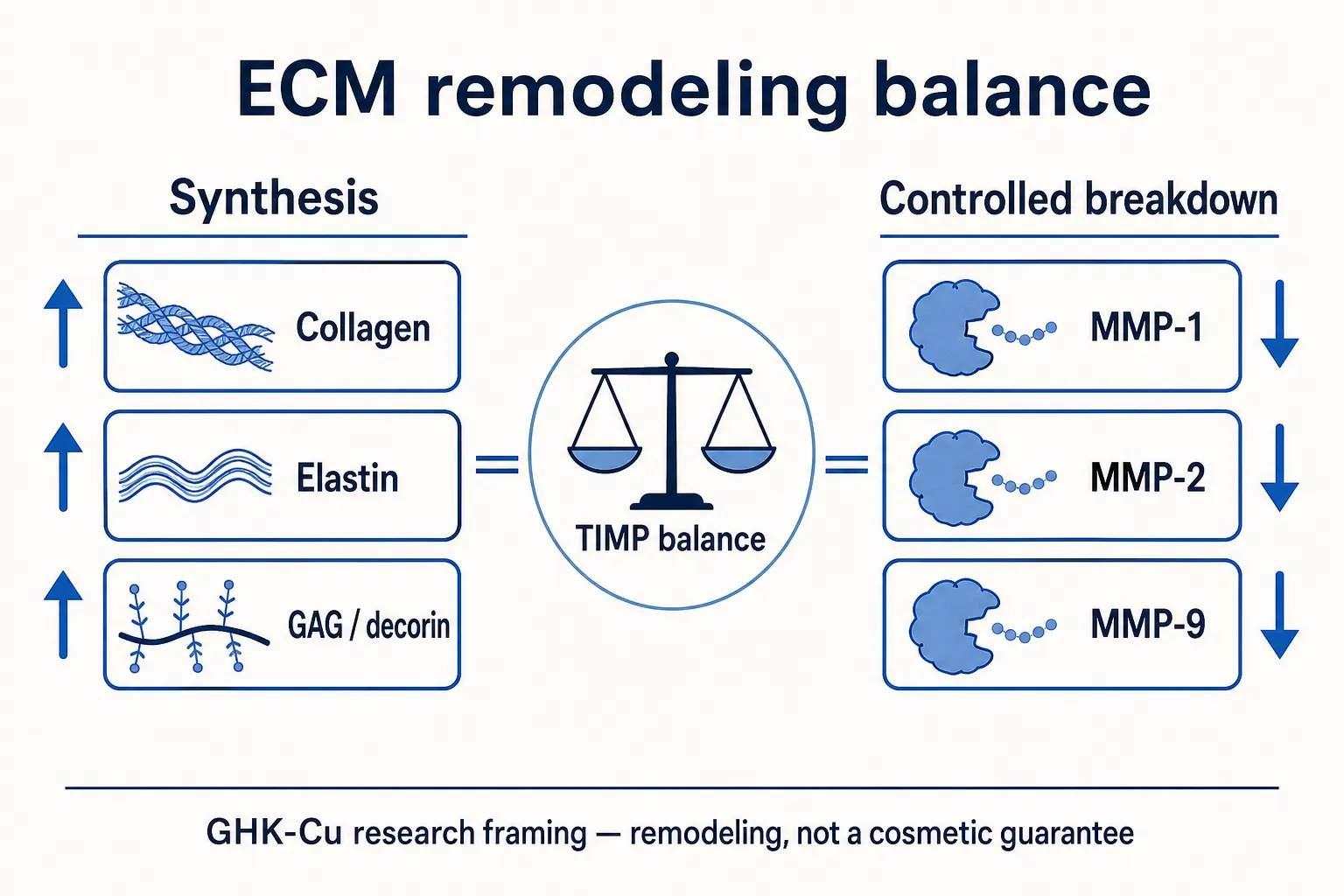
Foundational remodeling synthesis: Pickart’s Journal of Biomaterials Science review (PMID 18644225) catalogues collagen/elastin protein synthesis, angiogenesis, hair-follicle size signals, and aged-skin cosmetic endpoints reported in controlled studies (tightness, elasticity, firmness, fine lines, photodamage metrics). The 2015 BioMed Research International review expands gene-regulation and skin-regeneration framing.
Fibroblast and MMP/TIMP papers show that GHK-Cu can raise collagen and elastin output while shifting protease/inhibitor expression — consistent with coordinated remodeling rather than unmanaged fibrosis. Topical vehicle studies (including nano-carrier delivery comparisons in the wrinkle-parameter literature) add a pharmaceutical-formulation variable: observed facial metric changes depend on delivery system as much as on the peptide itself.
04 · Formats
Topical literature vs lyophilised research supply
Same tripeptide identity — different regulatory and experimental categories.
Emirates Peptides supplies lyophilised GHK-Cu for laboratory reconstitution and experimental use. That is a different category from finished cosmetic serums discussed in dermatology journals. Researchers reconstituting material should follow documented laboratory arithmetic with bacteriostatic water where appropriate and the reconstitution guide — framed as lab process, not personal use.
05 · Comparison
GHK-Cu vs Glow Blend and recovery peptides for skin endpoints
Matrix remodeling vs soft-tissue recovery hypotheses.
| Material | Primary research lens | Skin-density relevance | Product / guide |
|---|---|---|---|
| GHK-Cu | Copper tripeptide, ECM remodeling, fibroblast output | High — direct collagen/elastin/GAG corpus | GHK-Cu |
| BPC-157 | Cytoprotection, angiogenesis, soft-tissue models | Indirect — wound/soft-tissue, not skin-aging monograph | BPC overview |
| TB-500 | Actin / cell migration hypotheses | Indirect — migration/repair framing | TB-500 research |
| Glow Blend | Multi-peptide research combination | Composite — verify each component’s COA | Glow UAE guide · product |
06 · UAE
UAE heat, documentation, and handling
Cold-chain is part of data integrity.

07 · Limits
What this literature cannot support
Honest boundaries protect both compliance and science.
08 · Related
Related reading on the Emirates Peptides cluster
- GHK-Cu hair-loss research — follicle-adjacent remodeling
- Hair thinning: GHK-Cu vs recovery peptides (sibling draft)
- Why HPLC purity testing matters
02b · Depth
Collagen turnover, cross-linking, and what “density” can mean operationally
Pick an endpoint language before you pick a peptide concentration.
After roughly the third decade, dermal collagen production slows while cumulative UV and inflammatory MMP load continue. Cross-linking patterns also shift: early adulthood favours more orderly fibrillar architecture, whereas later decades accumulate fragmented collagen that fibroblasts struggle to remodel efficiently. That biology is why “skin density after 30” is a coherent research window even when plasma GHK decline curves are only approximate.
For assay design, separate anabolic readouts (COL1A1 protein, procollagen peptides, elastin, decorin) from catabolic readouts (MMP-1, MMP-2, MMP-9) and from balance readouts (TIMP-1/TIMP-2 ratios). A peptide that raises both collagen and MMP expression can still be a remodeling agent rather than a pure “builder.” Quote papers in that paired language.
Sex-hormone context belongs in the methods section whenever human tissue or clinical volunteers are involved. Oestrogen decline after menopause is associated with measurable dermal collagen losses in dermatology literature; peri-menopausal cohorts are not interchangeable with 32-year-old photoaged volunteers. If your model is neonatal foreskin fibroblasts — still common in culture labs — state that limitation when discussing “after 30” translational relevance.
Copper status is a silent confounder. GHK’s function as a copper carrier means media copper concentration, chelators, and competing albumin binding can move apparent dose–response curves. When repeating nanomolar culture work, lock basal copper and document lot numbers for serum/serum-free supplements. Otherwise “failed replication” may be media chemistry, not peptide inactivity.
Photodamage models deserve explicit UV dose logging (wavelength, J/cm², acute vs chronic). Many aged-skin cosmetic studies recruit clinically photoaged faces; fibroblast monolayers without UV stress answer a different question. If you want density recovery after damage, build the damage into the model rather than inferring it from chronological age alone.
Finally, distinguish topical flux problems from intrinsic peptide biology. A negative facial metric study can reflect poor stratum-corneum penetration rather than inactive GHK-Cu. Franz-cell or reconstructed-epidermis data should sit beside any claim that “topical copper peptides failed.” Conversely, culture nanomolar successes do not prove a 1% serum will thicken dermis in vivo.
03b · Depth
Designing a skin-density experiment around GHK-Cu
Controls, vehicles, and what to pre-register.
Minimum control set for culture work: untreated, vehicle, GHK without copper (if soluble and stable in your system), GHK-Cu across a pre-specified nanomolar ladder, and a positive matrix stimulus where available. For topical reconstructed-skin work, add Franz-cell flux or tape-strip depth profiles so negative efficacy is not misread as inactive peptide.
Sample-size thinking differs by endpoint variance. Hydroxyproline assays and ELISA panels need different replication than histologic dermal-thickness scoring. Blind histology readers. Pre-specify whether multiple testing across MMP/TIMP panels will use FDR correction.
Documentation for UAE labs should include COA lot, reconstitution date/concentration, storage temperature log, and freeze–thaw count. Those fields are as important as the p-value when another lab tries to reproduce your “after 30” fibroblast result. Link product identity to the GHK-Cu product page and purity education to HPLC guidance on site.
When writing the discussion, separate three claim tiers: (1) matrix remodeling in controlled systems, (2) topical cosmetic metric changes under specific vehicles, (3) translational speculation about chronological aging. Crossing tiers without labels is how research blogs become compliance problems.
Related commercial-cluster context remains Glow Blend and recovery peptides — useful for multi-pathway logistics, not for claiming a proven anti-aging stack. Keep COAs per component when any blend enters the freezer inventory.

09 · FAQ
Frequently asked questions
Do copper peptides increase collagen after age 30?
Published fibroblast and remodeling studies show GHK-Cu can stimulate collagen and related matrix components in controlled systems. Age-related GHK decline and dermal changes make “after 30” a relevant research frame, but that is not the same as a proven personal anti-aging treatment.
Is GHK-Cu the same as a cosmetic copper peptide serum?
The active motif may be related, but finished cosmetics, topical clinical vehicles, and lyophilised research-supply GHK-Cu are different categories with different documentation, purity claims, and intended use. Do not interchange citations across categories without stating the format.
What concentration is used in fibroblast collagen studies?
Foundational culture work often cites nanomolar bands (commonly summarised around 1–10 nM). Always verify the exact paper, cell type, and endpoint before copying a figure into a protocol.
How does Glow Blend relate to skin-density research?
Glow Blend combines GHK-Cu with BPC-157 and TB-500 for multi-pathway research discussions. GHK-Cu carries the clearest collagen/ECM corpus; recovery peptides are adjacent soft-tissue tools. Combination materials still need per-component verification.
Does Emirates Peptides GHK-Cu treat wrinkles?
No. Emirates Peptides supplies GHK-Cu for laboratory research only. It is not a medicine, not a cosmetic finish, and not approved for therapeutic use.
Why mention women or skin after 30 at all?
Because search intent and dermal biology often cluster around chronological collagen changes in adulthood. Sex and age are research covariates to document — not marketing personas for medical claims.
What endpoints should a skin-density study pre-register?
Examples: collagen I/III protein or mRNA, elastin, GAG panels, MMP/TIMP ratios, histology of dermal thickness, and mechanical firmness where tissue models allow. State primary vs exploratory endpoints before running the assay.
How should GHK-Cu be stored in the UAE?
Protect lyophilised vials from prolonged heat; keep reconstituted solutions refrigerated per lab SOP; avoid repeated freeze–thaw. See Emirates Peptides storage guidance for researchers.
10 · References
References and research sources
- Pickart L. The human tri-peptide GHK and tissue remodeling. J Biomater Sci Polym Ed. 2008. PMID 18644225
- Pickart L, Vasquez-Soltero JM, Margolina A. GHK peptide as a natural modulator of multiple cellular pathways in skin regeneration. Biomed Res Int. 2015. PMID 26236730
- Dou Y, et al. / Pickart gene-data synthesis. Regenerative and protective actions of the GHK-Cu peptide. Int J Mol Sci. 2018. MDPI IJMS 19/7/1987
- Pickart L, Margolina A. GHK-Cu may prevent oxidative stress in skin… Cosmetics. 2015. MDPI Cosmetics
- Maquart FX, Pickart L, et al. Stimulation of collagen synthesis in fibroblast cultures by GHK-Cu (foundational culture line — verify primary PDF).
- Siméon A, et al. Expression of glycosaminoglycans and small proteoglycans in response to GHK-Cu (decorin/GAG line — verify PDF).
- Effects of GHK-Cu on MMP and TIMP expression, collagen and elastin production, and facial wrinkle parameters (open-access dermal/wrinkle parameter paper — verify PDF before formal citation).
- Abdulghani AA, et al. Effects of topical formulations including copper peptide complexes on photoaged skin parameters (verify primary citation details).
- McCormack MC, et al. GHK-Cu and restoration of fibroblast replicative vitality after radiation (cited in Pickart reviews).
- Emirates Peptides. GHK-Cu copper peptide skin rejuvenation research.
- Emirates Peptides. GHK-Cu skin regeneration.
- Emirates Peptides. Glow Blend UAE guide.
- ICH Q5C / peptide stability principles for laboratory materials.
- General dermatology reviews on age-related dermal collagen organisation (use current textbooks/reviews when designing age-stratified protocols).
Glossary
| Term | Definition (research context) |
|---|---|
| ECM | Extracellular matrix — collagen, elastin, proteoglycans, and related structural proteins. |
| GHK-Cu | Copper complex of glycyl-histidyl-lysine tripeptide. |
| MMP / TIMP | Matrix metalloproteinases and their tissue inhibitors — remodeling balance. |
| Skin density | Operational research term for dermal thickness/organisation/firmness metrics — define per study. |
| RUO | Research use only. |
Related reading
- GHK-Cu product page
- GHK-Cu skin rejuvenation research
- Glow Blend UAE guide
- Peptide storage best practices
Disclaimer: For laboratory and in-vitro research use only. Not for human administration. Not approved for therapeutic use.
Was this article helpful?

🔬 Related Research Peptides
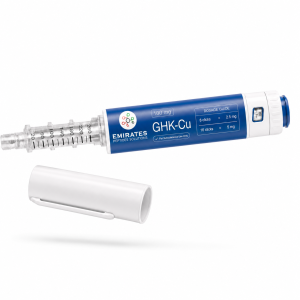
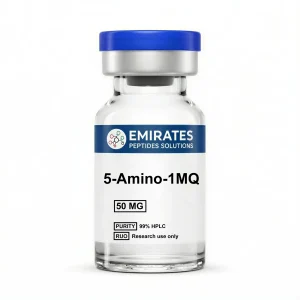
Explore Research-Grade Peptides
HPLC-verified, lab-tested peptides for your scientific research. Fast delivery across the UAE.
Browse All PeptidesRelated Articles


Emirates Peptides Research Team
A dedicated coalition of biochemists and clinical researchers focusing on advanced peptide synthesis and pharmacological applications. All data is verified against current clinical trials.
FROM INSTAGRAM