
Blog
GHK-Cu and Photoaged Skin in UAE Women: UV Exposure, Matrix Remodeling and Research Design


For research use only. Material is supplied as a lyophilized reference compound with HPLC purity verification.
- Key Facts at a Glance
- What photoexposure does to the dermal matrix
- Why GHK-Cu belongs in remodeling research
- Female and UAE-relevant variables to record
- A defensible GHK-Cu photoaging experiment
Evidence reviewed: 25 Jul 2026 · 10-minute read · 6 sources cited
In the UAE, ultraviolet exposure is a constant research variable, but “photoaged skin” is more complex than accumulated sunlight. Skin phototype, pigmentation response, clothing coverage, occupation, indoor exposure through glass, air pollution and chronological age can all shape the model. GHK-Cu is studied for extracellular-matrix remodeling (how skin’s support structure is broken down and rebuilt) and repair-related signalling. This article examines how that biology can be investigated in female UAE-relevant models without turning experimental findings into sunscreen, pigmentation or anti-ageing claims.
01 · UV biology
What photoexposure does to the dermal matrix
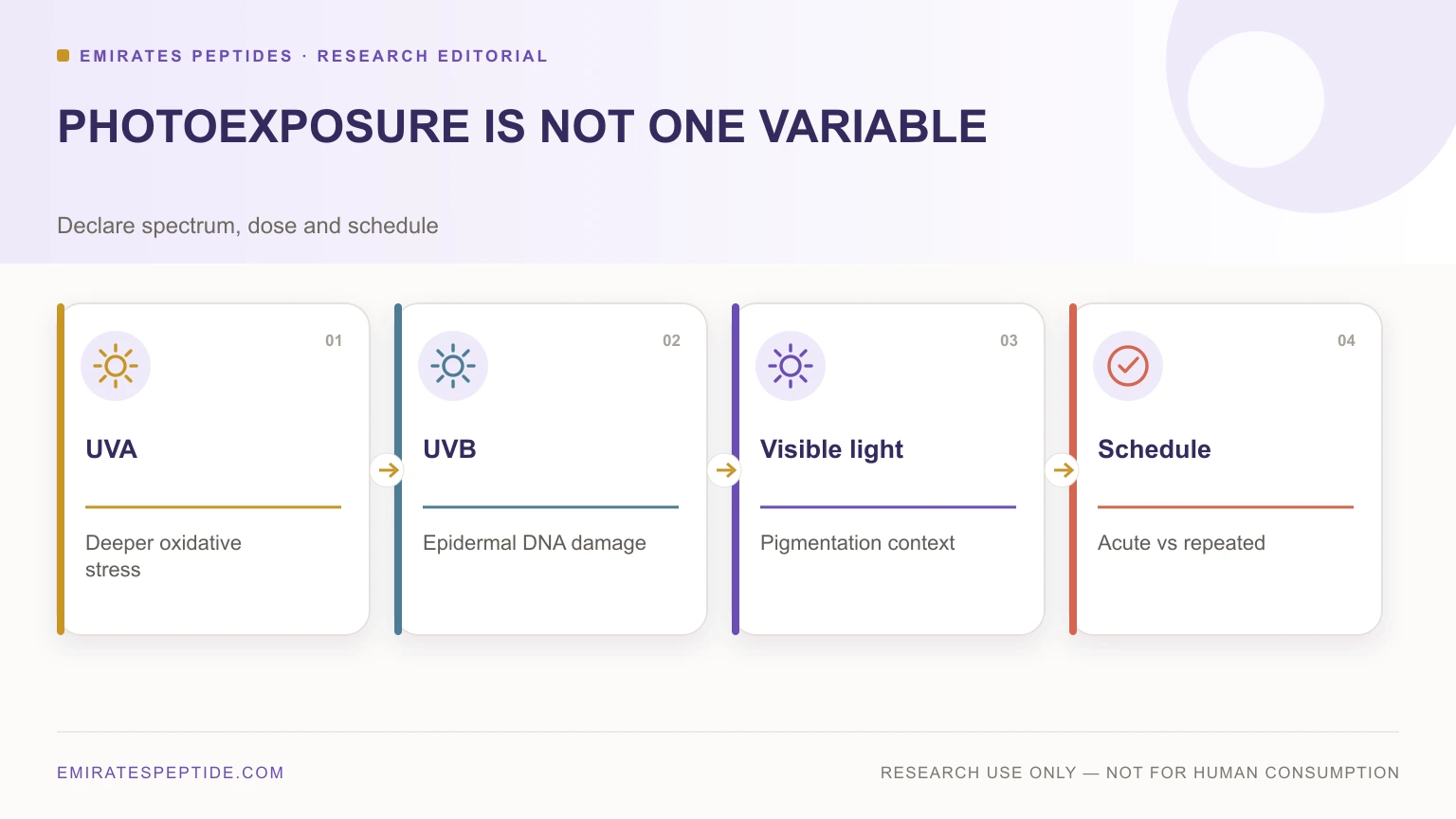
Photoaging is an accumulated remodeling imbalance, not simply “dry skin from the sun.”
UVA penetrates more deeply into the dermis than UVB and contributes to oxidative stress and matrix-metalloproteinase signalling. Repeated exposure can increase collagen fragmentation and reduce the mechanical environment fibroblasts need to maintain organised matrix. UVB has strong epidermal effects and produces direct DNA photoproducts. Both belong in a photoaging model, but dose, wavelength and timing must be documented.
Chronological ageing and photoaging overlap without being identical. Sun-protected skin can preserve a different collagen-response profile from exposed facial or forearm skin. A human study of topical estradiol in older adults found increased collagen production in sun-protected hip skin but not in photoaged forearm or facial sites after the tested period, illustrating how long-term exposure can change tissue responsiveness.
02 · GHK-Cu
Why GHK-Cu belongs in remodeling research
Latest research insights. No spam, ever.
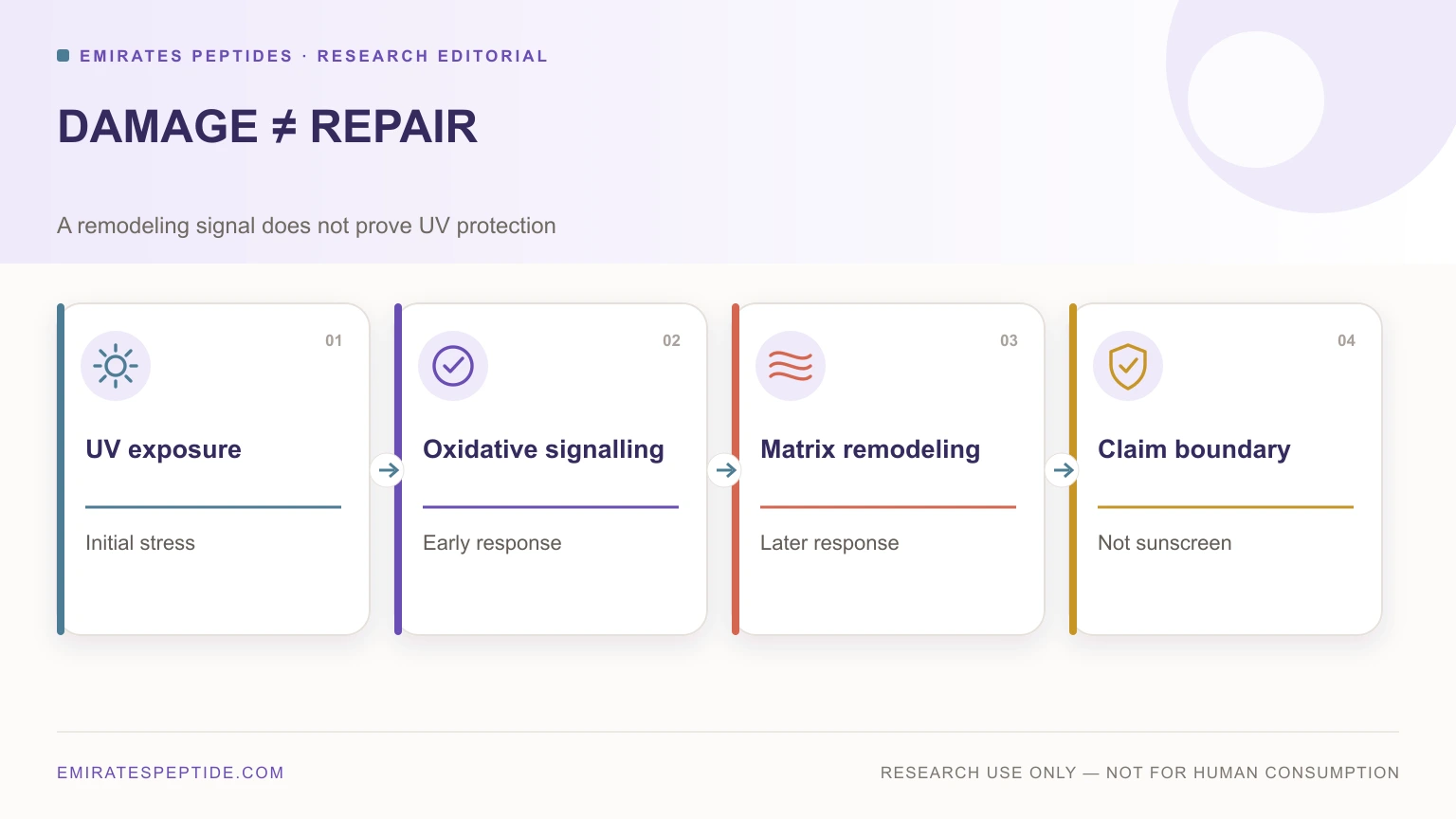
The hypothesis concerns post-damage matrix behaviour, not UV blocking.
GHK-Cu research describes collagen, elastin, glycosaminoglycan, antioxidant and MMP/TIMP-related effects across cell and tissue models. Those pathways make it a plausible tool for studying matrix response after controlled UV stress. The clean experimental question is whether GHK-Cu changes predefined repair or remodeling endpoints after a documented exposure.
The wrong question is whether GHK-Cu “protects women from the UAE sun.” It is not an ultraviolet filter, and current evidence does not justify replacing sunscreen, shade or protective clothing. A peptide may alter a downstream assay without preventing the initial DNA and oxidative damage produced by UV.
03 · Women
Female and UAE-relevant variables to record
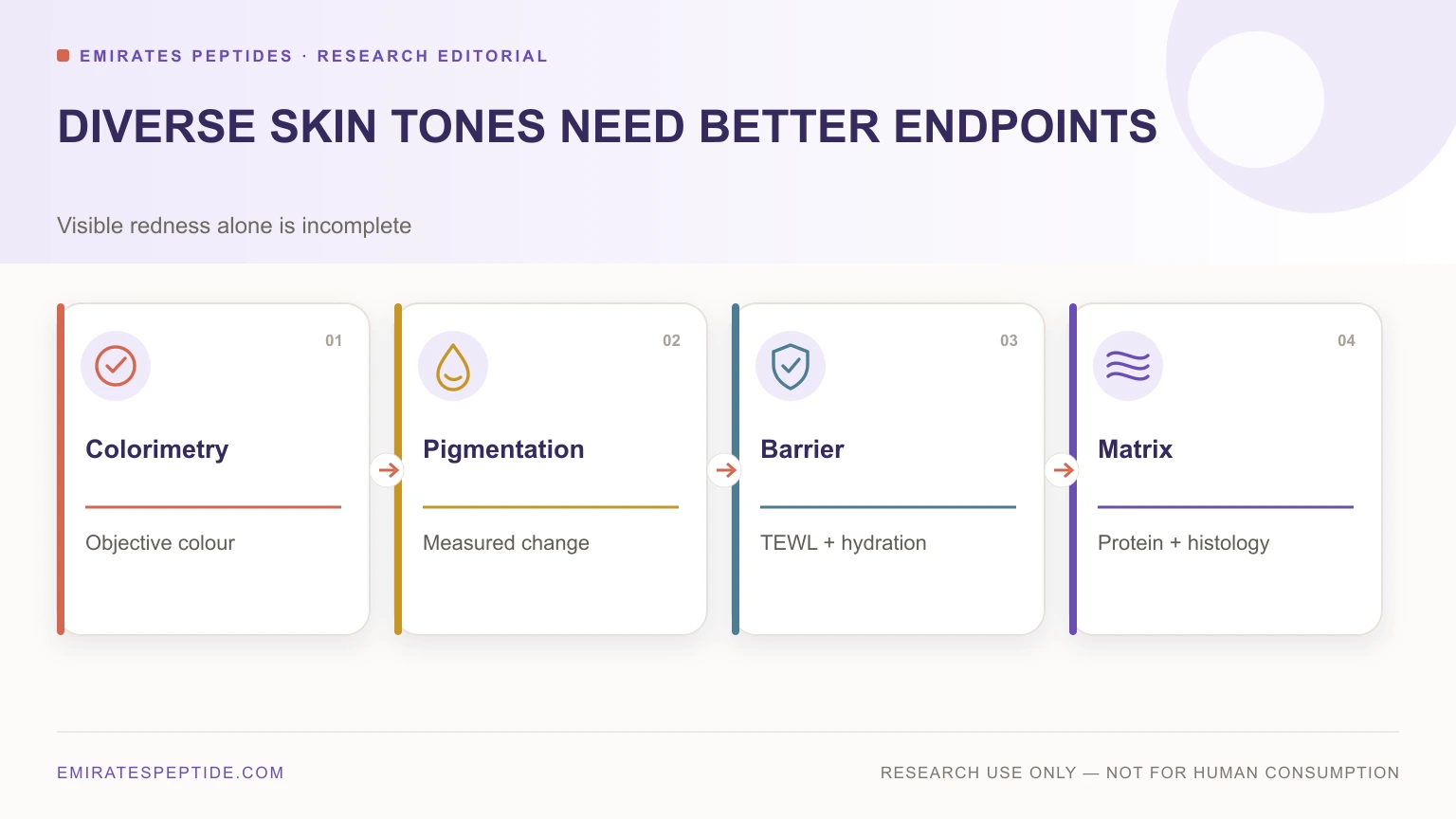
Female-focused research should add information, not merely change the photograph. Record reproductive or menopausal stage when relevant, because hormonal status affects collagen, elasticity and hydration. Record skin phototype or objective pigmentation measures, because erythema can be less visually obvious in darker skin and pigmentary responses may be more informative.
For a UAE-relevant model, also record anatomical coverage, occupational exposure, smoking status and pollutant exposure where feasible. Modest clothing can reduce exposure at covered sites while the face and hands remain chronically exposed. This creates a useful within-person research opportunity: matched exposed and protected samples may reveal more than comparisons between unrelated donors.
| Variable | Why it matters | Suggested measurement |
|---|---|---|
| UV wavelength and dose | UVA and UVB stress different pathways | J/cm², spectrum, acute/chronic schedule |
| Skin tone / phototype | Erythema and pigmentation differ | Objective colorimetry plus declared scale |
| Hormonal stage | Matrix and hydration biology vary | Declared reproductive/menopausal stratum |
| Anatomical coverage | Face, hands and covered skin receive different exposure | Matched exposed/protected sites |
| Vehicle penetration | Topical delivery may gate apparent activity | Franz-cell or depth-profile assay |
04 · Design
A defensible GHK-Cu photoaging experiment
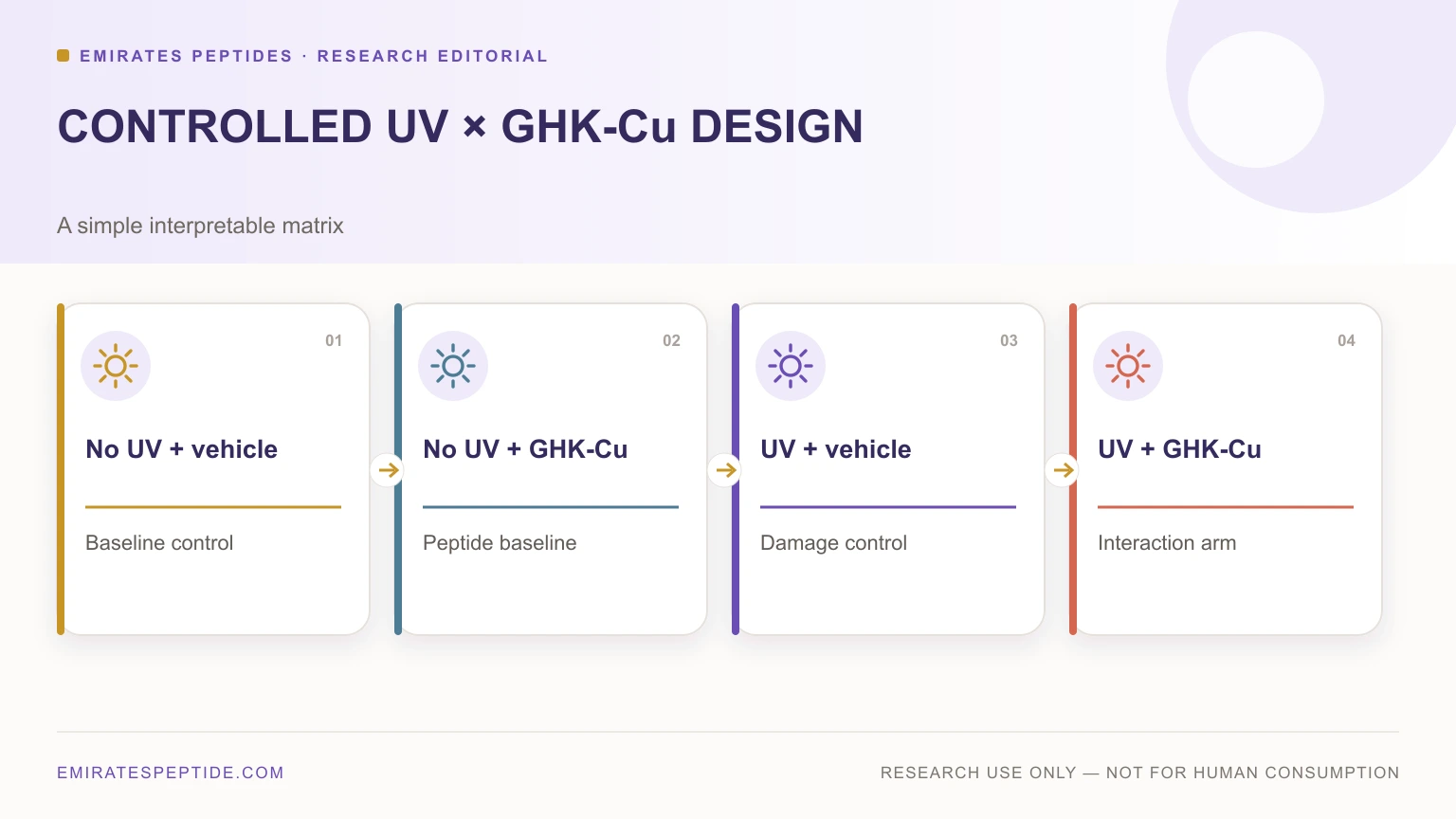
Pre-register one primary endpoint: for example COL1A1 protein, procollagen peptide, MMP-1/TIMP-1 balance or histological collagen organisation. Include non-irradiated control, irradiated vehicle control and irradiated GHK-Cu arms. If the study tests topical delivery, add vehicle stability and penetration data.
Use a fixed collection window after UV exposure. An early oxidative-stress endpoint and a later collagen endpoint answer different questions. Control basal copper and identify the exact peptide complex. Report negative findings: a small randomised study of GHK-Cu-containing skin care after CO₂ laser resurfacing found no objective advantage for erythema resolution or wrinkle improvement, although participants reported higher satisfaction. That result is a useful reminder that subjective and objective outcomes can diverge.
05 · Limits
Claims the literature cannot support
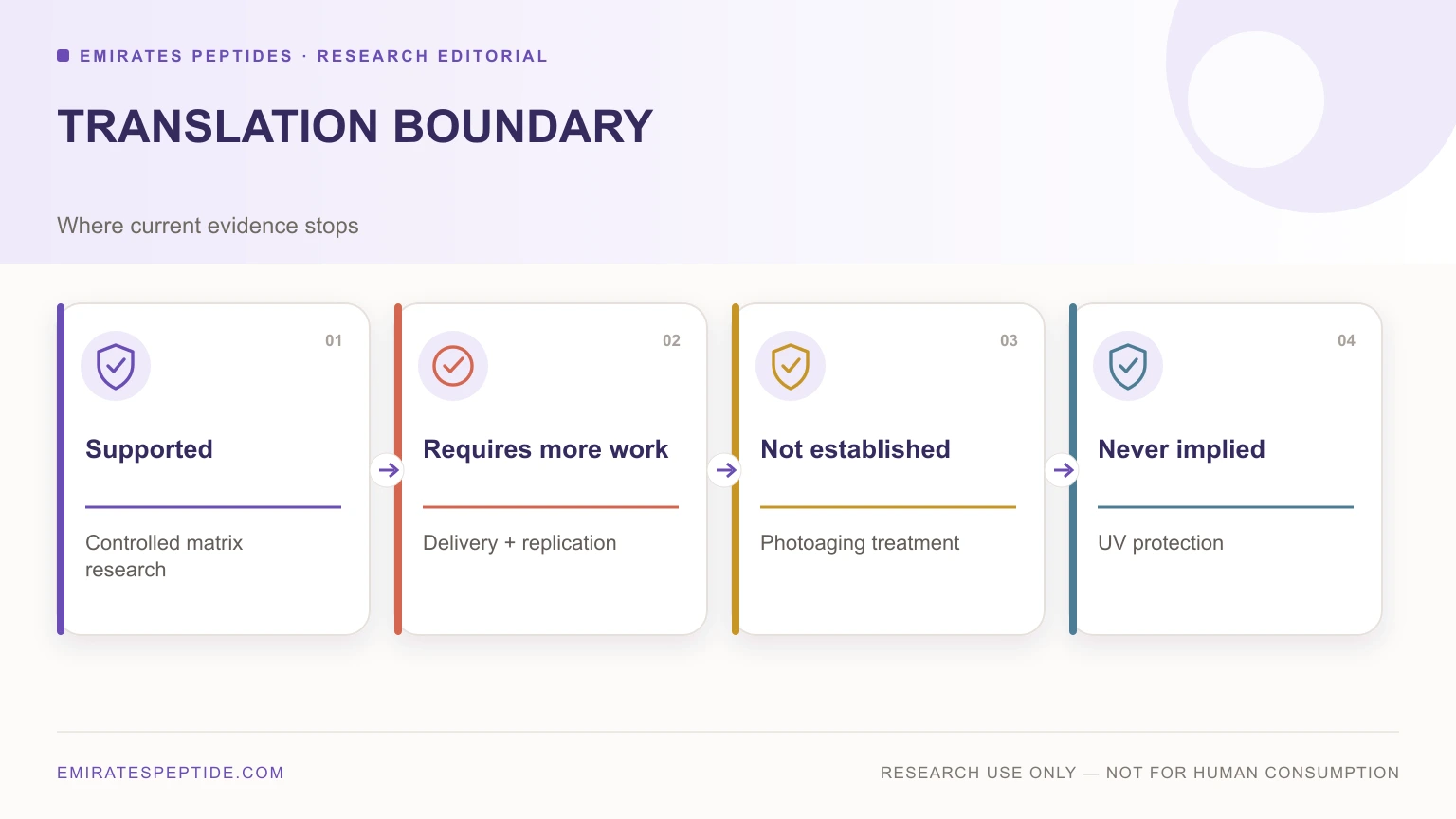
Do not claim that GHK-Cu prevents sunburn, blocks UVA or UVB, corrects pigmentation, treats melasma or reverses photoaging in women. Do not generalise a topical finished-product study to lyophilised research supply. Do not use a women-only sample to imply female-specific efficacy unless a comparator or interaction analysis supports it.
For the broad skin evidence base, read GHK-Cu for Skin: Collagen, Wrinkles and Regeneration. For age-related matrix endpoints, see Copper Peptides & Collagen Research: Skin Density After 30.
06 · Exposure depth
UVA, UVB and visible light should not be treated as one exposure
The source spectrum determines the biological question.
UVA spans longer ultraviolet wavelengths and reaches more deeply into skin than UVB. It contributes to oxidative stress and signalling that can increase matrix-degrading enzymes. UVB acts more strongly in the epidermis and directly produces characteristic DNA photoproducts. Laboratory lamps, solar simulators and natural sunlight can deliver very different spectral mixtures, so a reported energy value without wavelength information is incomplete.
Visible light is also relevant to pigmentation research, particularly across darker skin tones, but it should not be folded casually into a GHK-Cu matrix experiment. If pigmentation is an endpoint, the study needs appropriate light sources, objective colour measurement and a mechanistic rationale. A collagen-remodeling experiment does not automatically answer a melasma or post-inflammatory pigmentation question.
Acute high-dose exposure and repeated lower-dose exposure model different situations. A single stress event can be useful for mapping early oxidative or inflammatory responses, while chronic schedules may better reproduce accumulated matrix change. Researchers should avoid choosing a severe dose simply because it creates a large measurable signal. Excessive damage can reduce viability and make later matrix results difficult to interpret.
The time between exposure and measurement also matters. Reactive species and signalling events can appear rapidly, while collagen synthesis, degradation and tissue organisation evolve over longer periods. A six-hour MMP result and a seven-day histology result should not be described as the same outcome. Sampling windows should follow the proposed mechanism.
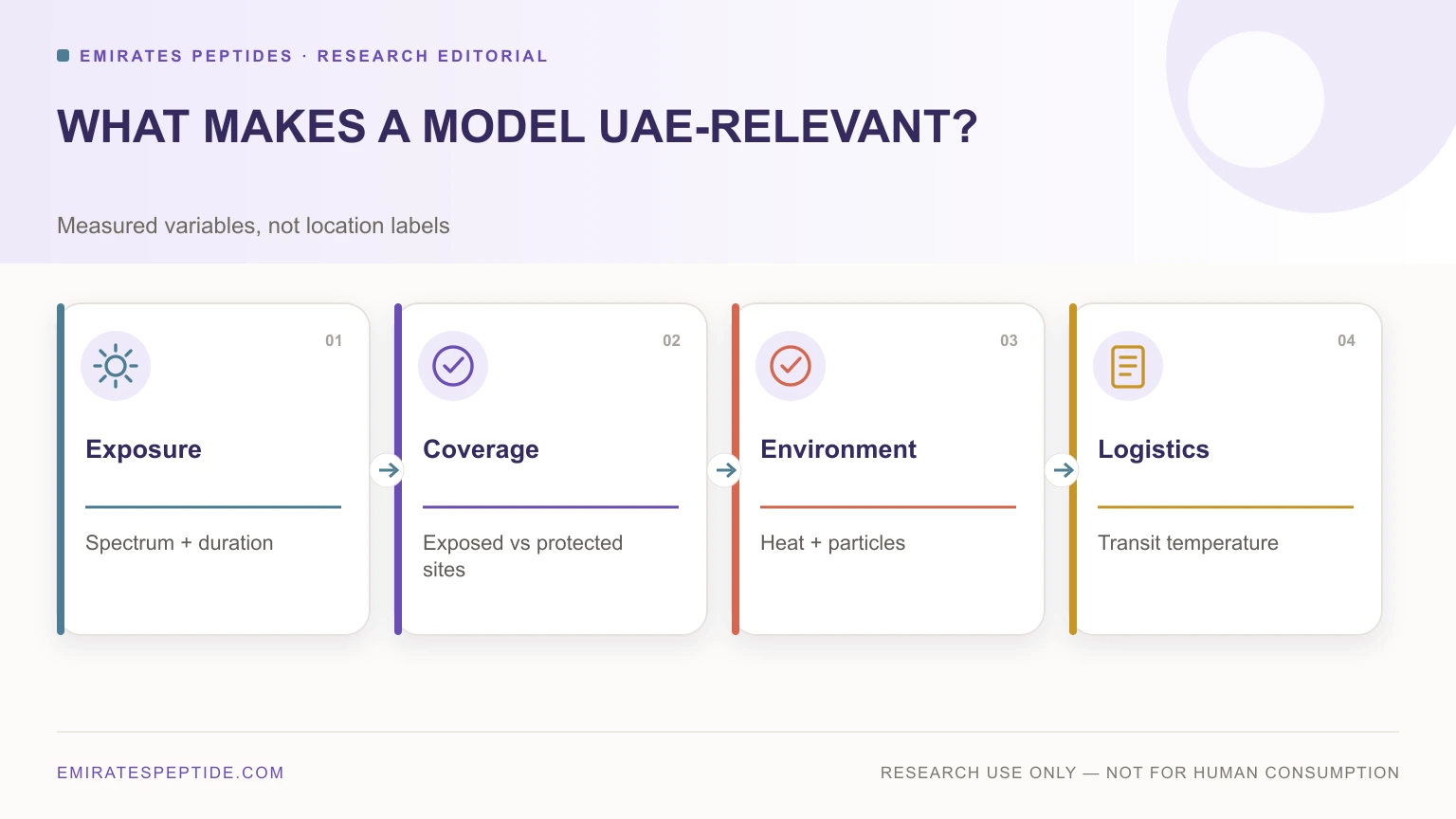
Environmental exposure in the UAE is not equivalent to a lamp protocol, but local relevance can guide experimental questions. High annual sunlight, outdoor commuting, reflected light and intermittent intense exposure may justify chronic or mixed-spectrum models. The study must still describe the laboratory exposure rather than imply it perfectly recreates daily life.
07 · Phototype
Why diverse skin tones require better endpoints than visible redness
An endpoint that is easy to see is not always the endpoint that is easiest to compare.
Erythema is a common sign of acute UV response, but visual grading can perform differently across skin tones. Instrumental measurements, carefully calibrated photography and additional biological endpoints can reduce reliance on subjective redness. Pigmentation responses may also last longer and carry different significance than transient erythema.
Fitzpatrick phototype is widely used but was designed around burning and tanning response, not as a complete biological classification. It can be supplemented with objective colorimetry or melanin-related measurements. Researchers should report how phototype was assigned and avoid treating broad racial or ethnic labels as substitutes for direct skin measurements.
Female UAE cohorts can include many ancestries and skin tones. This diversity is scientifically valuable when the study is designed to analyse it. Stratification must be planned so that small subgroups are not used to make confident comparative claims. If the sample is too small for interaction testing, report descriptive results and uncertainty.
Pigmentary conditions require a separate clinical and ethical framework. GHK-Cu matrix research should not be promoted as evidence for treating melasma or post-inflammatory hyperpigmentation. Even when a study measures melanocyte-related markers, translation to a condition requires dedicated formulation, safety and controlled human evidence.
08 · Matrix mechanics
Researcher deep dive: how UV changes the skin matrix
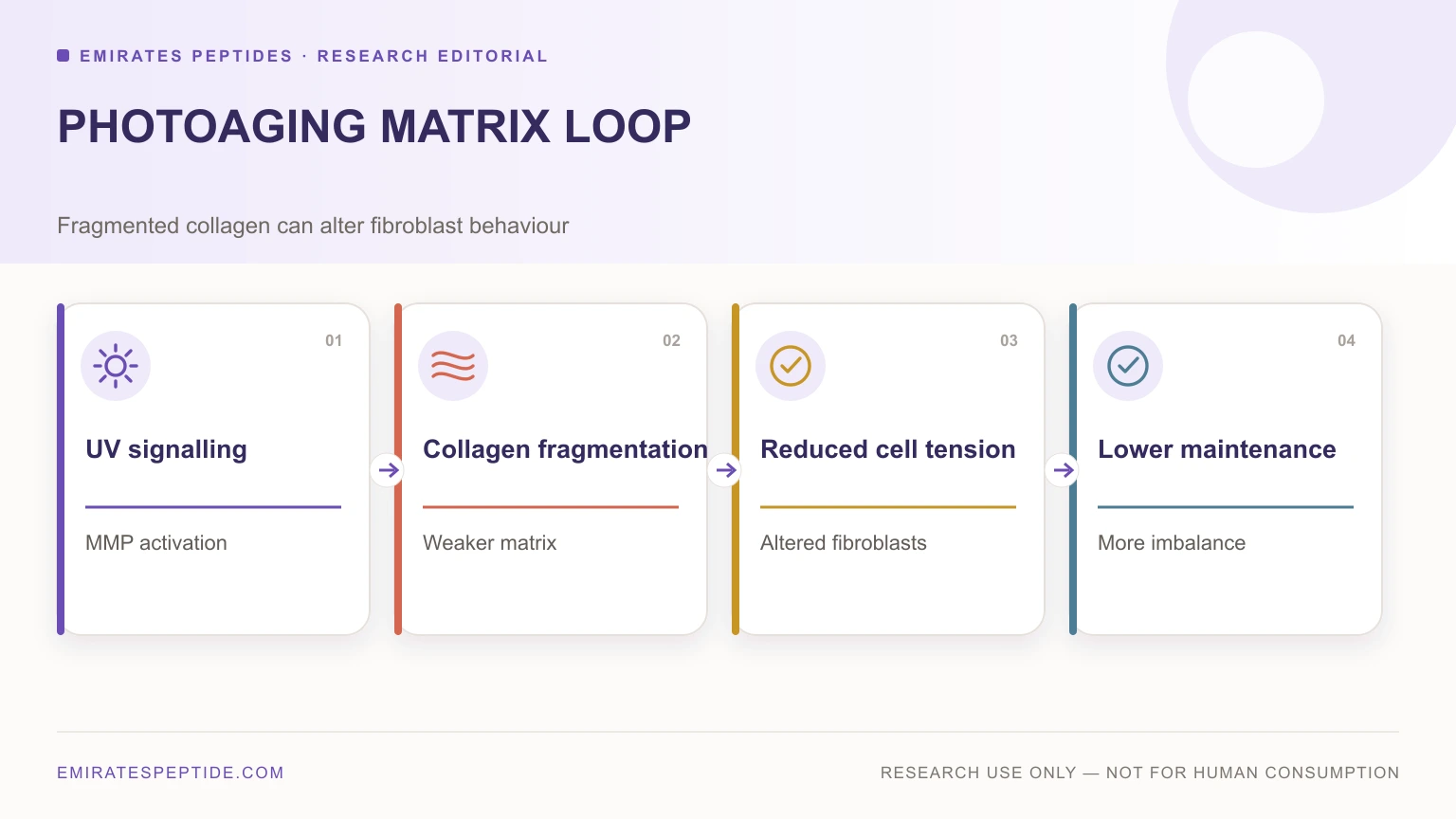
The matrix is both a structure and a signalling environment.
Fibroblasts maintain contact with surrounding collagen and respond to mechanical tension. When collagen becomes fragmented, this physical relationship changes. Cells can become less spread and generate less mechanical force, which may reduce new matrix production. At the same time, elevated matrix metalloproteinases can continue degradation. This creates a self-reinforcing environment associated with photoaged tissue.
GHK-Cu is relevant because its literature describes coordinated tissue remodeling rather than collagen synthesis alone. A robust experiment can measure both production and degradation: procollagen or COL1A1 alongside MMP and TIMP markers, for example. Histological organisation or mechanical testing can provide a third layer that shows whether molecular changes alter tissue structure.
Researchers should avoid assuming that lower MMP expression is always beneficial. Metalloproteinases also participate in normal turnover and repair. The goal is not zero degradation; it is appropriate balance. Timing is central because an early increase in remodeling activity may precede later organisation. A single time point can miss that sequence.
Oxidative-stress endpoints can help connect UV exposure to matrix signalling, but nonspecific antioxidant assays have limits. Declare the assay, compartment and timing. A change in a chemical radical-scavenging test is not proof that a peptide prevented photoaging in intact human skin.
09 · Negative evidence
Why neutral results strengthen the research story
An evidence review should include findings that resist the desired narrative.
In a small randomised study after CO₂ laser resurfacing, a GHK-Cu-containing skin-care regimen did not significantly improve objective erythema resolution or objective wrinkle and overall skin-quality assessments compared with the control regimen. Participant satisfaction differed, showing that subjective experience and blinded measurement can diverge.
This study does not settle every GHK-Cu question. The population, procedure, formulation, sample size and endpoints were specific. It does, however, prevent a blanket statement that GHK-Cu consistently accelerates visible recovery after controlled skin injury. A balanced article should present this boundary alongside mechanistic remodeling evidence.
Negative findings can point to delivery limitations, an unsuitable endpoint, incorrect timing, inadequate power or a true absence of meaningful effect. Researchers should examine these possibilities without automatically rescuing the hypothesis. Repeatedly explaining away null results while accepting positive findings at face value creates confirmation bias.
Pre-registration and publication of complete endpoint sets reduce selective reporting. For commercial research education, mentioning neutral evidence is also a credibility signal. It shows that “research-first” means evaluating the whole record rather than collecting only supportive sentences.
10 · UAE
Handling research material in a high-heat environment
Cold-chain and sample logging are part of study quality. Protect lyophilised material from prolonged heat, refrigerate working solutions as specified by the laboratory protocol, minimise freeze–thaw and log every deviation. Review Peptide Storage and Handling before beginning work.
11 · FAQ
Frequently asked questions
Does GHK-Cu protect skin from the sun?
It is studied in remodeling biology, not established as a UV filter or replacement for sun protection.
Why focus on UAE women?
The local model combines high ambient UV, diverse skin tones, different clothing-coverage patterns and female hormonal covariates.
Can a study use redness as its only endpoint?
That is weak across diverse skin tones. Objective pigmentation, barrier and matrix measurements provide a fuller picture.
Does a collagen change prove visible anti-ageing?
No. A molecular endpoint does not automatically translate into a visible or clinically meaningful outcome.
12 · References
References and research sources
- Pickart L. The human tri-peptide GHK and tissue remodeling. PMID 18644225
- Pickart L, et al. GHK and skin regeneration. PMID 26236730
- Campbell JD, et al. The potential of GHK as an anti-aging peptide. PMID 35083444
- Son ED, et al. Collagen induction in sun-protected and photodamaged human skin. PMID 18794456
- Miller TR, et al. Topical copper tripeptide complex on CO₂ laser-resurfaced skin. PMID 16847171
- Fisher GJ, et al. Pathophysiology of premature skin aging induced by ultraviolet light. PMID 9358139
Disclaimer: For laboratory research use only. Not for human administration. GHK-Cu is not sunscreen and this article is not dermatological or cosmetic advice.
Was this article helpful?

🔬 Related Research Peptides
Explore Research-Grade Peptides
HPLC-verified, lab-tested peptides for your scientific research. Fast delivery across the UAE.
Browse All PeptidesRelated Articles




Emirates Peptides Research Team
A dedicated coalition of biochemists and clinical researchers focusing on advanced peptide synthesis and pharmacological applications. All data is verified against current clinical trials.
FROM INSTAGRAM